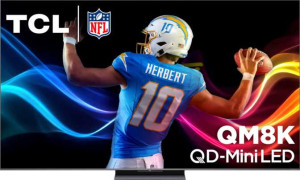
TCL 98QM8K 98"
TCL 98X11K 98"

TCL 98QM8K 98" TCL 98X11K 98"

Overview

Choosing between two flagship large-format televisions is never simple, and the comparison between the TCL 98QM8K 98″ and the TCL 98X11K 98″ is no exception. Both sets share the same impressive QLED Mini-LED panel technology and a fluid 144Hz refresh rate, yet they diverge in notable ways when it comes to design, wireless connectivity, and smart home integration. Read on as we break down every shared specification and key difference to help you find the right fit for your home theater setup.

Common Features

  • Both products have a display resolution of 4K (UHD).
  • Both products use QLED, LED-backlit, LCD, Mini-LED display technology.
  • Both products have a screen size of 97.5″.
  • Both products have a resolution of 3840 x 2160 px.
  • Both products have a pixel density of 45 ppi.
  • Both products support 1070 million display colors.
  • Both products have a bit depth of 10-bit.
  • Both products have a refresh rate of 144Hz.
  • Bluetooth is available on both products, with version 5.4.
  • Both products have an HDMI version of 2.1 with 4 HDMI ports.
  • Both products support Wi-Fi.
  • Both products have 2 USB ports and 1 RJ45 port.
  • Miracast support is available on both products.
  • Digital audio output is supported on both products.
  • SRS TheaterSound HD is not available on either product.
  • Both products feature stereo speakers and a subwoofer.
  • Dolby Virtual support is not available on either product.
  • Both products support HDMI ARC and HDMI eARC.
  • Both products support a VESA mount and share the same operating temperature range of 5 °C to 35 °C.
  • Chromecast built-in, AirPlay, and Google Assistant compatibility are present on both products.
  • Both products have a built-in smart TV platform and support smartphone remote control.
  • USB recording is supported on both products.
  • Both products have a standby power consumption of 0.5W.
  • Siri and Apple HomeKit are not supported on either product.

Main Differences

  • Wi-Fi 6 (802.11ax) support is present on TCL 98X11K 98″ but not available on TCL 98QM8K 98″, which supports Wi-Fi 4 and Wi-Fi 5 only.
  • Width is 2179.3 mm on TCL 98QM8K 98″ and 2177 mm on TCL 98X11K 98″.
  • Weight is 56001 g on TCL 98QM8K 98″ and 70300 g on TCL 98X11K 98″.
  • Thickness is 54.1 mm on TCL 98QM8K 98″ and 27 mm on TCL 98X11K 98″.
  • Height is 1235.9 mm on TCL 98QM8K 98″ and 1246 mm on TCL 98X11K 98″.
  • Volume is 145712.77 cm³ on TCL 98QM8K 98″ and 73238.63 cm³ on TCL 98X11K 98″.
  • Alexa support is available on TCL 98QM8K 98″ but not on TCL 98X11K 98″.
  • A rechargeable remote control is included with TCL 98X11K 98″ but not with TCL 98QM8K 98″.
Specs Comparison
TCL 98QM8K 98"

TCL 98QM8K 98"

TCL 98X11K 98"

TCL 98X11K 98"

Display:
display resolution 4K (UHD) 4K (UHD)
Display type QLED, LED-backlit, LCD, Mini-LED QLED, LED-backlit, LCD, Mini-LED
screen size 97.5" 97.5"
resolution 3840 x 2160 px 3840 x 2160 px
pixel density 45 ppi 45 ppi
display colors 1070 million 1070 million
bit depth 10-bit 10-bit
refresh rate 144Hz 144Hz
supports HDR10
supports HDR10+
supports Dolby Vision
supports HLG
Adaptive synchronization AMD FreeSync, AMD FreeSync Premium, AMD FreeSync Premium Pro AMD FreeSync, AMD FreeSync Premium, AMD FreeSync Premium Pro
has anti-reflection coating
has an ambient light sensor
maximum horizontal viewing angle 178º 178º
maximum vertical viewing angle 178º 178º

Across every Display spec provided, the TCL 98QM8K and TCL 98X11K are a perfect match. Both share a 97.5″ QLED Mini-LED LCD panel at 3840 x 2160 (4K UHD), a 144Hz refresh rate, 10-bit color depth rendering up to 1.07 billion colors, and identical 45 ppi pixel density — meaning sharpness, motion clarity, and color volume are equivalent on paper.

HDR coverage is equally identical: both support HDR10, HDR10+, Dolby Vision, and HLG, covering every major HDR format in use today. For gamers, both offer the full AMD FreeSync Premium Pro suite, enabling variable refresh rate with low-framerate compensation and HDR gaming support. Viewing angles top out at 178° horizontally and vertically on both models, and each includes an anti-reflection coating and ambient light sensor for adaptive brightness.

Based solely on the Display specs provided, these two TVs are completely tied — there is no differentiator in this category. Buyers choosing between them should look to other spec groups such as sound, processing, or connectivity to find meaningful distinctions.

Connectivity:
Has Bluetooth
HDMI version HDMI 2.1 HDMI 2.1
HDMI ports 4 4
supports Wi-Fi
Wi-Fi version Wi-Fi 4 (802.11n), Wi-Fi 5 (802.11ac) Wi-Fi 4 (802.11n), Wi-Fi 5 (802.11ac), Wi-Fi 6 (802.11ax)
Bluetooth version 5.4 5.4
USB ports 2 2
RJ45 ports 1 1
supports Miracast
has a socket for a 3.5 mm audio jack
has an external memory slot
has a VGA connector
has a DVI connector

The two TVs share a strong connectivity foundation: both offer 4 HDMI 2.1 ports — critical for 4K/120fps gaming from multiple consoles simultaneously — along with 2 USB ports, a dedicated RJ45 ethernet jack for a stable wired connection, Bluetooth 5.4, and Miracast wireless casting support.

The one meaningful split comes down to wireless networking. The 98QM8K tops out at Wi-Fi 5 (802.11ac), while the 98X11K adds support for Wi-Fi 6 (802.11ax). In practice, Wi-Fi 6 delivers notably better performance in congested network environments — common in homes with many connected devices — thanks to technologies like OFDMA and improved MU-MIMO, which reduce latency and improve throughput stability. For 4K HDR streaming or cloud gaming where consistent bandwidth matters, this is a tangible real-world advantage rather than a spec-sheet footnote.

The 98X11K holds a clear, if narrow, edge in this category purely due to its Wi-Fi 6 support. For users on wired ethernet, the difference is irrelevant. But for those relying on Wi-Fi — particularly in busy households — the X11K offers a more future-proof and reliable wireless connection.

Audio:
supports Digital Out
has SRS TheaterSound HD
has stereo speakers
supports Dolby Virtual
has a subwoofer
HDMI ARC / eARC HDMI ARC, HDMI eARC HDMI ARC, HDMI eARC

Audio hardware is identical across both models. Each TV includes stereo speakers with a built-in subwoofer — a setup that adds low-frequency body to movie soundtracks and music without requiring an external speaker system. Both also support HDMI ARC and eARC, which is the most practical spec here: eARC in particular enables high-bandwidth audio formats like Dolby TrueHD and DTS:HD Master Audio to pass through a single HDMI cable to a soundbar or AV receiver, eliminating the need for separate optical cables.

Neither model supports Dolby Virtual or SRS TheaterSound HD, meaning there is no virtual surround processing built in. Users after a more immersive soundstage will likely want to pair either TV with an external audio system — which the eARC port facilitates cleanly.

With every audio spec matching exactly, this category is a complete tie. Neither the 98QM8K nor the 98X11K holds any advantage here, and the audio decision should not factor into choosing between them.

Design:
width 2179.3 mm 2177 mm
weight 56001 g 70300 g
thickness 54.1 mm 27 mm
height 1235.9 mm 1246 mm
volume 145712.770667 cm³ 73238.634 cm³
Supports VESA mount
maximum operating temperature 35 °C 35 °C
lowest potential operating temperature 5 °C 5 °C

At nearly identical footprints — roughly 2178 mm wide and 1240 mm tall — these two 98″ panels occupy essentially the same wall or stand space. That similarity ends, however, when you look at depth and weight. The 98QM8K measures 54.1 mm thick compared to just 27 mm for the 98X11K, making the X11K roughly half as deep. For wall-mounted installations where a slim profile is a priority — especially in minimalist or home-theater setups — that difference is visually significant.

Weight tells a more nuanced story. Despite its slimmer chassis, the 98X11K is actually heavier at 70.3 kg versus the QM8K's 56 kg. That 14 kg gap is meaningful during installation — both TVs require at least two people and ideally a professional mount team at this size, but the X11K places greater demands on wall anchoring and VESA mount hardware rated for higher loads. Both models support VESA mounting, and operating temperature ranges are identical across the two.

The design trade-off here is clear-cut: the 98X11K has the edge in slimness, which matters most for wall-mount aesthetics, while the 98QM8K is notably lighter, easing installation logistics. Neither is strictly superior — the right choice depends on whether a thinner profile or lower installation weight is the higher priority for a given setup.

Features:
release date May 2025 February 2025
has Chromecast built-in
has AirPlay
has built-in smart TV
compatible with Google Assistant
works with Alexa
works with Siri/Apple HomeKit
supports a remote smartphone
has a rechargeable remote control
supports USB recording
standby power consumption 0.5W 0.5W
has a search browser
has a sleep timer
has a child lock
has voice commands

Both TVs arrive with a well-rounded smart feature set: Chromecast built-in, AirPlay, Google Assistant, smartphone remote support, USB recording, and a full smart TV platform. For most users, this shared foundation covers the essentials without requiring any additional streaming hardware.

Two specs split the models apart. The 98QM8K adds Alexa compatibility, which is a meaningful plus for households already invested in Amazon's smart home ecosystem — it allows the TV to respond to Alexa routines and commands alongside other Echo devices. The 98X11K, meanwhile, drops Alexa but includes a rechargeable remote control, eliminating the recurring cost and inconvenience of replacing disposable batteries. Neither model supports Siri or Apple HomeKit, so Apple ecosystem integration beyond AirPlay is off the table for both.

Which trade-off matters more depends entirely on the buyer's setup. The 98QM8K has the edge for Amazon smart home users who rely on Alexa automation, while the 98X11K is the more practical daily-use choice thanks to its rechargeable remote. Neither product holds a decisive overall advantage in this category — it comes down to ecosystem preference versus convenience.

Comparison Summary & Verdict

At their core, the TCL 98QM8K 98″ and TCL 98X11K 98″ are evenly matched where it matters most for picture quality: both deliver a 4K QLED Mini-LED image at 144Hz with identical port layouts and audio configurations. The differences, however, are telling. The QM8K is the lighter of the two at around 56 kg and offers native Amazon Alexa support, making it the more practical pick for users already embedded in the Alexa ecosystem. The X11K counters with a dramatically slimmer 27 mm profile, cutting-edge Wi-Fi 6 connectivity, and a rechargeable remote control, all of which signal a more premium and future-ready package. If Alexa integration and easier handling are your priorities, the QM8K delivers. If a sleeker aesthetic, superior wireless performance, and a refined remote experience top your list, the X11K is the stronger long-term investment.

TCL 98QM8K 98
Buy TCL 98QM8K 98" if...

Buy the TCL 98QM8K 98″ if Amazon Alexa integration is essential to your smart home setup and you prefer a lighter television that is easier to handle and install.

TCL 98X11K 98
Buy TCL 98X11K 98" if...

Buy the TCL 98X11K 98″ if you want a dramatically slimmer design, faster Wi-Fi 6 connectivity, and the added convenience of a rechargeable remote control.