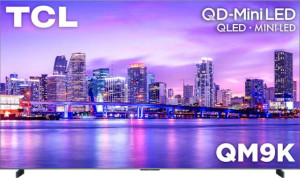
TCL 98QM9K 98"
TCL 98X11K 98"

TCL 98QM9K 98" TCL 98X11K 98"

Overview

When choosing between two 98-inch titans, every detail matters. This in-depth comparison pits the TCL 98QM9K 98″ against the TCL 98X11K 98″, two large-format Mini-LED QLED televisions that share a strong common foundation yet diverge in meaningful ways. From pixel density and audio capabilities to physical design and smart home compatibility, this head-to-head breakdown will help you determine which of these impressive screens best suits your living room and lifestyle.

Common Features

  • Both TVs have a 4K (UHD) display resolution.
  • Both TVs use a QLED, LED-backlit, LCD, Mini-LED display type.
  • Both TVs have a screen size of 97.5″.
  • Both TVs have a native resolution of 3840 x 2160 px.
  • Both TVs support 1070 million display colors at 10-bit depth.
  • Both TVs have a 144Hz refresh rate.
  • HDR10 support is available on both TVs.
  • Bluetooth 5.4 is available on both TVs.
  • Both TVs have 4 HDMI 2.1 ports.
  • Both TVs support Wi-Fi 4 (802.11n), Wi-Fi 5 (802.11ac), and Wi-Fi 6 (802.11ax).
  • Both TVs have 2 USB ports and 1 RJ45 port.
  • Both TVs support HDMI ARC and HDMI eARC.
  • Digital audio output is supported on both TVs.
  • SRS TheaterSound HD is not available on either TV.
  • Both TVs have stereo speakers.
  • Dolby Virtual is not supported on either TV.
  • Both TVs support VESA mounting.
  • Both TVs have an operating temperature range of 5 °C to 35 °C.
  • Chromecast built-in is available on both TVs.
  • AirPlay is available on both TVs.
  • Both TVs have a built-in smart TV platform and are compatible with Google Assistant.
  • Siri and Apple HomeKit support is not available on either TV.
  • Both TVs support remote smartphone control and USB recording.
  • Both TVs have a standby power consumption of 0.5W.

Main Differences

  • Pixel density is 54 ppi on TCL 98QM9K 98″ and 45 ppi on TCL 98X11K 98″.
  • A built-in subwoofer is present on TCL 98X11K 98″ but not available on TCL 98QM9K 98″.
  • Width is 2166.1 mm on TCL 98QM9K 98″ and 2177 mm on TCL 98X11K 98″.
  • Height is 1235.9 mm on TCL 98QM9K 98″ and 1246 mm on TCL 98X11K 98″.
  • Thickness is 54.1 mm on TCL 98QM9K 98″ and 27 mm on TCL 98X11K 98″.
  • Weight is 56001 g on TCL 98QM9K 98″ and 70300 g on TCL 98X11K 98″.
  • Volume is 144830.19 cm³ on TCL 98QM9K 98″ and 73238.63 cm³ on TCL 98X11K 98″.
  • Alexa compatibility is present on TCL 98QM9K 98″ but not available on TCL 98X11K 98″.
  • A rechargeable remote control is included with TCL 98X11K 98″ but not with TCL 98QM9K 98″.
Specs Comparison
TCL 98QM9K 98"

TCL 98QM9K 98"

TCL 98X11K 98"

TCL 98X11K 98"

Display:
display resolution 4K (UHD) 4K (UHD)
Display type QLED, LED-backlit, LCD, Mini-LED QLED, LED-backlit, LCD, Mini-LED
screen size 97.5" 97.5"
resolution 3840 x 2160 px 3840 x 2160 px
pixel density 54 ppi 45 ppi
display colors 1070 million 1070 million
bit depth 10-bit 10-bit
refresh rate 144Hz 144Hz
supports HDR10
supports HDR10+
supports Dolby Vision
supports HLG
Adaptive synchronization AMD FreeSync, AMD FreeSync Premium, AMD FreeSync Premium Pro AMD FreeSync, AMD FreeSync Premium, AMD FreeSync Premium Pro
has anti-reflection coating
has an ambient light sensor
maximum horizontal viewing angle 178º 178º
maximum vertical viewing angle 178º 178º

The TCL 98QM9K and TCL 98X11K share the same fundamental display foundation: both are 97.5″ QLED Mini-LED LCD panels running at a 4K (3840 x 2160) resolution with a 144Hz refresh rate, 10-bit color depth, and support for every major HDR format — HDR10, HDR10+, Dolby Vision, and HLG. For everyday viewing, gaming, and HDR content, both televisions enter the room on equal footing across the vast majority of specifications.

The one measurable display differentiator between them is pixel density: the QM9K registers 54 ppi versus the X11K's 45 ppi. On a screen this large, that gap translates to a slightly sharper, more refined image on the QM9K — particularly noticeable at closer viewing distances or when displaying fine text and detailed graphics. At typical living-room distances of 10–15 feet, however, the practical difference diminishes considerably, as both panels exceed the resolving threshold of normal human vision at those ranges.

Based strictly on the provided display specs, the TCL 98QM9K holds a narrow edge solely due to its higher pixel density. All other display attributes — panel technology, resolution, refresh rate, HDR compatibility, viewing angles, anti-reflection coating, and adaptive sync support — are identical between the two models, making the ppi advantage the only display-tier differentiator to weigh in a purchasing decision.

Connectivity:
Has Bluetooth
HDMI version HDMI 2.1 HDMI 2.1
HDMI ports 4 4
supports Wi-Fi
Wi-Fi version Wi-Fi 4 (802.11n), Wi-Fi 5 (802.11ac), Wi-Fi 6 (802.11ax) Wi-Fi 4 (802.11n), Wi-Fi 5 (802.11ac), Wi-Fi 6 (802.11ax)
Bluetooth version 5.4 5.4
USB ports 2 2
RJ45 ports 1 1
supports Miracast
has a socket for a 3.5 mm audio jack
has an external memory slot
has a VGA connector
has a DVI connector

Connectivity is a clean sweep of parity between these two models — every single spec in this category is identical. Both televisions offer 4 HDMI 2.1 ports, which is the premium standard for modern home theater setups, supporting 4K@120Hz passthrough for gaming consoles and high-end media players without any bottlenecking. Pair that with Wi-Fi 6 (802.11ax) support and you get faster throughput, lower latency, and better performance in congested wireless environments compared to older Wi-Fi standards.

Wireless peripheral handling is equally matched, with both running Bluetooth 5.4 — a relatively recent revision that brings improved connection stability and slightly better range over earlier Bluetooth 5.x iterations, useful for wireless soundbars, headphones, or keyboards. Miracast support adds screen mirroring from compatible Android and Windows devices without needing a third-party dongle.

Given that every connectivity attribute is a perfect mirror between the two, this category results in a complete tie. Neither the QM9K nor the X11K offers any advantage here — buyers should look to other specification groups to differentiate between the two models.

Audio:
supports Digital Out
has SRS TheaterSound HD
has stereo speakers
supports Dolby Virtual
has a subwoofer
HDMI ARC / eARC HDMI ARC, HDMI eARC HDMI ARC, HDMI eARC

Audio is where the first meaningful hardware divergence between these two models appears. Both share stereo speakers, Digital Out, and full HDMI ARC/eARC support — the latter being important for users routing audio through a soundbar or AV receiver, as eARC handles high-bandwidth formats like Dolby TrueHD and DTS:X without compression. So far, equal ground.

The standout difference is that the TCL 98X11K includes a built-in subwoofer, while the QM9K does not. On a screen this large, low-frequency reproduction matters — bass extension from a dedicated subwoofer adds weight to movie soundtracks, impact to action sequences, and depth to music that stereo drivers alone simply cannot replicate. For viewers who plan to rely primarily on the TV's internal speakers rather than a separate audio system, this is a tangible advantage in everyday listening quality.

For users already committed to an external soundbar or surround system, the subwoofer distinction largely disappears since eARC handles that handoff on both models. But judged purely on built-in audio capability, the X11K holds a clear edge in this category thanks to its integrated subwoofer.

Design:
width 2166.1 mm 2177 mm
weight 56001 g 70300 g
thickness 54.1 mm 27 mm
height 1235.9 mm 1246 mm
volume 144830.189759 cm³ 73238.634 cm³
Supports VESA mount
maximum operating temperature 35 °C 35 °C
lowest potential operating temperature 5 °C 5 °C

At nearly identical screen dimensions, the physical design of these two sets diverges sharply in two competing directions. The TCL 98X11K is dramatically slimmer at just 27 mm thick compared to the QM9K's 54.1 mm — roughly half the depth. For wall-mounted installations, that difference is visually significant: the X11K will sit flush and sleek against a wall, whereas the QM9K will protrude noticeably more, which can affect the overall aesthetic of a room.

The trade-off, however, is weight. Despite its slimmer chassis, the X11K is considerably heavier at 70.3 kg versus the QM9K's 56 kg — a difference of over 14 kg. That added mass has real installation implications: wall mounts must be rated for the higher load, and physically maneuvering a 70 kg panel into position typically requires more hands and care. The QM9K's lower weight makes handling and mounting a meaningfully easier process.

Both models support VESA mounting and share the same operating temperature range, so neither has an environmental advantage. The design verdict ultimately depends on use case: for a clean wall-mount aesthetic, the X11K's slim profile is the stronger choice; for easier installation and handling, the QM9K's lighter weight is the practical advantage. Neither product holds an unconditional edge — it is a genuine trade-off between form and installation convenience.

Features:
release date September 2025 February 2025
has Chromecast built-in
has AirPlay
has built-in smart TV
compatible with Google Assistant
works with Alexa
works with Siri/Apple HomeKit
supports a remote smartphone
has a rechargeable remote control
supports USB recording
standby power consumption 0.5W 0.5W
has a search browser
has a sleep timer
has a child lock
has voice commands

Across the smart feature set, these two televisions are nearly identical — both run a full smart TV platform with Chromecast built-in, AirPlay, Google Assistant, smartphone remote support, USB recording, and voice commands. For the overwhelming majority of daily smart TV interactions, users of either model will have the same experience.

Two specific features split them apart. The QM9K supports Amazon Alexa, while the X11K does not — a meaningful distinction for households already embedded in the Amazon ecosystem, where controlling the TV through an Echo device or Alexa routines adds genuine convenience. On the flip side, the X11K ships with a rechargeable remote control, sparing owners the recurring cost and hassle of replacing batteries. Over years of use, a rechargeable remote is a small but consistently appreciated quality-of-life feature.

Neither advantage is objectively more significant than the other — the right call depends on the buyer's priorities. Heavy Alexa users will find the QM9K's ecosystem integration more valuable, while those who prioritize a low-maintenance remote experience will prefer the X11K's rechargeable solution. On balance, this category is a contextual tie, with each model holding one practical edge over the other.

Comparison Summary & Verdict

Both the TCL 98QM9K 98″ and TCL 98X11K 98″ deliver a shared foundation of 4K Mini-LED quality, 144Hz refresh rate, and comprehensive connectivity, making either a formidable choice. However, their differences shape distinct user profiles. The TCL 98QM9K 98″ stands out with a higher pixel density of 54 ppi, making it the sharper-looking panel of the two, and it also offers Amazon Alexa compatibility for those embedded in that smart home ecosystem. The TCL 98X11K 98″, on the other hand, wins on audio immersion thanks to its built-in subwoofer, boasts a dramatically slimmer 27 mm profile, and includes a rechargeable remote control for added convenience. Choose the 98QM9K if picture clarity and Alexa integration are your priorities; opt for the 98X11K if bold sound, sleek design, and a premium remote experience matter most.

TCL 98QM9K 98
Buy TCL 98QM9K 98" if...

Buy the TCL 98QM9K 98″ if you prioritize sharper picture quality with a higher pixel density and want built-in Amazon Alexa support for your smart home setup.

TCL 98X11K 98
Buy TCL 98X11K 98" if...

Buy the TCL 98X11K 98″ if you want richer built-in audio with a subwoofer, a slimmer and more elegant design profile, and the convenience of a rechargeable remote control.