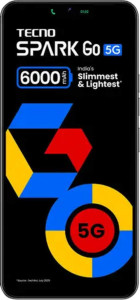
At the heart of the performance gap is the chipset pairing. The Camon 40 Pro 5G runs on the MediaTek Dimensity 7300, built on a 4 nm process node, while the Spark Go 5G uses the Dimensity 6400 on a 6 nm node. A smaller process size generally means greater power efficiency and thermal headroom — the Camon 40 Pro can sustain performance under load while consuming less energy. Paired with 12 GB of RAM versus the Spark Go's 4 GB, the Camon 40 Pro is in a different league for multitasking: more apps stay resident in memory, switching between them is faster, and demanding tasks like photo editing or gaming remain responsive. The Spark Go's 4 GB is workable for light, single-task use, but users will notice app reloads and slowdowns when juggling multiple applications.
Memory bandwidth is another dimension where the gap widens. The Camon 40 Pro's RAM runs at 6400 MHz with DDR5, compared to the Spark Go's 2133 MHz DDR4 — nearly three times the theoretical bandwidth. This directly feeds into how quickly data moves between the CPU, GPU, and memory, benefiting everything from app launch times to graphics rendering. On the GPU side, the Camon 40 Pro's Mali G615 MC2 clocked at 1047 MHz edges out the Spark Go's Mali-G57 MC2 at 950 MHz, though both support DirectX 12. Storage also differs meaningfully: 256 GB on the Camon 40 Pro versus 128 GB on the Spark Go, giving the former twice the room for apps, media, and files.
Across every performance dimension — chipset efficiency, RAM capacity, memory bandwidth, and storage — the Camon 40 Pro 5G holds a commanding advantage. The Spark Go 5G is suited to basic everyday tasks, but users seeking a phone that handles multitasking, gaming, or heavier workloads without compromise should look to the Camon 40 Pro.