Tecno Camon 40
Tecno Pova Curve 5G

Tecno Camon 40 Tecno Pova Curve 5G

Overview

Welcome to our in-depth comparison of the Tecno Camon 40 and the Tecno Pova Curve 5G, two feature-packed smartphones that share a surprising amount of common ground yet diverge in several meaningful ways. From chipset architecture and camera capabilities to connectivity and display performance, these two devices take distinctly different approaches to serving the modern smartphone user. Read on to discover which one aligns best with your needs.

Common Features

  • Both phones are water resistant.
  • Neither phone has a rugged build.
  • Neither phone can be folded.
  • Both phones feature an OLED/AMOLED display with a 6.78″ screen size.
  • Both phones have a pixel density of 393 ppi and a resolution of 1080 x 2436 px.
  • HDR10, HDR10+, and Dolby Vision support are not available on either phone.
  • Neither phone has a secondary screen.
  • Both phones come with 8GB of RAM and support 64-bit processing.
  • Both phones use big.LITTLE technology with 8 CPU threads and HMP support.
  • Both phones have integrated LTE and integrated graphics.
  • Both phones run Android 15 and share the same privacy features including clipboard warnings, location privacy options, and camera/microphone privacy options.
  • Both phones support theme customization and can block app tracking, but neither blocks cross-site tracking nor has Mail Privacy Protection.
  • Both phones support fast charging at 45W and have a non-removable battery.
  • Neither phone supports wireless charging.
  • Both phones lack a 3.5mm audio jack but feature stereo speakers and a radio.
  • Neither phone supports aptX, LDAC, aptX HD, aptX Adaptive, aptX Lossless, or Dolby Atmos audio codecs.
  • Both phones support dual SIM, USB Type-C (USB 2.0), NFC, and have a fingerprint scanner.
  • Emergency SOS via satellite and crash detection are not available on either phone.
  • Both phones have a curved display and a video light, but neither has a sapphire glass display or an e-paper display.
  • Both phones have a dual-lens main camera with a CMOS sensor, phase-detection autofocus, continuous autofocus during video recording, built-in HDR mode, and slow-motion video recording support.

Main Differences

  • Weight is 177.2 g on Tecno Camon 40 and 177 g on Tecno Pova Curve 5G.
  • Thickness is 7.3 mm on Tecno Camon 40 and 7.5 mm on Tecno Pova Curve 5G.
  • IP rating is IP66 on Tecno Camon 40 and IP64 on Tecno Pova Curve 5G.
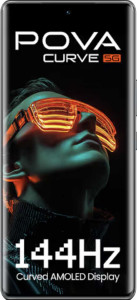
  • Display refresh rate is 120Hz on Tecno Camon 40 and 144Hz on Tecno Pova Curve 5G.
  • Damage-resistant glass is present on Tecno Pova Curve 5G but not available on Tecno Camon 40.
  • Internal storage is 256GB on Tecno Camon 40 and 128GB on Tecno Pova Curve 5G.
  • The chipset is MediaTek Helio G100 on Tecno Camon 40 and MediaTek Dimensity 7300 on Tecno Pova Curve 5G.
  • The GPU is Mali G57 on Tecno Camon 40 and Mali G615 MC2 on Tecno Pova Curve 5G.
  • CPU speed is 2 x 2.2 & 6 x 2 GHz on Tecno Camon 40 and 4 x 2.5 & 4 x 2 GHz on Tecno Pova Curve 5G.
  • GPU clock speed is 1000 MHz on Tecno Camon 40 and 1047 MHz on Tecno Pova Curve 5G.
  • RAM speed is 4266 MHz on Tecno Camon 40 and 6400 MHz on Tecno Pova Curve 5G.
  • Semiconductor size is 6 nm on Tecno Camon 40 and 4 nm on Tecno Pova Curve 5G.
  • DirectX version is DirectX 11 on Tecno Camon 40 and DirectX 12 on Tecno Pova Curve 5G.
  • Maximum memory amount is 12GB on Tecno Camon 40 and 16GB on Tecno Pova Curve 5G.
  • DDR memory version is DDR4 on Tecno Camon 40 and DDR5 on Tecno Pova Curve 5G.
  • Main camera resolution is 50 & 8 MP on Tecno Camon 40 and 64 & 2 MP on Tecno Pova Curve 5G.
  • Front camera resolution is 32MP on Tecno Camon 40 and 13MP on Tecno Pova Curve 5G.
  • Optical image stabilization is present on Tecno Camon 40 but not available on Tecno Pova Curve 5G.
  • The number of flash LEDs is 2 on Tecno Camon 40 and 1 on Tecno Pova Curve 5G.
  • Battery capacity is 5200 mAh on Tecno Camon 40 and 5500 mAh on Tecno Pova Curve 5G.
  • 5G support is available on Tecno Pova Curve 5G but not on Tecno Camon 40.
  • Download speed is 650 MBits/s on Tecno Camon 40 and 3270 MBits/s on Tecno Pova Curve 5G.
  • Upload speed is 150 MBits/s on Tecno Camon 40 and 3270 MBits/s on Tecno Pova Curve 5G.
  • A gyroscope is present on Tecno Camon 40 but not available on Tecno Pova Curve 5G.
  • Galileo satellite navigation support is available on Tecno Camon 40 but not on Tecno Pova Curve 5G.
Specs Comparison
Tecno Camon 40

Tecno Camon 40

Tecno Pova Curve 5G

Tecno Pova Curve 5G

Design:
water resistance Water resistant Water resistant
weight 177.2 g 177 g
thickness 7.3 mm 7.5 mm
Ingress Protection (IP) rating IP66 IP64
has a rugged build
can be folded

In terms of design, the Tecno Camon 40 and Tecno Pova Curve 5G are remarkably close siblings. Both weigh virtually the same — 177.2 g versus 177 g — a difference so negligible it is imperceptible in hand. Similarly, their thickness figures of 7.3 mm and 7.5 mm respectively place both firmly in the slim-phone category, though the Camon 40 edges fractionally thinner, which can contribute to a slightly more premium in-hand feel over extended use.

Where a meaningful distinction does emerge is in water resistance certification. Both carry IP-rated protection, but the Camon 40 holds an IP66 rating versus the Pova Curve 5G′s IP64. In practical terms, IP66 guards against powerful water jets from any direction, while IP64 only covers water splashes. This gap matters if the device is likely to be exposed to rain, sink splashes, or outdoor use — the Camon 40 offers a noticeably higher margin of safety in those scenarios.

Neither device features a rugged build or a foldable form factor, so both target the mainstream flat-slab smartphone audience. Overall, the designs are nearly identical in form, but the Camon 40 holds a clear edge in durability credentials thanks to its stronger IP66 water resistance rating.

Display:
Display type OLED/AMOLED OLED/AMOLED
screen size 6.78" 6.78"
pixel density 393 ppi 393 ppi
resolution 1080 x 2436 px 1080 x 2436 px
refresh rate 120Hz 144Hz
has branded damage-resistant glass
supports HDR10
supports HDR10+
supports Dolby Vision
Has a secondary screen
has a touch screen

On paper, these two displays are near-identical twins: both sport a 6.78″ OLED/AMOLED panel with a 1080 x 2436 px resolution and 393 ppi pixel density. That shared foundation means users of either device get the same vibrant colors, deep blacks, and sharp text that AMOLED technology is known for — a genuinely strong baseline for this price segment.

The differentiators, however, are real. The Pova Curve 5G steps up to a 144Hz refresh rate compared to the Camon 40′s 120Hz, a gap that is most noticeable during fast-scrolling, gaming, and UI animations — the higher the rate, the smoother and more responsive the experience feels. Alongside that, the Pova Curve 5G also features branded damage-resistant glass, which the Camon 40 lacks entirely. In day-to-day use, this coating provides meaningful protection against scratches from keys, sand, and everyday pocket debris — an often-underappreciated practical advantage.

Neither phone supports HDR10, HDR10+, or Dolby Vision, so premium streaming content will render identically on both. Weighing the two differentiators together, the Pova Curve 5G holds a clear display edge: the higher refresh rate improves fluidity and the damage-resistant glass adds longevity — two advantages the Camon 40 simply cannot match in this category.

Performance:
internal storage 256GB 128GB
RAM 8GB 8GB
Chipset (SoC) name MediaTek Helio G100 MediaTek Dimensity 7300
GPU name Mali G57 Mali G615 MC2
CPU speed 2 x 2.2 & 6 x 2 GHz 4 x 2.5 & 4 x 2 GHz
GPU clock speed 1000 MHz 1047 MHz
Has integrated LTE
RAM speed 4266 MHz 6400 MHz
semiconductor size 6 nm 4 nm
Supports 64-bit
DirectX version DirectX 11 DirectX 12
Has integrated graphics
Uses big.LITTLE technology
CPU threads 8 threads 8 threads
Uses HMP
maximum memory amount 12GB 16GB
DDR memory version 4 5

The silicon gap between these two devices is substantial. The Tecno Pova Curve 5G runs on the MediaTek Dimensity 7300, built on a 4nm process node, while the Camon 40 uses the MediaTek Helio G100 on a 6nm node. A smaller process node generally means greater energy efficiency and more transistors in the same space — translating to better sustained performance and lower heat generation under load. The Pova Curve 5G also has faster CPU performance cores clocked at 2.5 GHz versus the Camon 40′s 2.2 GHz, and pairs them with a newer Mali G615 MC2 GPU supporting DirectX 12, compared to the Camon 40′s Mali G57 capped at DirectX 11. For gaming and GPU-intensive tasks, this is a meaningful generational gap.

The memory architecture tells a similar story. The Pova Curve 5G uses DDR5 RAM at 6400 MHz and supports up to 16GB, versus the Camon 40′s DDR4 at 4266 MHz with a 12GB ceiling. Faster RAM reduces latency when the CPU and GPU are pulling data, which benefits multitasking and app-switching responsiveness in ways users feel daily. The one area where the Camon 40 fights back is onboard storage — it ships with 256GB versus the Pova Curve 5G′s 128GB, a practical win for users who store large media libraries without relying on cloud services.

The trade-off is clear: the Pova Curve 5G holds a decisive performance edge across chipset efficiency, CPU speed, GPU capability, and memory technology, while the Camon 40 compensates with double the base storage. Users who prioritize raw horsepower and future-proofing should lean toward the Pova Curve 5G; those who value local storage capacity will find the Camon 40 more accommodating.

Cameras:
megapixels (main camera) 50 & 8 MP 64 & 2 MP
Has a dual-lens (or multi-lens) main camera
megapixels (front camera) 32MP 13MP
has built-in optical image stabilization
Has a dual-tone LED flash
number of flash LEDs 2 1
has a BSI sensor
has a CMOS sensor
has continuous autofocus when recording movies
Has phase-detection autofocus for photos
supports slow-motion video recording
has a built-in HDR mode
has manual exposure
has a flash
optical zoom 0x 0x
has manual ISO
has a serial shot mode
has manual focus
has a front camera
Has laser autofocus
Shoots 360° panorama
has manual white balance
shoots raw
has touch autofocus
has manual shutter speed
can create panoramas in-camera
Has timelapse function
Has a front-facing LED flash
has a dual-lens (or multi-lens) front camera
supports HDR10 recording
supports Dolby Vision recording
has a front-facing camera under the display
Has a RGB LED flash
has 3D photo/video recording capabilities

Despite sharing the same dual-lens configuration and a nearly identical feature set — phase-detection autofocus, slow-motion, HDR, and a full suite of manual controls — the two cameras diverge meaningfully in the details. The Pova Curve 5G leads the primary lens with 64MP, versus the Camon 40′s 50MP, which on the surface suggests more resolving power. However, the secondary lens tells a different story: the Camon 40 pairs its main sensor with an 8MP secondary camera — a functionally useful lens for wide-angle or depth capture — while the Pova Curve 5G′s second lens is just 2MP, which in practice serves little purpose beyond basic depth-mapping for portrait mode.

Two further advantages cement the Camon 40′s lead. It includes optical image stabilization (OIS), which the Pova Curve 5G entirely lacks — a significant real-world difference when shooting handheld video or photos in low light, where OIS actively compensates for hand shake. The Camon 40 also fires with two flash LEDs versus one on the Pova Curve 5G, improving flash coverage and color balance in dark environments. For selfie-focused users, the gap is even wider: the Camon 40′s 32MP front camera dwarfs the Pova Curve 5G′s 13MP, offering noticeably more detail for portraits and video calls.

The Camon 40 holds a clear camera advantage across the board. The Pova Curve 5G′s higher primary megapixel count is its only edge, and it is outweighed by the Camon 40′s OIS, more capable secondary lens, dual-LED flash, and substantially higher-resolution front camera.

Operating system:
Android version Android 15 Android 15
has clipboard warnings
has location privacy options
has camera/microphone privacy options
has Mail Privacy Protection
has theme customization
can block app tracking
blocks cross-site tracking
has on-device machine learning
has notification permissions
has media picker
Can play games while they download
has dark mode
has Wi-Fi password sharing
has battery health check
has an extra dim mode
has focus modes
has dynamic theming
can offload apps
Has customizable notifications
has Live Text
has full-page screenshots
supports split screen
gets direct OS updates
has PiP
Can be used as a PC
Has sharing intents
has a child lock
Supports widgets
Is free and open source
Has offline voice recognition
has voice commands
Tracks the current position of a mobile device
is a multi-user system
has Quick Start

This is as close to a dead heat as a spec group can get. Both the Tecno Camon 40 and Tecno Pova Curve 5G run Android 15 and share an absolutely identical feature set across every single listed specification — from privacy controls like location, camera, and microphone permissions, to productivity features like split-screen, Picture-in-Picture, and dynamic theming.

The shared software experience is genuinely well-rounded for Android at this tier. Both devices offer on-device machine learning, offline voice recognition, customizable notifications, and a battery health check — features that collectively represent a modern, capable Android implementation. The absence of direct OS updates on both is worth noting, as it means neither device receives updates pushed straight from Google, relying instead on Tecno′s own update pipeline.

With zero differentiating data points between the two, this category is an absolute tie. A buyer′s software experience will be functionally indistinguishable regardless of which device they choose.

Battery:
battery power 5200 mAh 5500 mAh
has wireless charging
Supports fast charging
charging speed 45W 45W
has a removable battery
has a battery level indicator
has a rechargeable battery

Battery life is one area where the two devices converge closely, yet a small but real gap exists. The Pova Curve 5G packs a 5500 mAh cell versus the Camon 40′s 5200 mAh — a 300 mAh difference that, while not dramatic, can realistically translate to an extra 30 to 45 minutes of screen-on time during a heavy day of use. For users who regularly push through long days without access to a charger, that margin is worth having.

Where neither device concedes anything is on charging. Both support 45W fast charging, meaning replenishment speeds are equally brisk — and notably, the Pova Curve 5G′s slightly larger battery does not come at the cost of slower charging. Neither phone offers wireless charging, which keeps both squarely in the mid-range camp in terms of convenience features.

The Pova Curve 5G holds a modest but genuine battery edge — its larger capacity is the sole differentiator here, and with identical charging speeds, it gets more runtime for no additional trade-off.

Audio:
has a socket for a 3.5 mm audio jack
has stereo speakers
has aptX
has LDAC
has aptX HD
has aptX Adaptive
has aptX Lossless
Has a radio

Audio is another category where these two devices are indistinguishable on paper. Both the Tecno Camon 40 and Tecno Pova Curve 5G feature stereo speakers and a built-in FM radio, while both drop the 3.5mm headphone jack — a trade-off that has become increasingly common at this price tier, pushing users toward Bluetooth or USB-C audio solutions.

Neither device supports any high-resolution Bluetooth audio codec — no aptX, aptX HD, LDAC, or any variant thereof. This means wireless listening is capped at standard Bluetooth audio quality on both, which is acceptable for casual use but will disappoint audiophiles seeking lossless or near-lossless wireless playback through premium headphones.

With every listed spec in perfect alignment, this category is a complete tie. Buyers who prioritize audio quality beyond the basics will find neither device offers an advantage over the other.

Connectivity & Features:
release date March 2025 May 2025
has 5G support
SIM cards 2 SIM 2 SIM
Has USB Type-C
USB version 2 2
has NFC
download speed 650 MBits/s 3270 MBits/s
upload speed 150 MBits/s 3270 MBits/s
Has a fingerprint scanner
has emergency SOS via satellite
has crash detection
is DLNA-certified
has a gyroscope
supports ANT+
Has a heart rate monitor
has GPS
has a compass
supports Wi-Fi
Has an infrared sensor
has an accelerometer
has a cellular module
Has a barometer
has an HDMI output
Uses 3D facial recognition
Has an iris scanner
Stylus included
supports Galileo
Has motion tracking
Has optical tracking
Has a built-in projector

The most consequential divide in this category is cellular connectivity. The Pova Curve 5G supports 5G, while the Camon 40 is limited to 4G LTE — and the data speeds reflect this dramatically. The Pova Curve 5G reaches up to 3270 Mbits/s on both download and upload, compared to the Camon 40′s 650 Mbits/s down and a notably constrained 150 Mbits/s up. In practice, 5G means faster streaming, near-instant large file transfers, and more headroom for cloud-dependent tasks — a meaningful long-term advantage as 5G infrastructure continues to expand globally.

The Camon 40 quietly holds two connectivity advantages of its own. It includes a gyroscope, which the Pova Curve 5G lacks — relevant for gaming, AR applications, and image stabilization algorithms that rely on rotational sensor data. It also supports Galileo satellite positioning, adding an extra layer of GPS accuracy that the Pova Curve 5G does not offer. Both devices share NFC, dual-SIM, USB Type-C, fingerprint scanning, GPS, compass, and accelerometer, making the rest of the feature set evenly matched.

Overall, the Pova Curve 5G holds the stronger connectivity advantage — its 5G support and vastly superior data speeds outweigh the Camon 40′s gyroscope and Galileo additions for most users. However, buyers who game heavily or need precise location tracking may find the Camon 40′s sensor suite a worthwhile consideration.

Miscellaneous:
has a video light
Has sapphire glass display
Has a curved display
Has an e-paper display

The miscellaneous category offers little to separate these two devices — every listed spec is identical. Both the Tecno Camon 40 and Tecno Pova Curve 5G feature a curved display and a video light, and neither carries sapphire glass or an e-paper display.

The shared curved display is worth acknowledging as a genuine design feature at this price point, lending both devices a more premium aesthetic and a smoother edge-to-edge feel in hand. The video light, distinct from a standard camera flash, is optimized for continuous illumination during video recording rather than split-second burst photography — a small but practical inclusion for content creators.

With no differentiating data points available, this category is a complete tie. Neither device gains any advantage here.

Comparison Summary & Verdict

After a thorough comparison, both phones prove to be strong contenders, but each shines in different areas. The Tecno Camon 40 stands out for its superior camera system, featuring optical image stabilization, a higher-resolution 32MP front camera, double flash LEDs, and a generous 256GB of internal storage, making it the better pick for photography enthusiasts. It also adds a gyroscope and Galileo navigation support and earns a stronger IP66 water resistance rating. On the other hand, the Tecno Pova Curve 5G pulls ahead with its more powerful Dimensity 7300 chipset built on a 4nm process, DDR5 RAM, a faster 144Hz display, 5G connectivity with dramatically higher download speeds, and a larger 5500 mAh battery, making it the smarter choice for users who prioritize future-proof performance and connectivity.

Tecno Camon 40
Buy Tecno Camon 40 if...

Buy the Tecno Camon 40 if you prioritize a superior camera experience with optical image stabilization, a high-resolution 32MP selfie camera, more internal storage, and a stronger IP66 water resistance rating.

Tecno Pova Curve 5G
Buy Tecno Pova Curve 5G if...

Buy the Tecno Pova Curve 5G if you want a more powerful and future-proof device with 5G connectivity, a faster Dimensity 7300 chipset, DDR5 RAM, a smoother 144Hz display, and a larger battery.