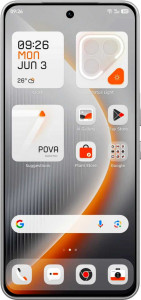
Tecno Pova 7 Pro 5G
Xiaomi Redmi Note 14 Pro 5G (Global)

Tecno Pova 7 Pro 5G Xiaomi Redmi Note 14 Pro 5G (Global)

Overview

Welcome to this in-depth comparison between the Tecno Pova 7 Pro 5G and the Xiaomi Redmi Note 14 Pro 5G (Global) — two compelling mid-range 5G smartphones sharing the same MediaTek Dimensity 7300 chipset and 12GB of RAM, yet diverging sharply in key areas. From battery capacity and water resistance to camera hardware and display features, each device makes distinct trade-offs worth examining closely before you decide which one belongs in your pocket.

Common Features

  • Neither product has a rugged build.
  • Neither product can be folded.
  • Both products use an OLED/AMOLED display type.
  • Always-On Display is available on both products.
  • Neither product has a secondary screen.
  • Both products have a touch screen.
  • Both products come with 12GB of RAM.
  • Both products use the MediaTek Dimensity 7300 chipset.
  • Both products feature the Mali G615 MC2 GPU.
  • Both products have a CPU speed of 4 x 2.5 & 4 x 2 GHz.
  • Both products have a GPU clock speed of 1047 MHz.
  • Both products have integrated LTE.
  • Both products have a RAM speed of 6400 MHz.
  • Both products are built on a 4 nm semiconductor size.
  • Both products feature a dual-lens or multi-lens main camera.
  • Neither product has a dual-tone LED flash.
  • Both products have a CMOS sensor.
  • Both products support continuous autofocus when recording movies.
  • Both products support phase-detection autofocus for photos.
  • Both products support slow-motion video recording.
  • Both products have a built-in HDR mode.
  • Both products display clipboard warnings.
  • Both products offer location privacy options.
  • Both products offer camera and microphone privacy options.
  • Neither product has Mail Privacy Protection.
  • Both products support theme customization.
  • Both products can block app tracking.
  • Neither product blocks cross-site tracking.
  • Both products have on-device machine learning.
  • Both products support fast charging.
  • Both products charge at 45W.
  • Neither product has a removable battery.
  • Both products have a battery level indicator.
  • Both products have a rechargeable battery.
  • Both products have stereo speakers.
  • Neither product supports aptX HD.
  • Neither product supports aptX Adaptive.
  • Neither product supports aptX Lossless.
  • Neither product has a radio.
  • Both products support 5G.
  • Both products have dual SIM card slots.
  • Neither product has an external memory slot.
  • Both products have a USB Type-C connector.
  • Both products use USB version 2.
  • Both products have NFC.
  • Both products have a download speed of 3270 MBits/s.
  • Both products have an upload speed of 3270 MBits/s.
  • Both products have a video light.
  • Neither product has a sapphire glass display.
  • Neither product has an e-paper display.

Main Differences

  • Water resistance is rated as Water resistant on Tecno Pova 7 Pro 5G and Waterproof on Xiaomi Redmi Note 14 Pro 5G (Global).
  • Weight is 195 g on Tecno Pova 7 Pro 5G and 190 g on Xiaomi Redmi Note 14 Pro 5G (Global).
  • Thickness is 8.2 mm on Tecno Pova 7 Pro 5G and 8.4 mm on Xiaomi Redmi Note 14 Pro 5G (Global).
  • Width is 75.9 mm on Tecno Pova 7 Pro 5G and 74.4 mm on Xiaomi Redmi Note 14 Pro 5G (Global).
  • Height is 163.5 mm on Tecno Pova 7 Pro 5G and 162.3 mm on Xiaomi Redmi Note 14 Pro 5G (Global).
  • IP rating is IP64 on Tecno Pova 7 Pro 5G and IP68 on Xiaomi Redmi Note 14 Pro 5G (Global).
  • Screen size is 6.78″ on Tecno Pova 7 Pro 5G and 6.67″ on Xiaomi Redmi Note 14 Pro 5G (Global).
  • Refresh rate is 144Hz on Tecno Pova 7 Pro 5G and 120Hz on Xiaomi Redmi Note 14 Pro 5G (Global).
  • Damage-resistant glass is present on Xiaomi Redmi Note 14 Pro 5G (Global) but not available on Tecno Pova 7 Pro 5G.
  • HDR10 support is present on Xiaomi Redmi Note 14 Pro 5G (Global) but not available on Tecno Pova 7 Pro 5G.
  • HDR10+ support is present on Xiaomi Redmi Note 14 Pro 5G (Global) but not available on Tecno Pova 7 Pro 5G.
  • Dolby Vision support is present on Xiaomi Redmi Note 14 Pro 5G (Global) but not available on Tecno Pova 7 Pro 5G.
  • Internal storage is 256GB on Tecno Pova 7 Pro 5G and 512GB on Xiaomi Redmi Note 14 Pro 5G (Global).
  • AnTuTu benchmark score is 676261 on Tecno Pova 7 Pro 5G and 720000 on Xiaomi Redmi Note 14 Pro 5G (Global).
  • Geekbench 6 multi-core result is 2932 on Tecno Pova 7 Pro 5G and 6487 on Xiaomi Redmi Note 14 Pro 5G (Global).
  • Geekbench 6 single-core result is 1026 on Tecno Pova 7 Pro 5G and 2051 on Xiaomi Redmi Note 14 Pro 5G (Global).
  • Main camera resolution is 64 & 8 MP on Tecno Pova 7 Pro 5G and 200 & 8 & 2 MP on Xiaomi Redmi Note 14 Pro 5G (Global).
  • Front camera resolution is 13MP on Tecno Pova 7 Pro 5G and 20MP on Xiaomi Redmi Note 14 Pro 5G (Global).
  • Optical image stabilization is present on Xiaomi Redmi Note 14 Pro 5G (Global) but not available on Tecno Pova 7 Pro 5G.
  • Number of flash LEDs is 2 on Tecno Pova 7 Pro 5G and 1 on Xiaomi Redmi Note 14 Pro 5G (Global).
  • Android version is Android 15 on Tecno Pova 7 Pro 5G and Android 14 on Xiaomi Redmi Note 14 Pro 5G (Global).
  • App offloading is supported on Tecno Pova 7 Pro 5G but not available on Xiaomi Redmi Note 14 Pro 5G (Global).
  • Battery capacity is 6000 mAh on Tecno Pova 7 Pro 5G and 5110 mAh on Xiaomi Redmi Note 14 Pro 5G (Global).
  • Wireless charging is supported on Tecno Pova 7 Pro 5G but not available on Xiaomi Redmi Note 14 Pro 5G (Global).
  • A 3.5 mm audio jack is present on Tecno Pova 7 Pro 5G but not available on Xiaomi Redmi Note 14 Pro 5G (Global).
  • aptX support is present on Xiaomi Redmi Note 14 Pro 5G (Global) but not available on Tecno Pova 7 Pro 5G.
  • LDAC support is present on Xiaomi Redmi Note 14 Pro 5G (Global) but not available on Tecno Pova 7 Pro 5G.
  • An infrared sensor is present on Xiaomi Redmi Note 14 Pro 5G (Global) but not available on Tecno Pova 7 Pro 5G.
  • A curved display is present on Xiaomi Redmi Note 14 Pro 5G (Global) but not available on Tecno Pova 7 Pro 5G.
Specs Comparison
Tecno Pova 7 Pro 5G

Tecno Pova 7 Pro 5G

Xiaomi Redmi Note 14 Pro 5G (Global)

Xiaomi Redmi Note 14 Pro 5G (Global)

Design:
water resistance Water resistant Waterproof
weight 195 g 190 g
thickness 8.2 mm 8.4 mm
width 75.9 mm 74.4 mm
height 163.5 mm 162.3 mm
volume 101.75913 cm³ 101.431008 cm³
Ingress Protection (IP) rating IP64 IP68
has a rugged build
can be folded

In terms of physical form, these two phones are remarkably close. The Tecno Pova 7 Pro 5G is marginally taller and wider, while the Redmi Note 14 Pro 5G is fractionally thicker at 8.4 mm versus 8.2 mm. The Redmi also comes in slightly lighter at 190 g compared to the Pova's 195 g. In practice, none of these differences are perceptible in daily use — both phones occupy essentially the same physical space and will feel comparable in hand. Neither device offers a rugged build or a folding form factor, placing them squarely in conventional smartphone territory.

Where the two phones genuinely diverge is in water and dust protection. The Tecno Pova 7 Pro 5G carries an IP64 rating, meaning it is fully dust-protected but only splash-resistant — it can handle rain or accidental spills, but should not be submerged. The Redmi Note 14 Pro 5G steps up significantly with an IP68 rating, which means it is both dust-tight and rated for submersion in water under controlled conditions. This is a meaningful real-world difference: IP68 gives users genuine peace of mind around pools, sinks, or unexpected drops in shallow water, whereas IP64 only covers incidental exposure.

The Xiaomi Redmi Note 14 Pro 5G holds a clear edge in this category. Its superior IP68 protection is a tangible, everyday advantage that the Pova 7 Pro cannot match, and this outweighs the Pova's marginal thinness advantage. For users who prioritize durability and environmental resilience in their device's design, the Redmi is the stronger choice here.

Display:
Display type OLED/AMOLED OLED/AMOLED
screen size 6.78" 6.67"
pixel density 440 ppi 446 ppi
resolution 1224 x 2720 px 1220 x 2712 px
refresh rate 144Hz 120Hz
has branded damage-resistant glass
supports HDR10
supports HDR10+
Always-On Display
supports Dolby Vision
Has a secondary screen
has a touch screen

Both phones share the same panel technology — OLED/AMOLED — and their raw sharpness figures are functionally identical, with pixel densities of 440 ppi and 446 ppi respectively, a difference no human eye can detect. The Tecno Pova 7 Pro 5G does offer a slightly larger canvas at 6.78″ versus the Redmi Note 14 Pro 5G's 6.67″, and its 144Hz refresh rate edges out the Redmi's 120Hz panel — a distinction that gamers and users sensitive to UI smoothness will notice, particularly in fast-scrolling content and supported titles.

However, the Redmi Note 14 Pro 5G counters with advantages that matter more for everyday media consumption. It supports the full HDR trifecta — HDR10, HDR10+, and Dolby Vision — while the Pova 7 Pro supports none of these standards. In practice, this means the Redmi can render a wider range of brightness and color on streaming platforms like Netflix or Prime Video when HDR content is available, producing more lifelike highlights and deeper shadows. The Redmi also includes branded damage-resistant glass, a notable omission on the Pova that affects long-term screen durability against scratches and accidental drops.

On balance, the Redmi Note 14 Pro 5G takes the edge in this category. The Pova's higher refresh rate is a real advantage, but it is outweighed by the Redmi's comprehensive HDR support and physical screen protection — features that deliver broader, more consistent benefits across typical use cases including streaming, browsing, and daily handling.

Performance:
internal storage 256GB 512GB
RAM 12GB 12GB
AnTuTu benchmark score 676261 720000
Chipset (SoC) name MediaTek Dimensity 7300 MediaTek Dimensity 7300
GPU name Mali G615 MC2 Mali G615 MC2
CPU speed 4 x 2.5 & 4 x 2 GHz 4 x 2.5 & 4 x 2 GHz
Geekbench 6 result (multi) 2932 6487
Geekbench 6 result (single) 1026 2051
GPU clock speed 1047 MHz 1047 MHz
Has integrated LTE
RAM speed 6400 MHz 6400 MHz
semiconductor size 4 nm 4 nm
Supports 64-bit
DirectX version DirectX 12 DirectX 12
Has integrated graphics
Uses big.LITTLE technology
CPU threads 8 threads 8 threads
Uses HMP
maximum memory amount 16GB 16GB
number of transistors 6200 million 6200 million
DDR memory version 5 5
supported displays 1 1

At the silicon level, these two phones are built on identical foundations: the same MediaTek Dimensity 7300 chipset, the same Mali G615 MC2 GPU, the same 12GB of DDR5 RAM running at 6400 MHz, and the same 4nm fabrication process. For everyday tasks — app switching, social media, casual gaming — both phones draw from the same hardware well, and users should expect a broadly similar experience in routine use.

Where the data diverges sharply is in benchmark results. The Redmi Note 14 Pro 5G posts a Geekbench 6 single-core score of 2051 and a multi-core score of 6487, compared to the Pova 7 Pro's 1026 and 2932 respectively — roughly double across the board. The AnTuTu gap is narrower but still present: 720,000 versus 676,261. These figures suggest meaningfully different levels of sustained performance optimization between the two devices, which can translate to faster app load times, smoother performance under load, and better handling of CPU-intensive tasks like video editing or extended gaming sessions.

Storage is the other practical differentiator: the Redmi ships with 512GB of internal storage versus the Pova's 256GB — a significant advantage for users who store large media libraries or prefer not to manage storage actively. Taken together, the Redmi Note 14 Pro 5G holds a clear performance edge in this category, driven by its substantially higher benchmark results and doubled base storage.

Cameras:
megapixels (main camera) 64 & 8 MP 200 & 8 & 2 MP
Has a dual-lens (or multi-lens) main camera
megapixels (front camera) 13MP 20MP
has built-in optical image stabilization
Has a dual-tone LED flash
number of flash LEDs 2 1
has a BSI sensor
has a CMOS sensor
has continuous autofocus when recording movies
Has phase-detection autofocus for photos
supports slow-motion video recording
has a built-in HDR mode
has manual exposure
has a flash
optical zoom 0x 0x
has manual ISO
has a serial shot mode
has manual focus
has a front camera
Has laser autofocus
Shoots 360° panorama
has manual white balance
shoots raw
has touch autofocus
has manual shutter speed
can create panoramas in-camera
Has timelapse function
Has a front-facing LED flash
has a dual-lens (or multi-lens) front camera
supports HDR10 recording
supports Dolby Vision recording
has a front-facing camera under the display
Has a RGB LED flash
has 3D photo/video recording capabilities

The camera systems on these two phones share a long list of common capabilities — phase-detection autofocus, continuous autofocus during video, slow-motion recording, HDR mode, and a full suite of manual controls. For the majority of shooting scenarios, both phones offer a comparable feature set on paper. The critical divergence, however, lies in sensor resolution and stabilization. The Redmi Note 14 Pro 5G leads with a 200 MP primary sensor backed by a triple-lens array, while the Tecno Pova 7 Pro 5G tops out at 64 MP across a dual-lens setup. A 200 MP sensor enables significantly more aggressive cropping in post without visible quality loss, and allows the camera software to use pixel-binning techniques that can improve low-light output.

The stabilization gap is equally consequential. The Redmi includes optical image stabilization (OIS), which physically compensates for hand movement during shots — a tangible advantage when shooting handheld in dim lighting or capturing video while walking. The Pova 7 Pro lacks OIS entirely, relying solely on software-based correction, which is generally less effective. On the front, the Redmi also pulls ahead with a 20 MP selfie camera versus the Pova's 13 MP.

The Redmi Note 14 Pro 5G wins this category decisively. The combination of a substantially higher-resolution primary sensor, a three-lens rear system, and the presence of OIS represents a meaningful, real-world imaging advantage that the Pova 7 Pro cannot offset with its otherwise comparable feature set.

Operating system:
Android version Android 15 Android 14
has clipboard warnings
has location privacy options
has camera/microphone privacy options
has Mail Privacy Protection
has theme customization
can block app tracking
blocks cross-site tracking
has on-device machine learning
has notification permissions
has media picker
Can play games while they download
has dark mode
has Wi-Fi password sharing
has battery health check
has an extra dim mode
has focus modes
has dynamic theming
can offload apps
Has customizable notifications
has Live Text
has full-page screenshots
supports split screen
gets direct OS updates
has PiP
Can be used as a PC
Has sharing intents
has a child lock
Supports widgets
Is free and open source
Has offline voice recognition
has voice commands
Tracks the current position of a mobile device
is a multi-user system
has Quick Start

Strip away the branding and these two phones run nearly identical software configurations. Both launch with Android, share the same privacy controls — including camera and microphone permissions, location options, and app tracking blockers — and support the same quality-of-life features like dark mode, dynamic theming, split-screen multitasking, Picture-in-Picture, and customizable notifications. For the vast majority of users, day-to-day software operation will feel functionally equivalent on either device.

The meaningful differences are few but worth noting. The Tecno Pova 7 Pro 5G ships on Android 15, one full version ahead of the Redmi Note 14 Pro 5G's Android 14. A newer Android version brings more recent security patches and platform-level improvements out of the box — a genuine, if modest, advantage at the point of purchase. The Pova also supports app offloading, a feature the Redmi lacks; this allows the system to remove unused apps while retaining their data, which can help manage storage without losing settings or progress.

Neither phone receives direct OS updates according to the provided data, which limits the long-term software advantage of the Pova's head start. Still, on the basis of what is specified here, the Tecno Pova 7 Pro 5G holds a narrow edge in this category — its more current Android version and app offloading capability give it a slight but tangible lead in an otherwise near-identical software matchup.

Battery:
battery power 6000 mAh 5110 mAh
has wireless charging
Supports fast charging
charging speed 45W 45W
has a removable battery
has a battery level indicator
has a rechargeable battery

Battery capacity is where the Tecno Pova 7 Pro 5G makes one of its strongest arguments. Its 6000 mAh cell is notably larger than the Redmi Note 14 Pro 5G's 5110 mAh — a difference of nearly 900 mAh, which is substantial by any measure. All else being equal, a larger battery directly translates to more screen-on time between charges, making the Pova a more compelling option for heavy users, frequent travelers, or anyone who regularly pushes through a full day without access to a charger.

Wired charging speed is identical on both devices at 45W, so replenishment time from a wall outlet is broadly comparable. The more notable asymmetry is in wireless charging: the Pova 7 Pro supports it, while the Redmi Note 14 Pro 5G does not. For users who rely on wireless pads at a desk or bedside, this is a genuine convenience gap that compounds the Pova's raw capacity advantage.

The Tecno Pova 7 Pro 5G wins this category clearly. It offers a larger battery reserve and the added flexibility of wireless charging — two meaningful advantages over the Redmi, with no offsetting disadvantage in wired charging speed.

Audio:
has a socket for a 3.5 mm audio jack
has stereo speakers
has aptX
has LDAC
has aptX HD
has aptX Adaptive
has aptX Lossless
Has a radio

Speakerphone output is equal footing for both devices — each delivers stereo sound, which means wider, more immersive audio for media playback compared to a mono setup. Beyond that shared baseline, however, the two phones diverge based on how their users are likely to listen privately. The Tecno Pova 7 Pro 5G retains a 3.5 mm headphone jack, a feature the Redmi Note 14 Pro 5G has dropped entirely. For users with wired headphones or earphones — whether for audio quality, reliability, or simply avoiding the need to charge another device — this is a meaningful practical advantage that should not be understated.

The Redmi counters for wireless listeners. It supports both aptX and LDAC, two Bluetooth audio codecs that transmit significantly more data than standard SBC or AAC, resulting in noticeably higher-quality audio over compatible wireless headphones. The Pova 7 Pro supports neither, meaning Bluetooth audio on the Tecno is limited to lower-fidelity codecs regardless of the headphones used.

This category is a genuine split that comes down to user preference. The Pova 7 Pro 5G is the better choice for wired headphone users, while the Redmi Note 14 Pro 5G serves wireless audio enthusiasts who want higher-quality Bluetooth transmission. Neither phone holds a universal edge — the right answer depends entirely on how a given user listens.

Connectivity & Features:
release date June 2025 January 2025
has 5G support
SIM cards 2 SIM 2 SIM
has an external memory slot
Has USB Type-C
USB version 2 2
has NFC
download speed 3270 MBits/s 3270 MBits/s
upload speed 3270 MBits/s 3270 MBits/s
Has a fingerprint scanner
has emergency SOS via satellite
has crash detection
is DLNA-certified
has a gyroscope
supports ANT+
Has a heart rate monitor
has GPS
has a compass
supports Wi-Fi
Has an infrared sensor
has an accelerometer
has a cellular module
Has a barometer
has an HDMI output
Uses 3D facial recognition
Has an iris scanner
Stylus included
supports Galileo
Has motion tracking
Has optical tracking
Has a built-in projector

Connectivity parity is the defining theme of this category. Both phones support 5G, dual SIM, NFC, USB Type-C (USB 2.0), and identical download and upload speeds of 3270 Mbits/s. Navigation capabilities are equally matched, with GPS, a compass, a gyroscope, an accelerometer, and Galileo support present on both devices. For the overwhelming majority of connectivity use cases — mobile data, contactless payments, file transfers, location services — users will find no meaningful difference between the two.

The sole differentiator in this entire category is the infrared sensor on the Xiaomi Redmi Note 14 Pro 5G, which the Tecno Pova 7 Pro 5G lacks. An IR blaster allows the phone to function as a universal remote control for televisions, air conditioners, and other consumer electronics — a niche but genuinely useful convenience for users who want to consolidate remotes or control appliances without a dedicated device.

This category is essentially a tie, with a narrow edge to the Redmi Note 14 Pro 5G by virtue of its infrared sensor. It is a small functional bonus rather than a decisive advantage, and users who have no interest in IR remote functionality will find both phones completely equivalent in this area.

Miscellaneous:
has a video light
Has sapphire glass display
Has a curved display
Has an e-paper display

This is a sparse category with limited data points, and three of the four specs are identical: both phones include a video light, neither features sapphire glass, and neither uses an e-paper display. The only differentiator is that the Xiaomi Redmi Note 14 Pro 5G has a curved display, while the Tecno Pova 7 Pro 5G uses a flat panel.

A curved screen is primarily an aesthetic and ergonomic choice — the edges of the display wrap gently toward the frame, which can lend a more premium feel in hand and reduce the visual presence of the bezels. The trade-off is that curved displays can be more prone to accidental edge touches and are sometimes harder to protect with standard screen protectors. Whether this counts as an advantage depends entirely on personal preference.

Given how thin this data set is, neither phone holds a meaningful edge here. The curved display on the Redmi Note 14 Pro 5G is a subjective design distinction rather than a functional advantage, and this category is best treated as essentially tied.

Comparison Summary & Verdict

After examining every specification, it becomes clear that these two phones target slightly different priorities. The Tecno Pova 7 Pro 5G stands out with its massive 6000 mAh battery, wireless charging, 144Hz refresh rate, headphone jack, and the newer Android 15 out of the box — making it a strong pick for power users and multimedia enthusiasts who value endurance and versatility. The Xiaomi Redmi Note 14 Pro 5G (Global), on the other hand, excels with its superior IP68 waterproof rating, a 200MP main camera with optical image stabilization, significantly higher Geekbench benchmark scores, HDR10+ and Dolby Vision display support, and premium audio codecs like LDAC and aptX. If you need a more durable, camera-focused device with a refined display experience, the Xiaomi is the stronger contender. But if battery life, wireless charging, and audio jack access matter most, the Tecno delivers compelling value.

Tecno Pova 7 Pro 5G
Buy Tecno Pova 7 Pro 5G if...

Buy the Tecno Pova 7 Pro 5G if you prioritize a larger 6000 mAh battery with wireless charging, a 144Hz display, a 3.5mm headphone jack, and Android 15 out of the box.

Xiaomi Redmi Note 14 Pro 5G (Global)
Buy Xiaomi Redmi Note 14 Pro 5G (Global) if...

Buy the Xiaomi Redmi Note 14 Pro 5G (Global) if you want superior IP68 waterproofing, a 200MP camera with optical image stabilization, HDR10+ and Dolby Vision display support, and higher overall benchmark performance.