Tecno Pova 7
ZTE Nubia Neo 3 GT

Tecno Pova 7 ZTE Nubia Neo 3 GT

Overview

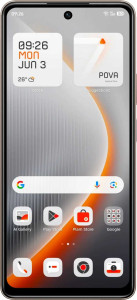
When choosing between the Tecno Pova 7 and the ZTE Nubia Neo 3 GT, buyers face a genuinely competitive decision. Both phones share the same OLED display technology, Android 15, 256GB storage, and fast charging — but they diverge sharply when it comes to raw performance, connectivity options, and battery capacity. This comparison takes a close look at every key specification to help you decide which device best fits your needs.

Common Features

  • Neither product has a rugged build.
  • Neither product can be folded.
  • Both products feature an OLED/AMOLED display type.
  • Both products have a 120Hz display refresh rate.
  • Neither product has branded damage-resistant glass.
  • Neither product supports HDR10, HDR10+, or Dolby Vision.
  • Neither product has a secondary screen.
  • Both products have a touchscreen.
  • Both products offer 256GB of internal storage.
  • Both products have integrated LTE.
  • Both products are built on a 6nm semiconductor process.
  • Both products support 64-bit processing.
  • Both products use big.LITTLE technology with HMP and 8 CPU threads.
  • Both products have integrated graphics.
  • Both products have a dual-lens main camera.
  • Neither product has built-in optical image stabilization.
  • Both products have a CMOS sensor with phase-detection autofocus and continuous autofocus during video recording.
  • Both products support slow-motion video recording.
  • Both products run Android 15.
  • Both products have clipboard warnings and location privacy options.
  • Both products have camera and microphone privacy options.
  • Neither product has Mail Privacy Protection.
  • Both products support theme customization and can block app tracking.
  • Neither product blocks cross-site tracking.
  • Neither product supports wireless charging.
  • Both products support fast charging.
  • Neither product has a removable battery.
  • Both products have a rechargeable battery with a battery level indicator.
  • Both products have stereo speakers.
  • Neither product supports aptX, aptX HD, aptX Adaptive, aptX Lossless, or LDAC.
  • Both products support dual SIM cards.
  • Neither product has an external memory slot.
  • Both products have USB Type-C.
  • Both products have NFC.
  • Both products have a fingerprint scanner.
  • Neither product has emergency SOS via satellite or crash detection.
  • Both products have a video light.
  • Neither product has a sapphire glass, curved, or e-paper display.

Main Differences

  • Screen size is 6.78″ on Tecno Pova 7 and 6.8″ on ZTE Nubia Neo 3 GT.
  • Pixel density is 396 ppi on Tecno Pova 7 and 386 ppi on ZTE Nubia Neo 3 GT.
  • Resolution is 1080 x 2460 px on Tecno Pova 7 and 1080 x 2392 px on ZTE Nubia Neo 3 GT.
  • RAM is 8GB on Tecno Pova 7 and 12GB on ZTE Nubia Neo 3 GT.
  • AnTuTu benchmark score is 411000 on Tecno Pova 7 and 800000 on ZTE Nubia Neo 3 GT.
  • The chipset is MediaTek Helio G100 on Tecno Pova 7 and Unisoc T9100 on ZTE Nubia Neo 3 GT.
  • The GPU is Mali G57 on Tecno Pova 7 and Mali G57 MP4 on ZTE Nubia Neo 3 GT.
  • CPU speed is 2 x 2.2 & 6 x 2 GHz on Tecno Pova 7 and 1 x 2.7 & 3 x 2.3 & 4 x 2.1 GHz on ZTE Nubia Neo 3 GT.
  • RAM speed is 4266 MHz on Tecno Pova 7 and 2133 MHz on ZTE Nubia Neo 3 GT.
  • OpenGL ES version is 3.2 on Tecno Pova 7 and 2.3 on ZTE Nubia Neo 3 GT.
  • Maximum memory amount is 12GB on Tecno Pova 7 and 8GB on ZTE Nubia Neo 3 GT.
  • Main camera resolution is 108 & 2 MP on Tecno Pova 7 and 50 & 2 MP on ZTE Nubia Neo 3 GT.
  • Front camera resolution is 8MP on Tecno Pova 7 and 16MP on ZTE Nubia Neo 3 GT.
  • Number of flash LEDs is 2 on Tecno Pova 7 and 1 on ZTE Nubia Neo 3 GT.
  • Battery capacity is 7000 mAh on Tecno Pova 7 and 6000 mAh on ZTE Nubia Neo 3 GT.
  • Charging speed is 45W on Tecno Pova 7 and 80W on ZTE Nubia Neo 3 GT.
  • A 3.5mm audio jack is present on Tecno Pova 7 but not available on ZTE Nubia Neo 3 GT.
  • A radio is present on Tecno Pova 7 but not available on ZTE Nubia Neo 3 GT.
  • 5G support is available on ZTE Nubia Neo 3 GT but not present on Tecno Pova 7.
  • Download speed is 650 MBits/s on Tecno Pova 7 and 750 MBits/s on ZTE Nubia Neo 3 GT.
  • Upload speed is 150 MBits/s on Tecno Pova 7 and 210 MBits/s on ZTE Nubia Neo 3 GT.
Specs Comparison
Tecno Pova 7

Tecno Pova 7

ZTE Nubia Neo 3 GT

ZTE Nubia Neo 3 GT

Design:
has a rugged build
can be folded

In terms of design fundamentals, the Tecno Pova 7 and the ZTE Nubia Neo 3 GT share identical footing: neither offers a rugged build nor a foldable form factor. This means both are standard candy-bar smartphones without reinforced durability certifications or the premium flexibility of modern foldable designs.

The absence of rugged construction on both devices signals that neither is engineered for demanding environments — users working in dusty, wet, or high-impact conditions should look elsewhere. Similarly, the lack of a foldable mechanism keeps both in the mainstream slab category, which is a practical choice for everyday users but offers no multitasking or compactness advantage associated with foldable hardware.

Based solely on the provided design specs, these two devices are in a complete tie. There is no differentiator between them in this category — both target the same conventional form factor without any structural specialization giving either a meaningful edge.

Display:
Display type OLED/AMOLED OLED/AMOLED
screen size 6.78" 6.8"
pixel density 396 ppi 386 ppi
resolution 1080 x 2460 px 1080 x 2392 px
refresh rate 120Hz 120Hz
has branded damage-resistant glass
supports HDR10
supports HDR10+
supports Dolby Vision
Has a secondary screen
has a touch screen

Both the Tecno Pova 7 and the ZTE Nubia Neo 3 GT sport OLED/AMOLED panels with 120Hz refresh rates, meaning users on either device will enjoy the deep blacks, vibrant contrast, and smooth scrolling that define the modern mid-range display experience. At this level, everyday tasks like browsing, streaming, and gaming all feel fluid and visually rich.

Where minor differences emerge is in screen size and pixel density. The Pova 7 measures 6.78″ at 396 ppi, while the Nubia Neo 3 GT comes in at 6.8″ with 386 ppi. The size gap is negligible in hand, but the Pova 7's slightly higher pixel density translates to marginally crisper text and finer detail — though at this range, the difference is unlikely to be noticeable to most users without a side-by-side comparison. Neither display carries branded damage-resistant glass or any HDR certification, so neither has an advantage in durability or premium video playback fidelity.

Overall, this category is effectively a near-tie with a very slim technical edge to the Tecno Pova 7, solely due to its slightly higher pixel density. For the vast majority of users, the display experience on both phones will feel essentially identical in daily use.

Performance:
internal storage 256GB 256GB
RAM 8GB 12GB
AnTuTu benchmark score 411000 800000
Chipset (SoC) name MediaTek Helio G100 Unisoc T9100
GPU name Mali G57 Mali G57 MP4
CPU speed 2 x 2.2 & 6 x 2 GHz 1 x 2.7 & 3 x 2.3 & 4 x 2.1 GHz
Has integrated LTE
RAM speed 4266 MHz 2133 MHz
semiconductor size 6 nm 6 nm
Supports 64-bit
Has integrated graphics
OpenGL ES version 3.2 2.3
Uses big.LITTLE technology
CPU threads 8 threads 8 threads
Uses HMP
Has TrustZone
OpenCL version 2 2
maximum memory amount 12GB 8GB
DDR memory version 4 4

Raw performance is where these two devices diverge most sharply. The ZTE Nubia Neo 3 GT is powered by the Unisoc T9100 and posts an AnTuTu score of approximately 800,000, while the Tecno Pova 7 — running the MediaTek Helio G100 — lands around 411,000. That is roughly a 2x gap in benchmark performance, which in real-world terms translates to noticeably faster app launches, smoother multitasking under load, and a more capable experience in graphically demanding games. The Nubia also ships with 12GB of base RAM versus the Pova 7's 8GB, giving it more headroom to keep apps active in the background simultaneously.

The Pova 7 does hold two counterpunches worth noting. Its RAM operates at 4266 MHz compared to the Nubia's 2133 MHz — nearly double the memory bandwidth — which can benefit certain workloads involving rapid data throughput. It also supports OpenGL ES 3.2 versus the Nubia's 2.3, meaning it has access to a broader set of modern graphics APIs, an advantage for compatible games and GPU-accelerated tasks. Interestingly, the Pova 7's maximum expandable memory ceiling of 12GB exceeds the Nubia's cap of 8GB, though both ship at their respective base configurations.

Taking the full picture into account, the Nubia Neo 3 GT holds a clear and decisive performance advantage. The AnTuTu gap is too large to be offset by faster RAM or a higher OpenGL version in everyday use — users who prioritize processing power, gaming performance, or heavy multitasking will find the Nubia the stronger choice in this category.

Cameras:
megapixels (main camera) 108 & 2 MP 50 & 2 MP
Has a dual-lens (or multi-lens) main camera
megapixels (front camera) 8MP 16MP
has built-in optical image stabilization
Has a dual-tone LED flash
number of flash LEDs 2 1
has a BSI sensor
has a CMOS sensor
has continuous autofocus when recording movies
Has phase-detection autofocus for photos
supports slow-motion video recording
has a built-in HDR mode
has manual exposure
has a flash
optical zoom 0x 0x
has manual ISO
has a serial shot mode
has manual focus
has a front camera
Has laser autofocus
Shoots 360° panorama
has manual white balance
shoots raw
has touch autofocus
has manual shutter speed
can create panoramas in-camera
Has timelapse function
Has a front-facing LED flash
has a dual-lens (or multi-lens) front camera
supports HDR10 recording
supports Dolby Vision recording
has a front-facing camera under the display
Has a RGB LED flash
has 3D photo/video recording capabilities

The camera systems on these two devices share an identical feature set across autofocus, slow-motion, HDR, manual controls, and panorama — making the meaningful comparison come down to just two specs: main camera resolution and front camera resolution. The Tecno Pova 7 leads on the rear with a 108 MP primary sensor, compared to the Nubia Neo 3 GT's 50 MP. A higher megapixel count enables more aggressive cropping in post and finer detail retention in good lighting conditions, which can matter for users who frequently enlarge or crop their shots.

The Nubia flips the advantage for selfies, offering a 16 MP front camera against the Pova 7's 8 MP. For video calls, social media content, or portrait selfies, that doubled resolution gives the Nubia a tangible edge in clarity and detail. The Pova 7 does edge out the Nubia with two flash LEDs versus one, which can improve illumination consistency in low-light scenarios — a modest but real practical benefit.

Neither device includes OIS, a BSI sensor, or RAW shooting, so both are comparable in their photographic ceiling for more demanding use cases. Ultimately, this category is a split decision: the Pova 7 is the stronger choice for users who prioritize rear camera resolution, while the Nubia Neo 3 GT is the better pick for selfie-focused shooters.

Operating system:
Android version Android 15 Android 15
has clipboard warnings
has location privacy options
has camera/microphone privacy options
has Mail Privacy Protection
has theme customization
can block app tracking
blocks cross-site tracking
has on-device machine learning
has notification permissions
has media picker
Can play games while they download
has dark mode
has Wi-Fi password sharing
has battery health check
has an extra dim mode
has focus modes
has dynamic theming
can offload apps
Has customizable notifications
has Live Text
has full-page screenshots
supports split screen
gets direct OS updates
has PiP
Can be used as a PC
Has sharing intents
has a child lock
Supports widgets
Is free and open source
Has offline voice recognition
has voice commands
Tracks the current position of a mobile device
is a multi-user system
has Quick Start

Running identical versions of Android 15 with a spec-for-spec matching feature set, the Tecno Pova 7 and the ZTE Nubia Neo 3 GT offer precisely the same software experience across every data point provided. From privacy controls — including location, camera, and microphone permissions — to productivity features like split-screen, Picture-in-Picture, and offline voice recognition, users on either device will encounter an identical functional landscape.

Notably, neither device receives direct OS updates from Google, meaning both rely on their respective manufacturers for software patches and version upgrades. This is a shared limitation worth flagging for security-conscious buyers, as update cadence and support duration will depend entirely on Tecno and ZTE's respective software policies rather than a guaranteed update pipeline. Beyond that, the presence of dynamic theming, on-device machine learning, and robust notification controls on both devices reflects a solid, modern Android 15 implementation across the board.

This category is an absolute tie — every single feature point matches between the two devices. A buyer's decision here will hinge entirely on factors outside this spec group, as the operating system experience offers no differentiating advantage to either the Pova 7 or the Nubia Neo 3 GT.

Battery:
battery power 7000 mAh 6000 mAh
has wireless charging
Supports fast charging
charging speed 45W 80W
has a removable battery
has a battery level indicator
has a rechargeable battery

Battery is a category where both devices make strong but contrasting arguments. The Tecno Pova 7 packs a massive 7000 mAh cell — 1000 mAh more than the ZTE Nubia Neo 3 GT's 6000 mAh. In practical terms, that extra capacity can translate to several additional hours of screen-on time, making the Pova 7 the more compelling option for heavy users, travelers, or anyone who struggles to find a charger during long days.

The Nubia hits back hard on charging speed, however. Its 80W fast charging is nearly double the Pova 7's 45W, meaning the Nubia can replenish its battery significantly faster when plugged in. For users with an active lifestyle who charge in short bursts — during a commute or a lunch break — the faster top-up speed can offset the smaller capacity in a meaningful way. Neither device supports wireless charging, so both are equally limited on that front.

The verdict here depends entirely on usage pattern. Users who want maximum endurance between charges should gravitate toward the Pova 7 and its larger battery, while those who prioritize quick recharge windows will find the Nubia Neo 3 GT's 80W charging more aligned with their needs. On balance, raw battery longevity is slightly harder to replicate with charging speed alone, giving the Tecno Pova 7 a narrow overall edge in this category.

Audio:
has a socket for a 3.5 mm audio jack
has stereo speakers
has aptX
has LDAC
has aptX HD
has aptX Adaptive
has aptX Lossless
Has a radio

Shared stereo speakers aside, the audio category reveals a clear divergence between these two devices. The Tecno Pova 7 retains a 3.5mm headphone jack — an increasingly rare feature that allows users to plug in any wired headphones or earphones without an adapter, a practical convenience that many audiophiles and budget-conscious users still value highly. The ZTE Nubia Neo 3 GT omits this port entirely, pushing users toward Bluetooth audio or a USB-C adapter solution.

The Pova 7 also includes an FM radio tuner, which the Nubia lacks. While radio may seem like a niche feature, it holds genuine utility in areas with limited data coverage or for users who prefer local broadcast content without consuming mobile data. Neither device supports high-resolution Bluetooth audio codecs — with no aptX, LDAC, or any of their variants on either side — so wireless audio quality is capped at standard Bluetooth performance for both.

The Tecno Pova 7 takes a clear win in this category. Its combination of a headphone jack and FM radio gives it two concrete advantages that the Nubia simply cannot match, making it the more versatile and accommodating choice for users who care about audio flexibility.

Connectivity & Features:
release date June 2025 March 2025
has 5G support
SIM cards 2 SIM 2 SIM
has an external memory slot
Has USB Type-C
has NFC
download speed 650 MBits/s 750 MBits/s
upload speed 150 MBits/s 210 MBits/s
Has a fingerprint scanner
has emergency SOS via satellite
has crash detection
is DLNA-certified
has a gyroscope
supports ANT+
Has a heart rate monitor
has GPS
has a compass
supports Wi-Fi
Has an infrared sensor
has an accelerometer
has a cellular module
Has a barometer
has an HDMI output
Uses 3D facial recognition
Has an iris scanner
Stylus included
supports Galileo
Has motion tracking
Has optical tracking
Has a built-in projector

The most consequential difference in this category is cellular generation: the ZTE Nubia Neo 3 GT supports 5G, while the Tecno Pova 7 is limited to 4G LTE. For users in areas with active 5G coverage, this translates directly into faster real-world download and upload speeds, lower latency, and a degree of future-proofing as networks continue to evolve. The raw LTE specs reflect this gap too — the Nubia reaches 750 Mbps down / 210 Mbps up versus the Pova 7's 650 Mbps down / 150 Mbps up, though in practice LTE speeds are heavily dependent on network conditions regardless of rated maximums.

Beyond cellular connectivity, the two devices are remarkably well-matched. Both offer NFC, dual SIM support, USB Type-C, fingerprint scanning, GPS with Galileo, gyroscope, compass, and accelerometer. The shared presence of NFC is worth highlighting as it enables contactless payments and quick device pairing — a feature that remains absent on many devices at this price tier. Neither phone includes an external memory slot, infrared sensor, or any advanced biometric options beyond fingerprint.

The Nubia Neo 3 GT holds a clear advantage in this category, and it is almost entirely attributable to 5G support. For buyers intending to keep their device for several years, or those already in markets with strong 5G rollout, this gap matters significantly. The Pova 7's connectivity suite is otherwise solid, but the absence of 5G is a structural limitation that cannot be patched or updated after purchase.
Miscellaneous:
has a video light
Has sapphire glass display
Has a curved display
Has an e-paper display

The miscellaneous spec group offers little to distinguish between the Tecno Pova 7 and the ZTE Nubia Neo 3 GT — every data point is identical. Both include a video light, and neither features sapphire glass, a curved display, or an e-paper panel. The presence of a video light on both is a minor but practical perk, useful for illuminating subjects during video recording in dim environments.

The absence of a curved display on both devices keeps them in the flat-screen mainstream, which many users actually prefer for reduced accidental edge touches and easier screen protector application. Similarly, neither phone ventures into niche territory with sapphire glass or e-paper technology — features that would only be relevant in very specific use cases anyway.

This is a straightforward tie with no differentiating factors present. The data in this group provides no basis for favoring either the Pova 7 or the Nubia Neo 3 GT, and buyers should weigh other spec categories when making their final decision.

Comparison Summary & Verdict

After examining all the specifications, both phones have clear strengths depending on your priorities. The Tecno Pova 7 stands out with its massive 7000 mAh battery, higher OpenGL ES 3.2 support, a higher-resolution 108 MP main camera, a 3.5mm audio jack, and built-in FM radio — making it an excellent pick for media lovers and heavy daily users. The ZTE Nubia Neo 3 GT, on the other hand, dominates in processing performance with a significantly higher AnTuTu score of 800,000, 12GB of RAM, 80W fast charging, a sharper 16 MP selfie camera, and crucially, 5G connectivity — making it the stronger choice for power users and those future-proofing their mobile experience.

Tecno Pova 7
Buy Tecno Pova 7 if...

Buy the Tecno Pova 7 if you want a larger 7000 mAh battery for extended use, prefer having a 3.5mm headphone jack and FM radio, or need a high-resolution 108 MP main camera.

ZTE Nubia Neo 3 GT
Buy ZTE Nubia Neo 3 GT if...

Buy the ZTE Nubia Neo 3 GT if you prioritize significantly higher performance, 5G connectivity, faster 80W charging, and a better front camera for selfies.