Tecno Spark Go 5G
ZTE Blade A76

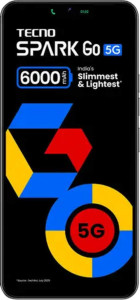
Tecno Spark Go 5G ZTE Blade A76

Overview

Welcome to our detailed spec comparison between the Tecno Spark Go 5G and the ZTE Blade A76. Both devices share a solid foundation — 5G connectivity, a 50 MP main camera, 128GB storage, and Android 15 — but they diverge in meaningful ways across battery capacity, display refresh rate, RAM, and camera versatility. Read on to discover which phone best matches your priorities.

Common Features

  • Both phones are water resistant.
  • Neither phone has a rugged build.
  • Neither phone can be folded.
  • Both phones feature an LCD IPS display type.
  • Neither phone has branded damage-resistant glass.
  • HDR10 support is not available on either phone.
  • HDR10+ support is not available on either phone.
  • Always-On Display is not available on either phone.
  • Dolby Vision support is not available on either phone.
  • Both phones have a touch screen.
  • Both phones come with 128GB of internal storage.
  • Both phones have integrated LTE.
  • Both phones support 64-bit processing.
  • Both phones use DirectX 12.
  • Both phones use big.LITTLE technology.
  • Both phones have a 50 MP main camera.
  • Neither phone has built-in optical image stabilization.
  • Both phones have a CMOS sensor.
  • Both phones support continuous autofocus when recording movies.
  • Both phones have phase-detection autofocus for photos.
  • Both phones support slow-motion video recording.
  • Both phones run Android 15.
  • Both phones have clipboard warnings.
  • Both phones have location privacy options.
  • Both phones have camera and microphone privacy options.
  • Mail Privacy Protection is not available on either phone.
  • Both phones support theme customization.
  • Both phones can block app tracking.
  • Cross-site tracking blocking is not available on either phone.
  • Neither phone has wireless charging.
  • Neither phone has a removable battery.
  • Both phones have a battery level indicator.
  • Both phones have a rechargeable battery.
  • Both phones have a 3.5mm audio jack.
  • Neither phone has stereo speakers.
  • Neither phone supports aptX, LDAC, aptX HD, aptX Adaptive, aptX Lossless.
  • Both phones support 5G.
  • Both phones support Wi-Fi 4 (802.11n) and Wi-Fi 5 (802.11ac).
  • Both phones have dual SIM card slots.
  • Both phones have a USB Type-C port.
  • Both phones have a fingerprint scanner.
  • Emergency SOS via satellite is not available on either phone.
  • Crash detection is not available on either phone.
  • Both phones have a video light.
  • Neither phone has a sapphire glass display.
  • Neither phone has a curved display.
  • Neither phone has an e-paper display.

Main Differences

  • Weight is 194 g on Tecno Spark Go 5G and 203 g on ZTE Blade A76.
  • Thickness is 8 mm on Tecno Spark Go 5G and 8.2 mm on ZTE Blade A76.
  • Width is 77.7 mm on Tecno Spark Go 5G and 74.8 mm on ZTE Blade A76.
  • Height is 167.7 mm on Tecno Spark Go 5G and 163.3 mm on ZTE Blade A76.
  • Volume is 104.24 cm³ on Tecno Spark Go 5G and 100.16 cm³ on ZTE Blade A76.
  • IP rating is IP64 on Tecno Spark Go 5G and IP54 on ZTE Blade A76.
  • Screen size is 6.74″ on Tecno Spark Go 5G and 6.75″ on ZTE Blade A76.
  • Pixel density is 260 ppi on Tecno Spark Go 5G and 262 ppi on ZTE Blade A76.
  • Resolution is 720 x 1600 px on Tecno Spark Go 5G and 720 x 1612 px on ZTE Blade A76.
  • Refresh rate is 120Hz on Tecno Spark Go 5G and 90Hz on ZTE Blade A76.
  • RAM is 4GB on Tecno Spark Go 5G and 6GB on ZTE Blade A76.
  • Chipset is MediaTek Dimensity 6400 on Tecno Spark Go 5G and Unisoc Tanggula T760 on ZTE Blade A76.
  • GPU is Arm Mali-G57 MC2 on Tecno Spark Go 5G and Mali-G57 on ZTE Blade A76.
  • CPU speed is 2 x 2.5 & 6 x 2 GHz on Tecno Spark Go 5G and 4 x 2.2 & 4 x 1.8 GHz on ZTE Blade A76.
  • Semiconductor size is 6 nm on Tecno Spark Go 5G and 7 nm on ZTE Blade A76.
  • A multi-lens main camera is present on ZTE Blade A76 but not on Tecno Spark Go 5G.
  • Front camera resolution is 5MP on Tecno Spark Go 5G and 8MP on ZTE Blade A76.
  • Main camera video recording is 1440 x 30 fps on Tecno Spark Go 5G and 2160 x 30 fps on ZTE Blade A76.
  • Number of flash LEDs is 2 on Tecno Spark Go 5G and 1 on ZTE Blade A76.
  • Battery capacity is 6000 mAh on Tecno Spark Go 5G and 5000 mAh on ZTE Blade A76.
  • Fast charging is supported on Tecno Spark Go 5G but not available on ZTE Blade A76.
  • Bluetooth version is 5.3 on Tecno Spark Go 5G and 5.4 on ZTE Blade A76.
  • An external memory slot is available on Tecno Spark Go 5G but not on ZTE Blade A76.
  • NFC is present on ZTE Blade A76 but not available on Tecno Spark Go 5G.
Specs Comparison
Tecno Spark Go 5G

Tecno Spark Go 5G

ZTE Blade A76

ZTE Blade A76

Design:
water resistance Water resistant Water resistant
weight 194 g 203 g
thickness 8 mm 8.2 mm
width 77.7 mm 74.8 mm
height 167.7 mm 163.3 mm
volume 104.24232 cm³ 100.161688 cm³
Ingress Protection (IP) rating IP64 IP54
has a rugged build
can be folded

Both the Tecno Spark Go 5G and the ZTE Blade A76 share a broadly similar design philosophy — slim, non-folding slabs with water resistance — but a few key numbers set them apart. The Spark Go is the physically larger device (167.7 × 77.7 mm vs. 163.3 × 74.8 mm), yet it is actually lighter at 194 g compared to the Blade A76's 203 g. In practice, this means the Spark Go offers a roomier footprint — likely benefiting screen real estate — while still feeling less heavy in the hand, a combination that tends to improve one-handed comfort over extended use.

The most meaningful differentiator in this group is the IP rating. The Spark Go carries an IP64 certification, while the Blade A76 is rated at IP54. Both share the same second digit (4), meaning equivalent protection against water splashes from any direction. The critical gap is the first digit: a 6 on the Spark Go denotes complete dust-tight sealing, whereas the Blade A76's 5 only guarantees partial dust ingress protection. For users in dusty, sandy, or outdoor environments, this is a tangible real-world advantage — fine particles that could eventually compromise the Blade A76's internals are fully blocked on the Spark Go.

Overall, the Tecno Spark Go 5G holds a clear edge in this design group. It is lighter despite being larger, and its superior IP64 dust resistance meaningfully extends durability beyond what the Blade A76's IP54 rating offers. The Blade A76 is marginally thinner (8.2 mm vs. 8 mm — negligible in feel), but that single spec does not offset the Spark Go's advantages in weight and environmental protection.

Display:
Display type LCD, IPS LCD, IPS
screen size 6.74" 6.75"
pixel density 260 ppi 262 ppi
resolution 720 x 1600 px 720 x 1612 px
refresh rate 120Hz 90Hz
has branded damage-resistant glass
supports HDR10
supports HDR10+
Always-On Display
supports Dolby Vision
Has a secondary screen
has a touch screen

At a glance, these two displays are remarkably close — both are LCD IPS panels, both hover around 6.74–6.75″ in size, and both render at 720p resolution with a pixel density of roughly 260–262 ppi. That density sits comfortably in the ″sharp enough for everyday use″ range for a budget screen of this size, meaning text and images will look acceptably crisp, though not as refined as a 1080p panel. Neither device offers HDR support, damage-resistant glass, or an Always-On Display, so those omissions cancel out entirely.

The one spec that genuinely separates them is the refresh rate. The Spark Go runs at 120Hz, while the Blade A76 tops out at 90Hz. In real-world use, a higher refresh rate translates directly to smoother scrolling through feeds and timelines, more fluid UI animations, and a generally more responsive feel — even without touching a single app. The gap between 90Hz and 120Hz is perceptible, especially to users who have experienced high-refresh screens before, making the Spark Go's display feel noticeably snappier in daily interactions.

Given how closely matched every other display attribute is, the Tecno Spark Go 5G takes a clear edge in this category on the strength of its 120Hz panel alone. The Blade A76's 90Hz refresh rate is decent for a budget device, but when the screen size, resolution, and panel type are essentially identical, the smoother motion cadence of the Spark Go is the deciding factor.
Performance:
internal storage 128GB 128GB
RAM 4GB 6GB
Chipset (SoC) name MediaTek Dimensity 6400 Unisoc Tanggula T760
GPU name Arm Mali-G57 MC2 Mali-G57
CPU speed 2 x 2.5 & 6 x 2 GHz 4 x 2.2 & 4 x 1.8 GHz
Has integrated LTE
RAM speed 2133 MHz 2133 MHz
semiconductor size 6 nm 7 nm
Supports 64-bit
DirectX version DirectX 12 DirectX 12
Has integrated graphics
Uses big.LITTLE technology
DDR memory version 4 4

The chipset matchup here is genuinely interesting, with each device holding a distinct advantage in different dimensions. The Spark Go's MediaTek Dimensity 6400 is built on a 6nm process, versus the 7nm node used by the Blade A76's Unisoc Tanggula T760. A smaller fabrication node typically yields better power efficiency and thermal management — meaning the Spark Go's chip can sustain performance longer under load while drawing less battery. The Spark Go also has a higher peak CPU clock at 2.5 GHz, compared to the Blade A76's 2.2 GHz top speed, which can translate to snappier single-core tasks like app launches and UI responsiveness.

Where the Blade A76 fights back is memory. Its 6GB of RAM versus the Spark Go's 4GB is a meaningful gap in day-to-day usability. More RAM allows the system to keep a greater number of apps resident in the background, reducing the frequency of cold reloads when switching between them — a difference that becomes especially noticeable for users who juggle social media, messaging, and streaming simultaneously. Both devices match on internal storage (128GB), RAM speed, DDR version, and GPU architecture family, so those specs offer no differentiation.

Declaring a single winner here requires weighing priorities. For raw processing efficiency and peak speed, the Tecno Spark Go 5G has the edge thanks to its more modern 6nm chip. But for fluid multitasking and keeping more apps alive in the background, the ZTE Blade A76's 6GB RAM advantage is a practical, everyday benefit. Users who prioritize smooth task-switching may lean toward the Blade A76, while those who value sustained performance and battery efficiency will find the Spark Go's silicon more compelling.

Cameras:
megapixels (main camera) 50 MP 50 MP
Has a dual-lens (or multi-lens) main camera
megapixels (front camera) 5MP 8MP
has built-in optical image stabilization
video recording (main camera) 1440 x 30 fps 2160 x 30 fps
Has a dual-tone LED flash
number of flash LEDs 2 1
has a BSI sensor
has a CMOS sensor
has continuous autofocus when recording movies
Has phase-detection autofocus for photos
supports slow-motion video recording
has a built-in HDR mode
has manual exposure
has a flash
optical zoom 0x 0x
has manual ISO
has a serial shot mode
has manual focus
has a front camera
Has laser autofocus
Shoots 360° panorama
has manual white balance
shoots raw
has touch autofocus
has manual shutter speed
can create panoramas in-camera
Has a front-facing LED flash
has a dual-lens (or multi-lens) front camera
supports HDR10 recording
supports Dolby Vision recording
has a front-facing camera under the display
Has a RGB LED flash
has 3D photo/video recording capabilities

Shared specs dominate much of this camera comparison — both phones pack a 50MP main sensor with phase-detection autofocus, continuous autofocus during video, HDR mode, slow-motion, and a comparable manual controls suite. But dig into the differences and the ZTE Blade A76 builds a meaningful lead on three fronts. Its rear system is a multi-lens setup versus the Spark Go's single camera, which opens up additional shooting versatility — typically a dedicated depth or macro lens at this price tier. Its front camera resolves at 8MP compared to the Spark Go's 5MP, a gap that matters for selfie detail and video calls. Most significantly, the Blade A76 records main camera video at 4K (2160p) 30fps, while the Spark Go caps out at 2560 × 1440p — a full resolution tier lower.

The Spark Go does reclaim one small point: it has two flash LEDs to the Blade A76's single LED, which can improve flash illumination consistency and coverage in low-light shots. However, this is a relatively minor hardware advantage that doesn't offset the Blade A76's gains elsewhere in the camera system.

Taken together, the ZTE Blade A76 holds a clear edge in this category. The combination of a higher-resolution front camera, a multi-lens rear system, and 4K video recording gives it a tangible advantage over the Spark Go for users who prioritize photographic versatility and video quality. The Spark Go's camera is entirely functional for everyday shooting, but it trails the Blade A76 on the specs that matter most to camera-focused buyers.

Operating system:
Android version Android 15 Android 15
has clipboard warnings
has location privacy options
has camera/microphone privacy options
has Mail Privacy Protection
has theme customization
can block app tracking
blocks cross-site tracking
has on-device machine learning
has notification permissions
has media picker
Can play games while they download
has dark mode
has Wi-Fi password sharing
has battery health check
has an extra dim mode
has focus modes
has dynamic theming
can offload apps
Has customizable notifications
has Live Text
has full-page screenshots
supports split screen
gets direct OS updates
has PiP
Can be used as a PC
Has sharing intents
has a child lock
Supports widgets
Is free and open source
Has offline voice recognition
has voice commands
Tracks the current position of a mobile device
is a multi-user system
has Quick Start

This is a rare category where the data tells a definitive story: the Tecno Spark Go 5G and the ZTE Blade A76 are in a complete dead heat. Both ship with Android 15, and every single feature in this spec group — from privacy controls (camera/microphone permissions, app tracking blockers, location options) to productivity tools (split screen, Picture-in-Picture, widgets, offline voice recognition) — is identical across the two devices.

Notably, both support on-device machine learning, dynamic theming, Live Text, and a battery health check — features that were once considered mid-range or premium perks but are now part of the standard Android 15 toolkit. Neither device receives direct OS updates from the Android source, meaning both will depend on their respective manufacturers for future software support, which is a shared limitation worth keeping in mind for long-term ownership.

There is simply no differentiator to call here — this group is an exact tie. Any decision between these two phones should rest entirely on the advantages identified in other specification categories, as the operating system experience they deliver is, based on the available data, completely equivalent.

Battery:
battery power 6000 mAh 5000 mAh
has wireless charging
Supports fast charging
has a removable battery
has a battery level indicator
has a rechargeable battery

Battery is one of the clearest wins of this entire comparison. The Tecno Spark Go 5G carries a 6000 mAh cell — a genuinely large capacity that places it in the upper tier of budget smartphones — while the ZTE Blade A76 makes do with a 5000 mAh pack. That 1000 mAh gap, roughly a 20% difference in raw capacity, translates to meaningfully more screen-on time between charges. For heavy users or those who can't always reach a charger mid-day, this is a practical, felt advantage rather than a marginal one.

The Spark Go compounds that lead with support for fast charging — a feature the Blade A76 entirely lacks. Not only does the Spark Go hold more charge, it also replenishes that larger battery more quickly. The Blade A76, by contrast, will rely solely on standard charging speeds, meaning longer waits to get back to full even though it's starting from a smaller capacity. In the real world, this combination — bigger battery plus faster refill — significantly reduces the friction of daily charging routines.

The Tecno Spark Go 5G wins this category decisively. It outpaces the Blade A76 on both dimensions that define battery usability: endurance and recovery time. For any buyer who ranks battery life among their top priorities, the Spark Go is the substantially stronger choice here.

Audio:
has a socket for a 3.5 mm audio jack
has stereo speakers
has aptX
has LDAC
has aptX HD
has aptX Adaptive
has aptX Lossless

Audio is another category where the data leaves no room for differentiation. Both the Tecno Spark Go 5G and the ZTE Blade A76 offer a 3.5mm headphone jack — a welcome inclusion at this price point that allows users to plug in wired headphones without an adapter — and both stop there. Neither device features stereo speakers, nor do they support any high-resolution Bluetooth audio codec such as aptX, LDAC, or their variants.

The absence of stereo speakers means both phones output mono audio, which limits the spatial quality of media playback when listening without headphones. The lack of advanced Bluetooth audio codecs is equally expected at this tier and means wireless listening is limited to standard SBC or AAC quality, which is adequate for casual use but won't satisfy audiophiles seeking lossless wireless audio.

This group is a complete tie — every audio spec is identical across both devices. The 3.5mm jack is the one genuinely user-friendly feature they share, and since neither gains any ground over the other, audio quality should play no role in choosing between these two phones.

Connectivity & Features:
release date August 2025 June 2025
has 5G support
Wi-Fi version Wi-Fi 4 (802.11n), Wi-Fi 5 (802.11ac) Wi-Fi 4 (802.11n), Wi-Fi 5 (802.11ac)
SIM cards 2 SIM 2 SIM
Bluetooth version 5.3 5.4
has an external memory slot
Has USB Type-C
has NFC
Has a fingerprint scanner
has emergency SOS via satellite
has crash detection
is DLNA-certified
supports ANT+
Has a heart rate monitor
has GPS
supports Wi-Fi
Has an infrared sensor
has an accelerometer
has a cellular module
Has a barometer
has an HDMI output
Uses 3D facial recognition
Has an iris scanner
Stylus included
supports Galileo
Has motion tracking
Has optical tracking
Has a built-in projector

Much of this category is shared ground — both phones offer 5G, dual SIM, USB Type-C, Wi-Fi 5, GPS with Galileo support, and a fingerprint scanner. The meaningful divergence comes down to three specific features. The ZTE Blade A76 includes NFC and a slightly newer Bluetooth 5.4, while the Tecno Spark Go 5G counters with a microSD card slot for expandable storage — a feature the Blade A76 entirely omits.

NFC is increasingly practical in daily life, enabling contactless payments, quick device pairing, and transit card emulation — capabilities that simply aren't available on the Spark Go. The Bluetooth version gap between 5.3 and 5.4 is marginal in real-world use and unlikely to be noticeable. The Spark Go's external memory slot, on the other hand, is a tangible storage flexibility advantage — users can expand capacity cheaply with a microSD card rather than being locked into the device's fixed internal storage, which matters especially for media-heavy users.

This group produces a genuine trade-off with no clean overall winner. The Blade A76 is the stronger pick for users who rely on NFC for mobile payments or smart device interactions. The Spark Go is the better choice for anyone who values the freedom to expand storage affordably. Which advantage is more meaningful depends entirely on the buyer's usage habits — NFC utility is growing but not universal, while storage expandability offers broad, lasting value.

Miscellaneous:
has a video light
Has sapphire glass display
Has a curved display
Has an e-paper display

The miscellaneous category wraps up this comparison with a clean sweep of identical specs. Both the Tecno Spark Go 5G and the ZTE Blade A76 have a video light, and neither features a sapphire glass display, curved screen, or e-paper panel — all of which are characteristics found only in significantly more expensive or niche device categories anyway.

This is a tie with nothing to separate the two devices. The shared video light is a minor but practical inclusion, useful for recording video in dim conditions, and its presence on both phones means neither gains an advantage here either.

Comparison Summary & Verdict

After a thorough spec-by-spec breakdown, both phones emerge as capable budget 5G devices, but each targets a slightly different user. The Tecno Spark Go 5G stands out with its larger 6000 mAh battery, support for fast charging, a smoother 120Hz display, and a more advanced IP64 water resistance rating, making it the stronger pick for users who demand all-day endurance and a fluid experience. The ZTE Blade A76, on the other hand, counters with 6GB of RAM, a higher-resolution front camera, 4K video recording, a multi-lens rear camera, and NFC support, appealing to users who prioritize multitasking, richer photography options, and contactless payments. Neither phone is an outright winner — your ideal choice comes down to whether battery life and smoothness or camera capability and NFC matter more to you.

Tecno Spark Go 5G
Buy Tecno Spark Go 5G if...

Buy the Tecno Spark Go 5G if you prioritize a larger battery with fast charging, a smoother 120Hz display, better dust and water resistance, and expandable storage.

ZTE Blade A76
Buy ZTE Blade A76 if...

Buy the ZTE Blade A76 if you value more RAM for multitasking, a versatile multi-lens camera with 4K video, a higher-resolution selfie camera, and NFC for contactless payments.