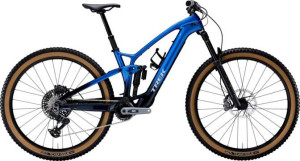
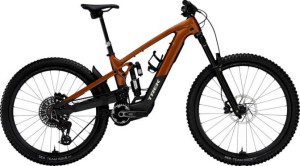
Both the Trek FUEL EXe 9.8 GX AXS T-Type and the Trek Slash Plus 9.9 X0 AXS T-Type share a fundamentally similar design DNA: full-suspension carbon fiber frames with internal cable routing and an integrated in-frame battery. These shared traits signal that both bikes are built to a high engineering standard — carbon keeps the chassis stiff yet light, internal routing protects cables from trail debris and improves aerodynamics, and the in-frame battery placement centralizes mass for better handling balance.
The most meaningful differentiator in this group is weight. The FUEL EXe tips the scale at 18,980 g, while the Slash Plus comes in at 20,880 g — a difference of 1,900 g (roughly 1.9 kg). In the real world, that gap is noticeable: a lighter bike accelerates more responsively, is easier to manual or lift over obstacles, and demands less effort on long climbs. For an e-MTB context, that weight saving also means slightly less rotational and inertial mass, which can translate to more agile, flickable handling on technical terrain.
Based strictly on the Design specs provided, the FUEL EXe holds a clear weight advantage. All other structural design attributes — frame material, suspension configuration, battery integration, cable routing — are identical between the two. Riders who prioritize nimbleness and reduced physical effort will find the FUEL EXe the more compelling package from a pure design standpoint, while the heavier Slash Plus likely carries that extra mass as a trade-off for geometry or components tuned toward more aggressive, enduro-oriented riding.