Trek Rail Plus 8 Gen 5
Trek Rail Plus 9.7 Gen 5

Trek Rail Plus 8 Gen 5 Trek Rail Plus 9.7 Gen 5

Overview

Welcome to our in-depth spec comparison between the Trek Rail Plus 8 Gen 5 and the Trek Rail Plus 9.7 Gen 5. Both are full-suspension e-mountain bikes sharing the same powerful 800 Wh battery and 250W motor, yet they diverge in meaningful ways. From frame material and weight to top speed and charging time, the differences between these two models could significantly shape your riding experience. Read on to find out which one fits your needs best.

Common Features

  • Both bikes feature front suspension.
  • Both bikes feature rear suspension.
  • Both bikes have an in-frame battery.
  • Neither bike can be folded.
  • Both bikes have internal cable routing.
  • Neither bike is designed for kids.
  • Both bikes share the same battery size of 800 Wh.
  • Regenerative braking is not available on either bike.
  • Both bikes have a removable battery.
  • Both bikes use hydraulic disc brakes.
  • Both bikes deliver a maximum torque of 85 Nm.
  • Turbo mode is available on both bikes.
  • Eco mode is available on both bikes.
  • Both bikes have a motor power of 250W.
  • Both bikes are multi-gear bikes with 12 gears.
  • Both bikes have a dedicated smartphone app.
  • Both bikes have front lights.

Main Differences

  • The frame material is aluminum on the Trek Rail Plus 8 Gen 5 and carbon fiber on the Trek Rail Plus 9.7 Gen 5.
  • The weight is 25080 g on the Trek Rail Plus 8 Gen 5 and 23730 g on the Trek Rail Plus 9.7 Gen 5.
  • The charge time is 7 hours on the Trek Rail Plus 8 Gen 5 and 5 hours on the Trek Rail Plus 9.7 Gen 5.
  • The top speed is 23 km/h on the Trek Rail Plus 8 Gen 5 and 32 km/h on the Trek Rail Plus 9.7 Gen 5.
  • A display is present on the Trek Rail Plus 8 Gen 5 but not available on the Trek Rail Plus 9.7 Gen 5.
  • Rear lights are present on the Trek Rail Plus 8 Gen 5 but not available on the Trek Rail Plus 9.7 Gen 5.
Specs Comparison
Trek Rail Plus 8 Gen 5

Trek Rail Plus 8 Gen 5

Trek Rail Plus 9.7 Gen 5

Trek Rail Plus 9.7 Gen 5

Design:
frame material Aluminum Carbon fiber
weight 25080 g 23730 g
has front suspension
has rear suspension
has an in-frame battery
can be folded
has internal cable routing
is designed for kids

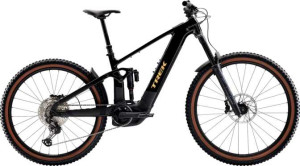
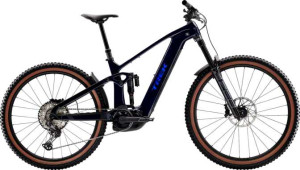
The most consequential design difference between these two bikes lies in their frame materials. The Rail Plus 8 uses an aluminum frame, while the Rail Plus 9.7 steps up to a carbon fiber frame. This distinction matters beyond prestige: carbon fiber allows engineers to tune stiffness and compliance in ways aluminum cannot, resulting in a ride that can feel more planted on technical terrain while absorbing trail chatter more effectively. Aluminum, by contrast, is durable and proven, but inherently denser and less forgiving in its vibration characteristics.

That material choice translates directly into a meaningful weight gap. The Rail Plus 8 weighs 25,080 g versus the Rail Plus 9.7 at 23,730 g — a difference of roughly 1.35 kg. On a full-suspension e-MTB where total mass already runs high, shedding that much weight improves handling agility, makes portability (loading into a vehicle, maneuvering tight switchbacks) noticeably easier, and can marginally extend range by reducing the load the motor must manage.

Both bikes share the same core design DNA: full front and rear suspension, an in-frame battery for a clean and protected build, internal cable routing for a tidy aesthetic and reduced maintenance exposure, and a full-size adult geometry. Neither is foldable, which is expected for this category. In this group, the Rail Plus 9.7 holds a clear advantage — its carbon fiber construction delivers a lighter, more refined chassis, and that difference has tangible real-world consequences for riders who push their bike hard on demanding trails.
Battery:
battery size 800 Wh 800 Wh
charge time 7 hours 5 hours
Has regenerative braking
has a removable battery

Both bikes draw from the same 800 Wh battery pack, which is a generous capacity for a full-suspension e-MTB and positions them well for long days on the trail without needing a mid-ride top-up. Neither model offers regenerative braking, which is typical for mountain bikes where the terrain and riding style don't lend themselves to the kind of consistent deceleration that makes regeneration worthwhile. The removable battery on both is a practical advantage shared across the lineup — it allows charging away from the bike and simplifies long-term battery replacement.

Where the two diverge is charge time. The Rail Plus 8 requires 7 hours to reach a full charge, while the Rail Plus 9.7 cuts that down to 5 hours — a 2-hour reduction that points to a more capable onboard charger. In practical terms, this means the 9.7 can recover meaningfully more charge during a lunch break or an overnight stop, and riders on multi-day tours or back-to-back ride days will feel that difference more acutely than casual weekend users.

On raw range potential, these two bikes are identical. But the Rail Plus 9.7 has a clear edge in this group purely on the strength of its faster charging — same energy stored, less time waiting to use it.

Performance:
braking system Hydraulic disc brakes Hydraulic disc brakes
maximum torque 85 Nm 85 Nm
has a turbo mode
has an eco mode
motor power 250W 250W
is a multi-gear bike
number of gears 12 12
is a single-gear bike
drive motor type Mid-drive motor Mid-drive motor
top speed 23 km/h 32 km/h

At the heart of both bikes sits the same powertrain: a 250W mid-drive motor producing 85 Nm of torque, a 12-speed drivetrain, hydraulic disc brakes, and the full range of assist modes from Eco to Turbo. Mid-drive placement is the right architecture for trail riding — it keeps the center of gravity low and central, and leverages the bike's gears to keep the motor in its efficient operating range on steep climbs. With 85 Nm on tap, both bikes are well-equipped to handle punishing gradients without the motor feeling strained.

The one performance spec that separates them is top speed. The Rail Plus 8 is limited to 23 km/h of assisted speed, whereas the Rail Plus 9.7 extends that ceiling to 32 km/h. This is a significant gap in practice — 23 km/h is a common regulatory cap in certain markets, while 32 km/h aligns with a higher-speed assist category. Riders who spend time on faster flowing trails, fire roads, or mixed-use paths will feel the Rail Plus 9.7's assist remain active at speeds where the Rail Plus 8's motor has already cut out, requiring purely human power to go faster.

For pure climbing performance and technical trail work, the two bikes are effectively identical given their shared motor specs. But on terrain where sustained higher speeds matter, the Rail Plus 9.7 holds a meaningful advantage — its extended assist range keeps the motor working for you longer, which is a tangible benefit over the course of a varied ride.

Features:
release date May 2025 April 2025
Has a display
Has a dedicated smartphone app
has front light(s)
has rear light(s)

Despite being the higher-spec model, the Rail Plus 9.7 actually comes with fewer onboard features than the Rail Plus 8 in this category. The Rail Plus 8 includes an integrated display, giving riders at-a-glance access to speed, assist level, and battery status without reaching for a phone. The Rail Plus 9.7 omits a display entirely, pushing riders toward the companion smartphone app for that information — a design philosophy some riders appreciate for its cleaner cockpit, though it introduces dependency on a mounted device or memorized button-press feedback.

The lighting situation is also worth noting. Both bikes include a front light, but only the Rail Plus 8 adds a rear light as well. For riders who venture out in low-light conditions or use their bike on shared paths, a rear light is a meaningful safety feature — its absence on the 9.7 means budgeting for an aftermarket addition if riding in those conditions is anticipated.

Both bikes share smartphone app connectivity, which covers route tracking, assist customization, and diagnostics. That parity aside, the Rail Plus 8 holds a clear advantage in this group — it offers more complete out-of-the-box usability with its onboard display and full lighting setup, while the 9.7 requires the rider to compensate for what's missing.

Comparison Summary & Verdict

After examining all the specifications, the Trek Rail Plus 8 Gen 5 and Trek Rail Plus 9.7 Gen 5 share a strong common foundation, including an 800 Wh removable battery, 85 Nm of torque, and a full-suspension platform. However, their differences reveal two distinct riding profiles. The Trek Rail Plus 8 Gen 5 stands out with its built-in display and rear lights, making it a more self-contained and commuter-friendly package, while accepting a slightly heavier aluminum frame and longer 7-hour charge time. The Trek Rail Plus 9.7 Gen 5, on the other hand, offers a lighter carbon fiber frame, a significantly higher top speed of 32 km/h, and faster 5-hour charging, catering to performance-focused riders willing to forgo the onboard display and rear lighting. Choose the 8 Gen 5 for practicality and completeness; choose the 9.7 Gen 5 for speed and a weight advantage on the trail.

Trek Rail Plus 8 Gen 5
Buy Trek Rail Plus 8 Gen 5 if...

Buy the Trek Rail Plus 8 Gen 5 if you want a fully equipped e-MTB with an onboard display and rear lights out of the box, and are comfortable with an aluminum frame and longer charge time.

Trek Rail Plus 9.7 Gen 5
Buy Trek Rail Plus 9.7 Gen 5 if...

Buy the Trek Rail Plus 9.7 Gen 5 if you prioritize a lighter carbon fiber frame, a higher top speed of 32 km/h, and faster 5-hour charging for performance-oriented trail riding.