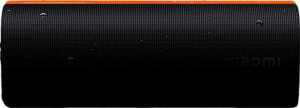
The most striking design difference between these two speakers is sheer physical scale. The Tribit StormBox Lava is a substantially larger unit — 309.88 × 151.89 × 146.81 mm with a volume of roughly 6910 cm³ and a weight of 2780 g — making it closer to a home party speaker than a grab-and-go companion. The Xiaomi Sound Party, by contrast, measures 255 × 92 × 92 mm, displaces only about 2158 cm³, and tips the scale at just 1200 g. That is less than half the weight, which translates directly into portability: the Xiaomi can be tucked into a backpack or carried one-handed without fatigue, while the Lava demands a dedicated carry.
On water resistance, both speakers are rated waterproof, but the Xiaomi holds a technical edge with an IP68 rating versus the Lava's IP67. In practice, IP67 already covers submersion up to 1 meter for 30 minutes, which handles rain, splashes, and poolside use comfortably. IP68 extends that protection to deeper or longer submersion — a meaningful advantage only in more extreme aquatic scenarios. The Xiaomi also includes a detachable cable, which adds a degree of future-proofing and convenience the Lava lacks. On the other hand, the Lava incorporates a neodymium magnet — a hardware feature the Xiaomi omits — which can contribute to more efficient driver performance relative to the speaker's size.
Overall in the Design category, the two products serve clearly different use cases. The Xiaomi Sound Party has the edge in portability, water protection level, and cable flexibility, making it the stronger choice for users prioritizing mobility and durability on the move. The StormBox Lava's larger footprint is a trade-off that likely supports greater acoustic volume and presence, but purely from a design and form-factor standpoint, the Xiaomi is the more versatile and travel-friendly option.