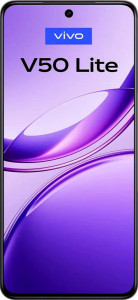
Vivo V50 Lite 4G
Vivo Y400 4G

Vivo V50 Lite 4G Vivo Y400 4G

Overview

Welcome to our in-depth comparison between the Vivo V50 Lite 4G and the Vivo Y400 4G, two mid-range smartphones that share the same processor and storage configuration yet take noticeably different paths in areas like battery capacity and charging speed, water resistance, and camera setup. Whether you are chasing the longest possible battery life or a more compact display with superior water protection, this side-by-side breakdown will help you weigh each phone on what matters most to you.

Common Features

  • Neither phone has a rugged build.
  • Neither phone can be folded.
  • Both phones have an OLED/AMOLED display.
  • Both phones have a 120Hz refresh rate.
  • Neither phone has branded damage-resistant glass.
  • HDR10+ support is not available on either phone.
  • Always-On Display is available on both phones.
  • Dolby Vision support is not available on either phone.
  • Neither phone has a secondary screen.
  • Both phones have a touch screen.
  • Both phones come with 256GB of internal storage and 8GB of RAM.
  • Both phones are powered by the Qualcomm Snapdragon 685 4G chipset with an Adreno 610 GPU.
  • Both phones have a CPU speed of 4 x 2.8 and 4 x 1.9 GHz.
  • Both phones scored 1510 on Geekbench 6 multi-core and 473 on single-core.
  • Both phones have a dual-lens main camera with 50 and 2 MP.
  • Neither phone has built-in optical image stabilization.
  • Both phones record main camera video at 1080 x 30 fps.
  • Both phones run Android 15.
  • Both phones support fast charging but do not have wireless charging.
  • Neither phone has a removable battery.
  • Both phones have stereo speakers but no 3.5mm audio jack.
  • Neither phone supports 5G.
  • Both phones support Wi-Fi 4 and Wi-Fi 5, Bluetooth 5, NFC, and USB Type-C 2.0.
  • Both phones support dual SIM and have a download speed of 390 MBits/s.

Main Differences

  • Water resistance is rated IP65 on Vivo V50 Lite 4G, while Vivo Y400 4G is rated IP68.
  • The Vivo V50 Lite 4G is water resistant, whereas the Vivo Y400 4G is fully waterproof.
  • Weight is 196g on Vivo V50 Lite 4G and 198g on Vivo Y400 4G.
  • Thickness is 7.8mm on Vivo V50 Lite 4G and 7.9mm on Vivo Y400 4G.
  • Width is 76.3mm on Vivo V50 Lite 4G and 75.3mm on Vivo Y400 4G.
  • Height is 163.8mm on Vivo V50 Lite 4G and 162.3mm on Vivo Y400 4G.
  • Screen size is 6.77″ on Vivo V50 Lite 4G and 6.67″ on Vivo Y400 4G.
  • Pixel density is 388 ppi on Vivo V50 Lite 4G and 395 ppi on Vivo Y400 4G.
  • Resolution is 1080 x 2392 px on Vivo V50 Lite 4G and 1080 x 2400 px on Vivo Y400 4G.
  • Typical brightness is 1300 nits on Vivo V50 Lite 4G and 1200 nits on Vivo Y400 4G.
  • HDR10 support is present on Vivo Y400 4G but not available on Vivo V50 Lite 4G.
  • Front camera resolution is 32MP on Vivo V50 Lite 4G and 8MP on Vivo Y400 4G.
  • Front camera aperture is f/2.5 on Vivo V50 Lite 4G and f/2.1 on Vivo Y400 4G.
  • A CMOS sensor is present on Vivo Y400 4G but not on Vivo V50 Lite 4G.
  • Battery capacity is 6500 mAh on Vivo V50 Lite 4G and 6000 mAh on Vivo Y400 4G.
  • Charging speed is 90W on Vivo V50 Lite 4G and 44W on Vivo Y400 4G.
  • A curved display is featured on Vivo Y400 4G but not on Vivo V50 Lite 4G.
Specs Comparison
Vivo V50 Lite 4G

Vivo V50 Lite 4G

Vivo Y400 4G

Vivo Y400 4G

Design:
water resistance Water resistant Waterproof
weight 196 g 198 g
thickness 7.8 mm 7.9 mm
width 76.3 mm 75.3 mm
height 163.8 mm 162.3 mm
volume 97.483932 cm³ 96.547401 cm³
Ingress Protection (IP) rating IP65 IP68
has a rugged build
can be folded

The most meaningful design difference between these two phones lies in their water protection ratings. The Vivo Y400 4G carries an IP68 certification, meaning it can withstand submersion in water beyond a brief splash, while the Vivo V50 Lite 4G is rated IP65, which covers protection against water jets but not immersion. In practical terms, IP68 gives the Y400 4G a clear real-world advantage — accidental drops in a pool, sink, or puddle are far less of a concern, whereas the V50 Lite 4G is better suited for rain or minor splashes only.

In terms of physical form, the two phones are nearly identical. The weight difference is negligible at 196 g vs 198 g, and the dimensional gap — a fraction of a millimeter in thickness and a couple of millimeters in height and width — is imperceptible in daily handling. Neither device has a rugged build or foldable form factor, so both target the same mainstream, slim-slab audience.

Overall, the Y400 4G holds a clear edge in this group, and solely because of its superior IP68 rating. For users who prioritize durability and peace of mind around water, that single spec makes a meaningful difference. If water resistance is not a concern, the two phones are essentially tied on every other design dimension.

Display:
Display type OLED/AMOLED OLED/AMOLED
screen size 6.77" 6.67"
pixel density 388 ppi 395 ppi
resolution 1080 x 2392 px 1080 x 2400 px
refresh rate 120Hz 120Hz
brightness (typical) 1300 nits 1200 nits
has branded damage-resistant glass
supports HDR10
supports HDR10+
Always-On Display
supports Dolby Vision
Has a secondary screen
has a touch screen

Both phones share the same OLED/AMOLED panel technology and a 120Hz refresh rate, so the fundamentals — deep blacks, vibrant colors, and smooth scrolling — are equally strong on either device. Where they diverge is in screen size and brightness: the V50 Lite 4G offers a slightly larger 6.77″ display at 1300 nits typical brightness, compared to the Y400 4G's 6.67″ panel at 1200 nits. That extra 100 nits translates to noticeably better legibility in direct sunlight — a real, everyday advantage for outdoor use.

Pixel density tells a different story. Despite its smaller screen, the Y400 4G resolves at 395 ppi versus the V50 Lite 4G's 388 ppi, though both figures sit well above the threshold where individual pixels become invisible to the naked eye. In practice, neither phone will look sharper than the other to most users. The Y400 4G also supports HDR10, which means compatible streaming content — from Netflix or YouTube — can render with a wider dynamic range and more accurate colors, a meaningful perk for media consumption that the V50 Lite 4G simply lacks.

Weighing these trade-offs, there is no single dominant winner, but the edge shifts depending on use case. For outdoor visibility and a larger canvas, the V50 Lite 4G has the advantage. For HDR streaming and a marginally sharper pixel count, the Y400 4G pulls ahead. Users who primarily consume video content will likely favor the Y400 4G, while those who spend more time outdoors will appreciate the V50 Lite 4G's superior brightness.

Performance:
internal storage 256GB 256GB
RAM 8GB 8GB
Chipset (SoC) name Qualcomm Snapdragon 685 4G Qualcomm Snapdragon 685 4G
GPU name Adreno 610 Adreno 610
CPU speed 4 x 2.8 & 4 x 1.9 GHz 4 x 2.8 & 4 x 1.9 GHz
Geekbench 6 result (multi) 1510 1510
Geekbench 6 result (single) 473 473
Geekbench 5 result (multi) 1787 1787
Geekbench 5 result (single) 442 442
GPU clock speed 1260 MHz 1260 MHz
Has integrated LTE
RAM speed 2133 MHz 2133 MHz
semiconductor size 6 nm 6 nm
Supports 64-bit
DirectX version DirectX 12 DirectX 12
Has integrated graphics
OpenGL ES version 3.2 3.2
Uses big.LITTLE technology
CPU threads 8 threads 8 threads
Has NX bit
Has TrustZone
maximum memory bandwidth 17 GB/s 17 GB/s
OpenCL version 2 2
eMMC version 5.1 5.1
maximum memory amount 16GB 16GB
GPU turbo 1260 MHz 1260 MHz
DDR memory version 4 4

Performance is the one area where this comparison requires no deliberation: the Vivo V50 Lite 4G and Vivo Y400 4G are powered by the exact same hardware across every measurable dimension. Both run the Qualcomm Snapdragon 685 4G chip, built on a 6 nm process, paired with an Adreno 610 GPU, 8 GB of DDR4 RAM, and 256 GB of internal storage. The benchmark scores confirm this parity — identical Geekbench 6 results of 1510 multi-core and 473 single-core on both devices.

What this means in practice is that everyday tasks — app switching, social media, casual gaming — will feel exactly the same on either phone. The Snapdragon 685 is a capable mid-range chip, well-suited for smooth day-to-day use, though users expecting demanding 3D gaming or heavy multitasking should calibrate expectations accordingly. Neither device holds a raw performance edge over the other.

This group is an unambiguous tie. Choosing between these two phones on performance grounds is simply not possible — the silicon, memory, storage, and benchmark results are identical. Any purchase decision should be driven entirely by the differences found in other spec groups.

Cameras:
megapixels (main camera) 50 & 2 MP 50 & 2 MP
wide aperture (main camera) 2.4 & 1.8f 2.4 & 1.8f
Has a dual-lens (or multi-lens) main camera
megapixels (front camera) 32MP 8MP
has built-in optical image stabilization
video recording (main camera) 1080 x 30 fps 1080 x 30 fps
Has a dual-tone LED flash
number of flash LEDs 1 1
has a BSI sensor
has a CMOS sensor
has continuous autofocus when recording movies
Has phase-detection autofocus for photos
supports slow-motion video recording
has a built-in HDR mode
has manual exposure
has a flash
optical zoom 0x 0x
has manual ISO
has a serial shot mode
has manual focus
has a front camera
Has laser autofocus
Shoots 360° panorama
has manual white balance
shoots raw
has touch autofocus
has manual shutter speed
can create panoramas in-camera
wide aperture (front camera) 2.5f 2.1f
Has timelapse function
Has a front-facing LED flash
has a dual-lens (or multi-lens) front camera
supports HDR10 recording
supports Dolby Vision recording
has a front-facing camera under the display
Has a RGB LED flash
has 3D photo/video recording capabilities

On the rear camera system, these two phones are carbon copies of each other — a 50 MP primary lens paired with a 2 MP secondary, identical apertures, no optical image stabilization, and video capped at 1080p 30fps on both. The feature set is equally matched: phase-detection autofocus, continuous autofocus during recording, slow-motion, HDR mode, and a solid suite of manual controls are all present on either device. For everyday rear-camera photography and video, users should expect indistinguishable results.

The selfie camera is where a significant gap opens up. The V50 Lite 4G sports a 32 MP front shooter, compared to just 8 MP on the Y400 4G — a fourfold resolution advantage that translates directly into sharper, more detailed selfies and cleaner crops. The Y400 4G partially compensates with a wider front aperture of f/2.1 versus f/2.5 on the V50 Lite 4G, meaning it admits more light and can perform better in dimly lit selfie scenarios. The Y400 4G also explicitly lists a CMOS sensor for its rear camera, though the real-world impact of that single spec difference is difficult to quantify without additional sensor data.

On balance, the V50 Lite 4G holds a clear edge in this group, driven almost entirely by its superior 32 MP front camera. For users who frequently take selfies or make video calls and prioritize resolution, the choice here is straightforward. Those who shoot in low light more often might find the Y400 4G's wider front aperture a partial trade-off worth considering, but the raw megapixel gap is hard to overcome.

Operating system:
Android version Android 15 Android 15
has clipboard warnings
has location privacy options
has camera/microphone privacy options
has Mail Privacy Protection
has theme customization
can block app tracking
blocks cross-site tracking
has on-device machine learning
has notification permissions
has media picker
Can play games while they download
has dark mode
has Wi-Fi password sharing
has battery health check
has an extra dim mode
has focus modes
has dynamic theming
can offload apps
Has customizable notifications
has Live Text
has full-page screenshots
supports split screen
gets direct OS updates
has PiP
Can be used as a PC
Has sharing intents
has a child lock
Supports widgets
Is free and open source
Has offline voice recognition
has voice commands
Tracks the current position of a mobile device
is a multi-user system
has Quick Start

A full spec-by-spec review of the operating system data reveals something straightforward: the Vivo V50 Lite 4G and Vivo Y400 4G run identical software configurations across every single listed attribute. Both ship with Android 15 and share the same feature set — from privacy controls like location and camera/microphone permissions, to usability staples like split screen, picture-in-picture, dark mode, and dynamic theming. Neither device receives direct OS updates, and neither supports features like Wi-Fi password sharing or focus modes.

This is a complete tie, with no differentiator to analyze. A user choosing between these two phones will have an identical software experience on either device — the same privacy toolset, the same productivity features, and the same limitations. Any decision should rest entirely on the hardware differences covered in other spec groups.

Battery:
battery power 6500 mAh 6000 mAh
has wireless charging
Supports fast charging
charging speed 90W 44W
has a removable battery
has a battery level indicator
has a rechargeable battery

Battery is one of the more consequential spec groups in this comparison, and it plays out as a genuine trade-off rather than a clean win for either side. The V50 Lite 4G houses a larger 6500 mAh cell versus the 6000 mAh in the Y400 4G — a 500 mAh difference that, on identical hardware and software, realistically translates to a meaningful buffer of extra screen-on time, particularly for heavy users who push their phone through a full day and into the evening.

Flip the equation to charging speed, however, and the Y400 4G's advantage evaporates quickly. The V50 Lite 4G supports 90W fast charging — a genuinely fast standard that can replenish a large battery in a short window — while the Y400 4G tops out at 44W, roughly half the wattage. In practical terms, the V50 Lite 4G not only starts with more capacity but also recharges significantly faster, compressing the time it spends tethered to a charger. Neither device supports wireless charging, so that distinction is moot.

The V50 Lite 4G holds a clear edge here on both dimensions that matter — a bigger battery and faster charging. For users who prioritize endurance and convenience around power, the V50 Lite 4G is the stronger choice in this category without meaningful compromise.

Audio:
has a socket for a 3.5 mm audio jack
has stereo speakers
Has a radio

Audio specs offer nothing to separate these two devices. Both the V50 Lite 4G and the Y400 4G feature stereo speakers — a genuine quality-of-life feature at this price tier, enabling wider, more immersive sound for media playback and calls compared to a single mono speaker. Both equally omit a 3.5 mm headphone jack, meaning wired audio requires a USB-C adapter on either device, and neither includes a built-in radio.

This group is a straightforward tie. Users who care about audio should factor in that both phones offer the same speaker configuration and the same connectivity constraints. The decision between these two remains, as with the OS comparison, entirely dependent on differences in other spec categories.

Connectivity & Features:
release date March 2025 August 2025
has 5G support
Wi-Fi version Wi-Fi 4 (802.11n), Wi-Fi 5 (802.11ac) Wi-Fi 4 (802.11n), Wi-Fi 5 (802.11ac)
SIM cards 2 SIM 2 SIM
Bluetooth version 5 5
Has USB Type-C
USB version 2 2
has NFC
download speed 390 MBits/s 390 MBits/s
upload speed 150 MBits/s 150 MBits/s
Has a fingerprint scanner
has emergency SOS via satellite
has crash detection
is DLNA-certified
has a gyroscope
supports ANT+
Has a heart rate monitor
has GPS
has a compass
supports Wi-Fi
Has an infrared sensor
has an accelerometer
has a cellular module
Has a barometer
has an HDMI output
Uses 3D facial recognition
Has an iris scanner
Stylus included
supports Galileo
Has motion tracking
Has optical tracking
Has a built-in projector

Connectivity is yet another category where these two phones converge entirely. Both the V50 Lite 4G and the Y400 4G support Wi-Fi 5, Bluetooth 5, NFC, and USB Type-C (USB 2.0), with identical cellular download and upload speeds of 390 Mbps and 150 Mbps respectively. NFC is worth highlighting as a genuine convenience feature at this tier — it enables contactless payments and quick device pairing on both phones equally.

The sensor and feature set is likewise a mirror image: dual SIM, fingerprint scanner, GPS with Galileo support, gyroscope, accelerometer, and compass are all present on both devices. Neither phone offers 5G, which is expected given the 4G positioning of both models, and neither includes an infrared sensor, barometer, or any advanced biometric options beyond the fingerprint reader.

This group is a complete tie with no differentiator to weigh. Every connectivity standard, sensor, and feature either exists on both devices or is absent from both. As with performance and software, users should look to the hardware-differentiated categories — display, cameras, battery, and design — to guide their final decision.

Miscellaneous:
has a video light
Has sapphire glass display
Has a curved display
Has an e-paper display

There is only one differentiator in this category worth discussing: the Vivo Y400 4G features a curved display, while the V50 Lite 4G has a flat screen. A curved panel wraps the edges of the glass slightly toward the frame, giving the device a more premium, seamless aesthetic and a softer feel when swiping from the edges. Whether this is a practical advantage or merely a stylistic one is largely a matter of personal preference — some users appreciate the look, while others find flat displays easier to use with screen protectors and less prone to accidental edge touches.

Everything else in this group is identical: both phones include a video light and neither carries a sapphire glass display or an e-paper panel — neither of those omissions is notable at this product tier. The result is a group with a single, subjective differentiator. The Y400 4G has a marginal edge for users who value a curved-screen aesthetic, but this is a preference-driven distinction rather than a functional one, and unlikely to be a deciding factor for most buyers.

Comparison Summary & Verdict

After examining every specification, it is clear that both phones are evenly matched at their core, sharing the same Qualcomm Snapdragon 685 4G chipset, 8GB of RAM, 256GB of storage, and identical camera hardware on the rear. Where they diverge is meaningful. The Vivo V50 Lite 4G stands out with its larger 6500 mAh battery and considerably faster 90W charging, a larger screen, higher typical brightness, and a high-resolution 32MP front camera, making it the stronger pick for power users and selfie enthusiasts. The Vivo Y400 4G counters with a superior IP68 waterproof rating, a curved OLED display, HDR10 support, and slightly higher pixel density, making it the better choice for users who prioritize durability and a premium screen experience in a marginally more pocketable form.

Vivo V50 Lite 4G
Buy Vivo V50 Lite 4G if...

Buy the Vivo V50 Lite 4G if you want a larger battery, significantly faster 90W charging, and a higher-resolution 32MP front camera for selfies.

Vivo Y400 4G
Buy Vivo Y400 4G if...

Buy the Vivo Y400 4G if you need stronger IP68 waterproofing, a curved display with HDR10 support, and a more compact design.