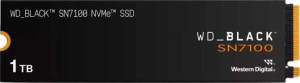
Western Digital WD Black SN7100 1TB
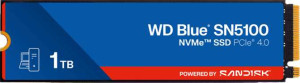
Western Digital WD Blue SN5100 1TB

Western Digital WD Black SN7100 1TB Western Digital WD Blue SN5100 1TB

Overview

When choosing between the Western Digital WD Black SN7100 1TB and the Western Digital WD Blue SN5100 1TB, buyers are faced with two high-performance M.2 NVMe SSDs that share a strong common foundation yet differ in meaningful ways. Both drives sit on the PCIe 4 platform and offer the same 1TB capacity and 600 TBW endurance rating, but key battlegrounds emerge around sequential and random write speeds, storage cell technology, and NVMe protocol version.

Common Features

  • Both drives have a random read speed of 1000000 IOPS.
  • Both drives use the M.2 form factor.
  • Both drives use HMB (Host Memory Buffer) as SSD cache.
  • Both drives are NVMe SSDs.
  • Both drives have 1000GB of internal storage.
  • Both drives use PCIe version 4.
  • Both drives have 4 controller channels.
  • Both drives have a Terabytes Written (TBW) rating of 600.
  • Both drives come with a 5-year warranty period.

Main Differences

  • Sequential read speed is 7250 MB/s on Western Digital WD Black SN7100 1TB and 7100 MB/s on Western Digital WD Blue SN5100 1TB.
  • Sequential write speed is 6900 MB/s on Western Digital WD Black SN7100 1TB and 6700 MB/s on Western Digital WD Blue SN5100 1TB.
  • Random write speed is 1400000 IOPS on Western Digital WD Black SN7100 1TB and 1300000 IOPS on Western Digital WD Blue SN5100 1TB.
  • NVMe version is 1.4 on Western Digital WD Black SN7100 1TB and 2 on Western Digital WD Blue SN5100 1TB.
  • The controller is the Polaris 3 A101-000172-A1 on Western Digital WD Black SN7100 1TB and the WD Polaris 3 A101-000103-A1 on Western Digital WD Blue SN5100 1TB.
  • SSD storage type is TLC on Western Digital WD Black SN7100 1TB and QLC on Western Digital WD Blue SN5100 1TB.
Specs Comparison
Western Digital WD Black SN7100 1TB

Western Digital WD Black SN7100 1TB

Western Digital WD Blue SN5100 1TB

Western Digital WD Blue SN5100 1TB

Read speed:
sequential read speed 7250 MB/s 7100 MB/s
random read speed 1000000 IOPS 1000000 IOPS

Both drives deliver flagship-class read performance, but there is a small gap at the sequential level. The WD Black SN7100 reaches 7250 MB/s sequential read, edging out the WD Blue SN5100 at 7100 MB/s. In practice, that 150 MB/s difference is unlikely to be perceptible in everyday workloads such as booting an OS or launching applications, but it can matter when continuously transferring very large files — think multi-gigabyte video projects or disk images.

Where the two drives are completely indistinguishable is random read performance: both are rated at 1,000,000 IOPS. Random I/O is what actually governs responsiveness for typical desktop and gaming use — loading game assets, opening files, or running a database. Matching at this ceiling means users should expect identical ″snappiness″ in day-to-day tasks regardless of which drive they choose.

Overall, the SN7100 holds a narrow sequential read edge, making it the marginally stronger pick for throughput-intensive workflows. For mainstream use, however, the identical random read rating means both drives perform on equal footing where it counts most.

Write speed:
sequential write speed 6900 MB/s 6700 MB/s
random write speed 1400000 IOPS 1300000 IOPS

Write performance is where the gap between these two drives becomes more pronounced. The SN7100 posts 6900 MB/s sequential write against the SN5100's 6700 MB/s — a 200 MB/s spread that, while still modest in isolation, is slightly wider than what was seen on the read side. For creators regularly writing large media files or performing full-drive backups, this advantage can translate to a few seconds saved per operation at scale.

The more meaningful differentiator here is random write IOPS. The SN7100 is rated at 1,400,000 IOPS versus the SN5100's 1,300,000 IOPS — a 100,000 IOPS advantage, roughly 7.7% higher. Random write speed governs how quickly a drive handles fragmented, small-block operations such as installing software, compiling code, or running virtual machines. That headroom gives the SN7100 a tangible edge in write-intensive professional workloads.

Taken together, the SN7100 leads on both write metrics, and the advantage is more consistent than on the read side. For users whose workflows lean heavily on sustained writes or high-concurrency storage tasks, the SN7100 is the clearer choice. Casual users will find the SN5100 still delivers very strong write throughput for its class.

General info:
type M2 M2
SSD cache HMB (Host Memory Buffer) HMB (Host Memory Buffer)
Is an NVMe SSD
NVMe version 1.4 2
internal storage 1000GB 1000GB
release date March 2025 August 2025
controller Polaris 3 A101-000172-A1 WD Polaris 3 A101-000103-A1
SSD storage type TLC QLC
PCI Express (PCIe) version 4 4
Controller channels 4 4
Terabytes Written (TBW) 600 600
warranty period 5 years 5 years
Has an integrated heatsink
bits of encryption supported 0 0
has RGB lighting

Underneath the shared M.2 PCIe 4.0 form factor, the most consequential difference is NAND flash type. The SN7100 uses TLC (Triple-Level Cell) storage, while the SN5100 uses QLC (Quad-Level Cell). TLC stores three bits per cell and QLC stores four, meaning QLC achieves higher density but at the cost of lower write endurance and typically reduced sustained write performance outside of cache bursts. For users who write to their drive heavily and frequently — video editors, developers, power users — TLC is the more resilient choice long-term.

Interestingly, both drives share an identical 600 TBW (Terabytes Written) rating and a 5-year warranty, which partially narrows the practical endurance gap on paper. One area where the SN5100 pulls ahead is its NVMe 2.0 compliance versus the SN7100's NVMe 1.4 — the newer spec introduces efficiency improvements and better queue management, though for mainstream consumer workloads the real-world difference is rarely significant today.

On balance, the SN7100 holds a structural advantage thanks to its TLC NAND, which tends to be more durable and consistent under sustained write pressure. The SN5100's QLC flash and newer NVMe version make it competitive on paper, but users prioritizing long-term reliability and write consistency should lean toward the SN7100.

Comparison Summary & Verdict

After a thorough look at the specifications, both drives are compelling PCIe 4 NVMe SSDs with identical random read performance and the same 5-year warranty, making either a solid choice for mainstream storage needs. However, the differences are worth noting. The Western Digital WD Black SN7100 1TB pulls ahead with higher sequential read and write speeds (7250 MB/s and 6900 MB/s respectively) and a faster random write throughput of 1,400,000 IOPS, while also using TLC NAND, which generally offers better write endurance and longevity under heavy workloads. The Western Digital WD Blue SN5100 1TB, on the other hand, supports the newer NVMe 2.0 protocol and uses QLC NAND, making it a more budget-oriented option for light to moderate everyday use. Choose the SN7100 for demanding tasks and the SN5100 for cost-conscious general computing.

Western Digital WD Black SN7100 1TB
Buy Western Digital WD Black SN7100 1TB if...

Buy the Western Digital WD Black SN7100 1TB if you need maximum sequential and random write performance for demanding workloads. Its TLC NAND also makes it the more durable long-term choice under heavy usage.

Western Digital WD Blue SN5100 1TB
Buy Western Digital WD Blue SN5100 1TB if...

Buy the Western Digital WD Blue SN5100 1TB if you want a drive with the latest NVMe 2.0 protocol support and have lighter, everyday storage demands where top-tier write speeds are less critical.