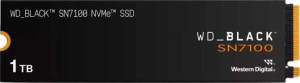
Western Digital WD Black SN7100 1TB
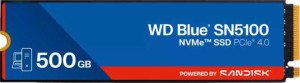
Western Digital WD Blue SN5100 500GB

Western Digital WD Black SN7100 1TB Western Digital WD Blue SN5100 500GB

Overview

Welcome to our in-depth comparison between the Western Digital WD Black SN7100 1TB and the Western Digital WD Blue SN5100 500GB. Both drives share the same M.2 NVMe PCIe 4.0 foundation, yet they target meaningfully different users. In this head-to-head, we examine the key battlegrounds: sequential and random speeds, storage type, endurance ratings, and overall value — to help you decide which drive truly fits your needs.

Common Features

  • Both drives use the M.2 form factor.
  • Both drives use HMB (Host Memory Buffer) as their SSD cache.
  • Both drives are NVMe SSDs.
  • Both drives use PCI Express (PCIe) version 4.
  • Both drives have 4 controller channels.
  • Both drives come with a 5-year warranty.
  • Neither drive has an integrated heatsink.
  • Neither drive supports hardware encryption.

Main Differences

  • Sequential read speed is 7250 MB/s on Western Digital WD Black SN7100 1TB and 6600 MB/s on Western Digital WD Blue SN5100 500GB.
  • Random read speed is 1,000,000 IOPS on Western Digital WD Black SN7100 1TB and 660,000 IOPS on Western Digital WD Blue SN5100 500GB.
  • Sequential write speed is 6900 MB/s on Western Digital WD Black SN7100 1TB and 5600 MB/s on Western Digital WD Blue SN5100 500GB.
  • Random write speed is 1,400,000 IOPS on Western Digital WD Black SN7100 1TB and 1,100,000 IOPS on Western Digital WD Blue SN5100 500GB.
  • NVMe version is 1.4 on Western Digital WD Black SN7100 1TB and 2 on Western Digital WD Blue SN5100 500GB.
  • Internal storage capacity is 1000GB on Western Digital WD Black SN7100 1TB and 500GB on Western Digital WD Blue SN5100 500GB.
  • The controller is the Polaris 3 A101-000172-A1 on Western Digital WD Black SN7100 1TB and the WD Polaris 3 A101-000103-A1 on Western Digital WD Blue SN5100 500GB.
  • SSD storage type is TLC on Western Digital WD Black SN7100 1TB and QLC on Western Digital WD Blue SN5100 500GB.
  • Terabytes Written (TBW) endurance rating is 600 TBW on Western Digital WD Black SN7100 1TB and 300 TBW on Western Digital WD Blue SN5100 500GB.
Specs Comparison
Western Digital WD Black SN7100 1TB

Western Digital WD Black SN7100 1TB

Western Digital WD Blue SN5100 500GB

Western Digital WD Blue SN5100 500GB

Read speed:
sequential read speed 7250 MB/s 6600 MB/s
random read speed 1000000 IOPS 660000 IOPS

Both drives deliver strong read performance, but the WD Black SN7100 1TB holds a clear edge across the board. Its 7250 MB/s sequential read speed outpaces the WD Blue SN5100 500GB's 6600 MB/s by roughly 10% — a gap that becomes tangible when transferring large files such as 4K video projects or disk images, where sustained throughput directly translates to waiting less.

The random read gap is even more pronounced: the SN7100 reaches 1,000,000 IOPS versus the SN5100's 660,000 IOPS — a difference of over 50%. Random read performance governs how snappy a system feels during everyday tasks like launching applications, booting the OS, or loading game assets, since these workloads consist of thousands of small, scattered reads rather than one continuous stream. A drive with higher IOPS handles these bursts more efficiently, reducing micro-stutter and latency under mixed workloads.

The SN7100 has a clear advantage in this category. While both drives are fast enough for mainstream use, the SN7100's superior sequential and — especially — random read speeds make it the stronger choice for users running demanding workloads, high-performance gaming rigs, or creative pipelines where read responsiveness matters.

Write speed:
sequential write speed 6900 MB/s 5600 MB/s
random write speed 1400000 IOPS 1100000 IOPS

On the write side, the WD Black SN7100 1TB again leads, posting a sequential write speed of 6900 MB/s against the WD Blue SN5100 500GB's 5600 MB/s — a roughly 23% advantage. In practice, this matters most when writing large volumes of data continuously: exporting a video render, cloning a drive, or moving a sizeable game library. The wider the gap in sequential write speed, the more time saved on these bulk operations.

Random write performance tells a similar story. The SN7100's 1,400,000 IOPS versus the SN5100's 1,100,000 IOPS represents a ~27% lead — meaningful for workloads that scatter small writes across the drive simultaneously, such as database operations, software compilation, or running virtual machines. Sustained random write capability also influences how gracefully a drive handles background tasks while the system remains responsive under load.

The SN7100 takes the edge in this category decisively. Both drives are competitive at their respective tiers, but across sequential and random write metrics, the SN7100 consistently outperforms the SN5100 by a margin large enough to matter in any write-intensive scenario.

General info:
type M2 M2
SSD cache HMB (Host Memory Buffer) HMB (Host Memory Buffer)
Is an NVMe SSD
NVMe version 1.4 2
internal storage 1000GB 500GB
release date March 2025 August 2025
controller Polaris 3 A101-000172-A1 WD Polaris 3 A101-000103-A1
SSD storage type TLC QLC
PCI Express (PCIe) version 4 4
Controller channels 4 4
Terabytes Written (TBW) 600 300
warranty period 5 years 5 years
Has an integrated heatsink
bits of encryption supported 0 0
has RGB lighting

Beneath the shared M.2 PCIe 4.0 form factor and identical controller channel counts, the most consequential difference here is NAND flash type. The WD Black SN7100 uses TLC (Triple-Level Cell) storage, while the WD Blue SN5100 relies on QLC (Quad-Level Cell). TLC stores three bits per cell versus QLC's four, which translates directly to better sustained write performance, lower write amplification, and greater long-term cell endurance — advantages that compound over years of daily use. For write-heavy workloads, TLC is the more resilient architecture.

Endurance figures reflect this difference proportionally: the SN7100 is rated for 600 TBW against the SN5100's 300 TBW, but since the SN7100 also has twice the capacity, the per-gigabyte endurance is effectively identical. One genuine surprise is that the SN5100 carries the newer NVMe 2.0 specification versus the SN7100's NVMe 1.4 — though in practice, NVMe 2.0 introduces features largely relevant to enterprise and data center use cases, so this distinction is unlikely to matter for most consumer workloads.

Overall, the SN7100 holds the edge in this category, primarily due to its TLC NAND, which offers a more durable and consistent foundation for demanding use. Both drives share the same warranty period, interface, and cache mechanism, making the flash type the defining factor for users prioritizing longevity and sustained performance.

Comparison Summary & Verdict

After a thorough look at the specs, both drives prove to be solid NVMe M.2 PCIe 4.0 options with a shared 5-year warranty, but they serve distinct audiences. The Western Digital WD Black SN7100 1TB stands out with its higher sequential read speed of 7250 MB/s, superior random IOPS, TLC NAND flash for better long-term reliability, double the capacity, and a 600 TBW endurance rating — making it the clear pick for power users, gamers, and creative professionals who demand peak throughput and durability. The Western Digital WD Blue SN5100 500GB, on the other hand, offers a more accessible entry point with its QLC storage and 300 TBW rating, making it a practical choice for everyday computing tasks where top-tier performance is not the primary concern.

Western Digital WD Black SN7100 1TB
Buy Western Digital WD Black SN7100 1TB if...

Buy the Western Digital WD Black SN7100 1TB if you need maximum sequential and random performance, greater storage capacity, higher endurance with 600 TBW, and the long-term reliability of TLC NAND.

Western Digital WD Blue SN5100 500GB
Buy Western Digital WD Blue SN5100 500GB if...

Buy the Western Digital WD Blue SN5100 500GB if you have lighter everyday storage needs and are looking for a more compact, entry-level NVMe option with a lower capacity requirement.