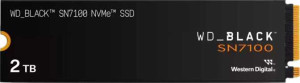
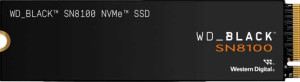
Both drives share the same M.2 form factor, NVMe protocol, TLC NAND storage type, 2TB capacity, and a 5-year warranty — a solid common foundation. The critical architectural differences, however, lie under the hood. The SN8100 runs on PCIe 5.0 with an NVMe 2.0 interface, while the SN7100 operates on PCIe 4.0 with NVMe 1.4. PCIe 5.0 doubles the available bandwidth of its predecessor, which is the primary enabler of the SN8100's significantly higher throughput figures seen in read and write performance.
Controller architecture is another meaningful differentiator. The SN8100 uses the Silicon Motion SM2508 with 8 controller channels, versus the SN7100's Polaris 3 controller with just 4 channels. More channels allow the controller to parallelize read/write operations across more NAND dies simultaneously, directly contributing to higher peak performance and better sustained speeds under load. Equally important is the cache type: the SN8100 uses a dedicated DRAM cache, whereas the SN7100 relies on HMB (Host Memory Buffer), which borrows a portion of system RAM. A dedicated DRAM cache generally delivers more consistent low-latency performance, especially during sustained or mixed workloads, since it does not compete with the host system for memory resources.
On endurance, both drives are rated at an identical 1200 TBW, meaning long-term reliability is evenly matched. Overall, the SN8100 holds a clear architectural edge — PCIe 5.0, doubled controller channels, and a dedicated DRAM cache collectively position it as the more capable platform, whereas the SN7100 is better suited to systems that do not yet support PCIe 5.0 or where the price-to-performance trade-off is the priority.