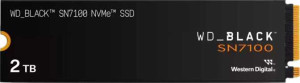
Western Digital WD Black SN7100 2TB
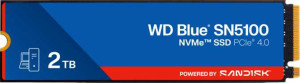
Western Digital WD Blue SN5100 2TB

Western Digital WD Black SN7100 2TB Western Digital WD Blue SN5100 2TB

Overview

Welcome to our in-depth comparison of the Western Digital WD Black SN7100 2TB and the Western Digital WD Blue SN5100 2TB. Both drives share a strong foundation as PCIe 4.0 NVMe M.2 SSDs with 2TB of storage and a 5-year warranty, yet they diverge in meaningful ways across write performance, storage cell technology, and long-term endurance. Read on to discover which drive best suits your specific needs.

Common Features

  • Both drives share the same random read speed of 1000000 IOPS.
  • Both are M.2 form factor SSDs.
  • Both use HMB (Host Memory Buffer) as SSD cache.
  • Both are NVMe SSDs.
  • Both offer 2000GB (2TB) of internal storage.
  • Both use PCIe version 4.
  • Both have 4 controller channels.
  • Both come with a 5-year warranty.
  • Neither drive includes an integrated heatsink.

Main Differences

  • Sequential read speed is 7250 MB/s on Western Digital WD Black SN7100 2TB and 7100 MB/s on Western Digital WD Blue SN5100 2TB.
  • Sequential write speed is 6900 MB/s on Western Digital WD Black SN7100 2TB and 6700 MB/s on Western Digital WD Blue SN5100 2TB.
  • Random write speed is 1400000 IOPS on Western Digital WD Black SN7100 2TB and 1300000 IOPS on Western Digital WD Blue SN5100 2TB.
  • NVMe version is 1.4 on Western Digital WD Black SN7100 2TB and 2 on Western Digital WD Blue SN5100 2TB.
  • The controller is Polaris 3 A101-000172-A1 on Western Digital WD Black SN7100 2TB and WD Polaris 3 A101-000103-A1 on Western Digital WD Blue SN5100 2TB.
  • SSD storage type is TLC on Western Digital WD Black SN7100 2TB and QLC on Western Digital WD Blue SN5100 2TB.
  • Terabytes Written (TBW) endurance rating is 1200 TB on Western Digital WD Black SN7100 2TB and 900 TB on Western Digital WD Blue SN5100 2TB.
Specs Comparison
Western Digital WD Black SN7100 2TB

Western Digital WD Black SN7100 2TB

Western Digital WD Blue SN5100 2TB

Western Digital WD Blue SN5100 2TB

Read speed:
sequential read speed 7250 MB/s 7100 MB/s
random read speed 1000000 IOPS 1000000 IOPS

In terms of read performance, the two drives are remarkably close. The WD Black SN7100 edges ahead with a sequential read speed of 7250 MB/s, compared to 7100 MB/s for the WD Blue SN5100 — a difference of just 150 MB/s, or roughly 2%. At this tier of NVMe performance, both drives are firmly in PCIe Gen 4 territory, meaning large sequential transfers like copying video files or loading game assets will feel virtually identical in everyday use.

Where the two drives are completely indistinguishable is random read performance: both deliver 1,000,000 IOPS. This metric is arguably more impactful for real-world responsiveness — it governs how fast the drive handles the thousands of small, scattered read requests that occur during OS boot, application launches, and multitasking. A tie here means neither drive has a practical advantage in day-to-day snappiness.

Overall, the SN7100 holds a marginal edge in sequential read speed, but the gap is too narrow to produce any perceptible difference outside of synthetic benchmarks. On read performance alone, these two drives are effectively tied, and the sequential advantage of the SN7100 should not be a deciding factor for most users.

Write speed:
sequential write speed 6900 MB/s 6700 MB/s
random write speed 1400000 IOPS 1300000 IOPS

Write performance is where a slightly more meaningful gap opens up between these two drives. The SN7100 posts a sequential write speed of 6900 MB/s versus 6700 MB/s for the SN5100 — a 3% difference that remains largely imperceptible during typical file transfers, but reflects the SN7100's positioning as the higher-performance sibling.

More telling is the random write comparison: the SN7100 pulls ahead with 1,400,000 IOPS against the SN5100's 1,300,000 IOPS — a 7.7% advantage. Random write performance directly influences how quickly a drive handles database operations, frequent saves in creative applications, and sustained multitasking under write-heavy workloads. For professionals writing large volumes of small files — think cache operations, logs, or project autosaves — this gap is the most tangible differentiator between the two drives.

The SN7100 holds a clear edge in write performance, particularly in the random write category where the difference is large enough to matter in demanding workloads. For mainstream users, neither gap will translate to a noticeable experience difference, but power users and content creators who stress their storage regularly will find the SN7100 the more capable option here.

General info:
type M2 M2
SSD cache HMB (Host Memory Buffer) HMB (Host Memory Buffer)
Is an NVMe SSD
NVMe version 1.4 2
internal storage 2000GB 2000GB
release date March 2025 August 2025
controller Polaris 3 A101-000172-A1 WD Polaris 3 A101-000103-A1
SSD storage type TLC QLC
PCI Express (PCIe) version 4 4
Controller channels 4 4
Terabytes Written (TBW) 1200 900
warranty period 5 years 5 years
Has an integrated heatsink
bits of encryption supported 0 0
has RGB lighting

The most consequential difference in this group comes down to NAND flash technology. The SN7100 uses TLC (Triple-Level Cell) storage, while the SN5100 uses QLC (Quad-Level Cell). Each QLC cell stores one additional bit of data compared to TLC, which allows for higher density at lower cost — but at the expense of endurance and sustained write consistency. This directly explains the SN7100's significantly higher TBW (Terabytes Written) rating of 1200 TB versus just 900 TB for the SN5100, a 33% gap that reflects how much harder QLC NAND wears under repeated write cycles.

One counterintuitive detail: the SN5100 carries the newer NVMe 2.0 specification, compared to NVMe 1.4 on the SN7100. However, the practical benefits of NVMe 2.0 — such as improved power efficiency and ZNS support — are largely irrelevant in consumer workloads on identical PCIe 4.0 hardware. Both drives share the same form factor, interface generation, channel count, cache type, and warranty length, so this version bump does not translate into a meaningful real-world advantage for typical users.

On balance, the SN7100 holds a clear advantage in this group. Its TLC NAND makes it the more durable and write-resilient drive, particularly for users who move large amounts of data regularly. The SN5100's QLC foundation and lower TBW rating position it as the more budget-oriented option — suitable for read-heavy, lighter-workload scenarios where longevity is less of a concern.

Comparison Summary & Verdict

After examining the full specification set, both drives deliver competitive performance on a shared PCIe 4.0 platform, but their differences reveal clearly distinct target audiences. The Western Digital WD Black SN7100 2TB stands out with its TLC NAND storage, higher 1200 TBW endurance rating, and faster sequential and random write speeds, making it the stronger choice for power users, content creators, and professionals who write large amounts of data regularly. The Western Digital WD Blue SN5100 2TB, while slightly behind in raw write performance and endurance, adopts the newer NVMe 2.0 standard and uses QLC NAND, which may appeal to everyday users seeking solid read performance at potentially better value. Neither drive includes an integrated heatsink, so thermal management will depend on your system. Overall, your workload intensity and long-term write demands should be the deciding factor between these two capable SSDs.

Western Digital WD Black SN7100 2TB
Buy Western Digital WD Black SN7100 2TB if...

Buy the Western Digital WD Black SN7100 2TB if you prioritize higher write endurance (1200 TBW), faster sequential and random write speeds, and the greater long-term reliability of TLC NAND storage.

Western Digital WD Blue SN5100 2TB
Buy Western Digital WD Blue SN5100 2TB if...

Buy the Western Digital WD Blue SN5100 2TB if you value the newer NVMe 2.0 standard and your workload is more read-intensive with moderate write demands.