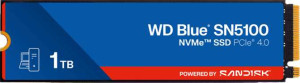
Western Digital WD Blue SN5100 1TB
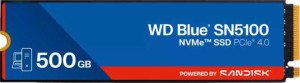
Western Digital WD Blue SN5100 500GB

Western Digital WD Blue SN5100 1TB Western Digital WD Blue SN5100 500GB

Overview

When choosing between the Western Digital WD Blue SN5100 1TB and the Western Digital WD Blue SN5100 500GB, buyers are weighing storage capacity and raw performance against a more compact, budget-friendly option. Both drives share the same M2 form factor, NVMe 2.0 standard, PCIe 4.0 interface, and WD Polaris 3 controller, making the key battlegrounds sequential and random speeds, TBW endurance, and overall benchmark performance.

Common Features

  • Both products use the M2 form factor.
  • Both products use HMB (Host Memory Buffer) as their SSD cache.
  • Both products are NVMe SSDs.
  • Both products support NVMe version 2.
  • Both products are powered by the WD Polaris 3 A101-000103-A1 controller.
  • Both products use QLC SSD storage type.
  • Both products use PCI Express (PCIe) version 4.
  • Both products have 4 controller channels.

Main Differences

  • Internal storage is 1000GB on Western Digital WD Blue SN5100 1TB and 500GB on Western Digital WD Blue SN5100 500GB.
  • Sequential read speed is 7100 MB/s on Western Digital WD Blue SN5100 1TB and 6600 MB/s on Western Digital WD Blue SN5100 500GB.
  • Random read speed is 1000000 IOPS on Western Digital WD Blue SN5100 1TB and 660000 IOPS on Western Digital WD Blue SN5100 500GB.
  • Sequential write speed is 6700 MB/s on Western Digital WD Blue SN5100 1TB and 5600 MB/s on Western Digital WD Blue SN5100 500GB.
  • Random write speed is 1300000 IOPS on Western Digital WD Blue SN5100 1TB and 1100000 IOPS on Western Digital WD Blue SN5100 500GB.
  • Terabytes Written (TBW) is 600 on Western Digital WD Blue SN5100 1TB and 300 on Western Digital WD Blue SN5100 500GB.
  • PassMark result is 47478 on Western Digital WD Blue SN5100 1TB and 31151 on Western Digital WD Blue SN5100 500GB.
Specs Comparison
Western Digital WD Blue SN5100 1TB

Western Digital WD Blue SN5100 1TB

Western Digital WD Blue SN5100 500GB

Western Digital WD Blue SN5100 500GB

Read speed:
sequential read speed 7100 MB/s 6600 MB/s
random read speed 1000000 IOPS 660000 IOPS

Both drives belong to the same WD Blue SN5100 family, but the 1TB model holds a measurable read speed advantage across the board. Its sequential read rate of 7100 MB/s outpaces the 500GB's 6600 MB/s — a roughly 8% gap that translates to noticeably faster large-file transfers, such as loading game levels, moving video footage, or booting large applications.

The difference is even more pronounced in random read performance, where the 1TB reaches 1,000,000 IOPS versus the 500GB's 660,000 IOPS — a gap of over 50%. Random IOPS governs how quickly a drive handles the many small, scattered read requests typical of OS operations, multitasking, and database workloads. In everyday use, a higher IOPS ceiling means snappier application launches and more responsive system behavior under load.

The 1TB variant has a clear read speed edge in both sequential and random scenarios. This is a common pattern in NVMe drives, where higher-capacity models benefit from more NAND channels operating in parallel, boosting throughput. Users who prioritize read-heavy workloads — such as content creation, gaming, or running multiple applications simultaneously — will find the 1TB the stronger performer strictly on these metrics.

Write speed:
sequential write speed 6700 MB/s 5600 MB/s
random write speed 1300000 IOPS 1100000 IOPS

On the write side, the 1TB SN5100 again pulls ahead, posting a sequential write speed of 6700 MB/s compared to 5600 MB/s on the 500GB — a roughly 20% advantage. For write-intensive tasks like video editing, large backup operations, or bulk file ingestion, that gap compounds quickly: moving 100GB of data could realistically complete in seconds less on the 1TB.

Random write performance tells a similar story, with the 1TB reaching 1,300,000 IOPS against the 500GB's 1,100,000 IOPS. While both numbers are strong in absolute terms, the ~18% lead of the 1TB matters in workloads involving frequent small writes — think virtual machines, compile-heavy development environments, or applications that constantly update metadata and indexes. Under sustained mixed workloads, that headroom can prevent performance degradation.

Across every write metric provided, the 1TB model holds a consistent and meaningful advantage. Much like the read speed gap, this likely stems from the 1TB leveraging more NAND parallelism. For users whose workflows are write-heavy — content creators, developers, or power users managing large datasets — the 1TB is the stronger choice based strictly on these figures.

Benchmarks:
PassMark result 47478 31151

PassMark scores offer a synthetic but holistic view of storage performance, aggregating read, write, and seek operations into a single index. The 1TB SN5100 scores 47,478 against the 500GB's 31,151 — a gap of over 52%. That is not a marginal difference; it places the two drives in meaningfully different performance tiers despite sharing the same product family.

What makes this gap significant is that PassMark captures the kind of mixed, real-world workloads that raw sequential specs alone cannot fully represent. A score difference of this magnitude suggests the 1TB will feel noticeably more responsive in day-to-day use — faster system boot times, quicker application launches, and smoother performance when juggling multiple tasks simultaneously.

The 1TB model holds an unambiguous advantage in this benchmark. Users who rely on a single composite score to gauge overall drive responsiveness will find the 1TB substantially ahead, reinforcing the pattern already seen across the individual read and write metrics.

General info:
type M2 M2
SSD cache HMB (Host Memory Buffer) HMB (Host Memory Buffer)
Is an NVMe SSD
NVMe version 2 2
internal storage 1000GB 500GB
release date August 2025 August 2025
controller WD Polaris 3 A101-000103-A1 WD Polaris 3 A101-000103-A1
SSD storage type QLC QLC
PCI Express (PCIe) version 4 4
Controller channels 4 4
Terabytes Written (TBW) 600 300
MTBF 1.3million hours 1.3million hours
warranty period 5 years 5 years
Has an integrated heatsink
bits of encryption supported 0 0
has RGB lighting

At their core, these two drives are architecturally identical. Both are M.2 NVMe SSDs built on PCIe 4.0 with NVMe 2.0, share the same WD Polaris 3 controller with 4 channels, use QLC NAND flash, and rely on HMB (Host Memory Buffer) instead of dedicated DRAM for caching. The practical implication is that any performance difference between them comes from capacity-driven parallelism, not from any fundamental architectural distinction.

The one general spec where they diverge meaningfully — beyond raw storage — is endurance. The 1TB is rated for 600 TBW versus 300 TBW for the 500GB, which scales proportionally with capacity. TBW defines how much data can be written to the drive over its lifetime before reliability is no longer guaranteed; for typical consumer workloads the 300 TBW figure is still ample, but power users or prosumers writing large volumes of data daily will find the 1TB's headroom more comfortable long-term. Both drives share an identical 1.3 million hour MTBF and 5-year warranty, so reliability assurances are equal.

For general configuration, this is essentially a capacity choice between two otherwise equivalent drives. Neither offers hardware encryption or a heatsink, keeping both positioned squarely as mainstream consumer options. The 1TB holds an edge solely in endurance, while everything else — platform, controller, interface, and warranty — is a dead tie.

Comparison Summary & Verdict

After examining all available specifications, the two drives share a strong common foundation — identical controller, PCIe 4.0 interface, QLC storage, and NVMe 2.0 support — but diverge meaningfully in performance metrics. The Western Digital WD Blue SN5100 1TB leads across every measurable speed category, with a sequential read of 7100 MB/s, a random read of 1,000,000 IOPS, and a PassMark score of 47,478, while also doubling the TBW endurance at 600. The Western Digital WD Blue SN5100 500GB still delivers capable performance with 6600 MB/s sequential reads and a PassMark of 31,151, making it a solid choice for lighter workloads. In short, power users and those needing higher endurance and top-tier throughput will find the 1TB model worth the upgrade, while the 500GB variant suits everyday computing needs on a tighter budget or storage requirement.

Western Digital WD Blue SN5100 1TB
Buy Western Digital WD Blue SN5100 1TB if...

Buy the Western Digital WD Blue SN5100 1TB if you need maximum sequential and random read/write speeds, higher TBW endurance, and stronger overall benchmark performance for demanding workloads.

Western Digital WD Blue SN5100 500GB
Buy Western Digital WD Blue SN5100 500GB if...

Buy the Western Digital WD Blue SN5100 500GB if your storage needs are modest and you want a capable NVMe drive with the same core platform at a lower capacity tier.