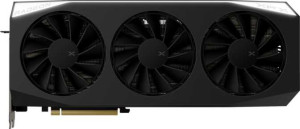
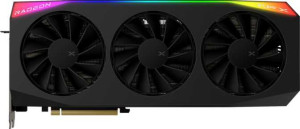
Both cards share identical silicon configurations — 4096 shading units, 256 TMUs, and 128 ROPs — meaning the underlying GPU die is the same. The real story is in the clocks: the OC Gaming Edition runs a meaningfully higher base clock of 1870 MHz versus 1660 MHz on the standard Gaming Edition, and its turbo peaks at 3100 MHz compared to 2970 MHz. That 130 MHz turbo gap may look modest in isolation, but it compounds across every compute pipeline simultaneously.
The practical consequence shows up clearly in the derived throughput metrics. The OC variant delivers 50.79 TFLOPS of floating-point performance versus 48.66 TFLOPS — a roughly 4.4% lead — and its texture rate of 793.6 GTexels/s versus 760.3 GTexels/s translates to marginally sharper texture throughput in complex scenes. Pixel fill rate follows the same pattern: 396.8 GPixel/s against 380.2 GPixel/s. These are not transformative differences, but they are consistent and real — the kind that can nudge frame rates by a few percent in GPU-limited scenarios, particularly at higher resolutions where raw throughput matters most. Memory speed is identical at 2518 MHz on both, so neither card has a bandwidth advantage.
The OC Gaming Edition holds a clear, if incremental, performance edge in this group. Every compute metric favors it, all stemming from its factory overclocked clocks rather than any architectural difference. For users who prioritize peak throughput and want to extract every frame without manually overclocking, the OC edition is the stronger choice. The standard Gaming Edition, however, closes most of that gap and will perform near-identically in the majority of real-world workloads.