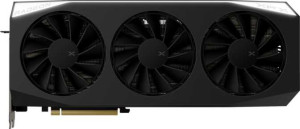
XFX Mercury Radeon RX 9070 XT Gaming Edition
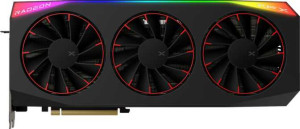
XFX Mercury Radeon RX 9070 XT OC Magnetic Air Edition

XFX Mercury Radeon RX 9070 XT Gaming Edition XFX Mercury Radeon RX 9070 XT OC Magnetic Air Edition

Overview

When choosing between the XFX Mercury Radeon RX 9070 XT Gaming Edition and the XFX Mercury Radeon RX 9070 XT OC Magnetic Air Edition, both cards share the same RDNA 4.0 architecture, 16GB GDDR6 memory, and 304W TDP foundation. The real question comes down to clock speeds and raw throughput, where the two cards take noticeably different stances. In this comparison, we break down every specification to help you decide which variant best fits your needs.

Common Features

  • Both products have a GPU memory speed of 2518 MHz.
  • Both products feature 4096 shading units.
  • Both products include 256 texture mapping units (TMUs).
  • Both products have 128 render output units (ROPs).
  • Double Precision Floating Point (DPFP) is supported on both products.
  • Both products have an effective memory speed of 20000 MHz.
  • Both products offer a maximum memory bandwidth of 640 GB/s.
  • Both products come with 16GB of VRAM.
  • Both products use GDDR6 memory.
  • Both products have a 256-bit memory bus width.
  • ECC memory is supported on both products.
  • Both products support DirectX 12 Ultimate.
  • Both products support OpenGL version 4.6.
  • Both products support OpenCL version 2.2.
  • Multi-display technology is supported on both products.
  • Ray tracing is supported on both products.
  • 3D support is available on both products.
  • DLSS is not supported on either product.
  • FSR4 is available on both products.
  • Both products have one HDMI 2.1b output and three DisplayPort outputs, with no USB-C or DVI outputs.
  • Both products are built on the RDNA 4.0 GPU architecture.
  • Both products have a Thermal Design Power (TDP) of 304W.
  • Both products use PCIe version 5.
  • Both products are manufactured on a 4 nm semiconductor process.
  • Both products feature 53900 million transistors.
  • Both products come with a 3-year warranty.
  • Neither product uses air-water cooling.
  • Both products have a width of 360 mm.

Main Differences

  • GPU clock speed is 1660 MHz on the XFX Mercury Radeon RX 9070 XT Gaming Edition and 1870 MHz on the XFX Mercury Radeon RX 9070 XT OC Magnetic Air Edition.
  • GPU turbo clock is 2970 MHz on the XFX Mercury Radeon RX 9070 XT Gaming Edition and 3100 MHz on the XFX Mercury Radeon RX 9070 XT OC Magnetic Air Edition.
  • Pixel rate is 380.2 GPixel/s on the XFX Mercury Radeon RX 9070 XT Gaming Edition and 396.8 GPixel/s on the XFX Mercury Radeon RX 9070 XT OC Magnetic Air Edition.
  • Floating-point performance is 48.66 TFLOPS on the XFX Mercury Radeon RX 9070 XT Gaming Edition and 50.79 TFLOPS on the XFX Mercury Radeon RX 9070 XT OC Magnetic Air Edition.
  • Texture rate is 760.3 GTexels/s on the XFX Mercury Radeon RX 9070 XT Gaming Edition and 793.6 GTexels/s on the XFX Mercury Radeon RX 9070 XT OC Magnetic Air Edition.
Specs Comparison
XFX Mercury Radeon RX 9070 XT Gaming Edition

XFX Mercury Radeon RX 9070 XT Gaming Edition

XFX Mercury Radeon RX 9070 XT OC Magnetic Air Edition

XFX Mercury Radeon RX 9070 XT OC Magnetic Air Edition

Performance:
GPU clock speed 1660 MHz 1870 MHz
GPU turbo 2970 MHz 3100 MHz
pixel rate 380.2 GPixel/s 396.8 GPixel/s
floating-point performance 48.66 TFLOPS 50.79 TFLOPS
texture rate 760.3 GTexels/s 793.6 GTexels/s
GPU memory speed 2518 MHz 2518 MHz
shading units 4096 4096
texture mapping units (TMUs) 256 256
render output units (ROPs) 128 128
Has Double Precision Floating Point (DPFP)

Both cards share the same fundamental GPU silicon — identical 4096 shading units, 256 TMUs, and 128 ROPs — meaning the architectural throughput ceiling is the same. The real story in this group is clock speed. The OC Magnetic Air Edition ships with a notably higher base clock of 1870 MHz versus 1660 MHz on the Gaming Edition, and a higher turbo of 3100 MHz against 2970 MHz. That 130 MHz turbo advantage may sound modest in isolation, but it flows directly into every derived throughput metric.

The practical consequences show up clearly: the OC variant delivers 50.79 TFLOPS of floating-point throughput compared to 48.66 TFLOPS — roughly a 4.4% lead — along with a texture rate of 793.6 GTexels/s versus 760.3 GTexels/s and a pixel fill rate of 396.8 GPixel/s versus 380.2 GPixel/s. In real-world terms, this translates to slightly higher sustained frame rates and better headroom in texture-heavy or compute-bound scenarios. Memory speed is identical at 2518 MHz on both, so the bandwidth pipeline does not widen the gap further.

The OC Magnetic Air Edition holds a clear, if measured, performance advantage in this group. The higher factory clock speeds give it a consistent edge across all throughput metrics. For users who prioritize peak GPU performance out of the box without manual overclocking, the OC variant is the stronger choice based strictly on these specs. The Gaming Edition is not far behind, but it trails on every clock-dependent metric.

Memory:
effective memory speed 20000 MHz 20000 MHz
maximum memory bandwidth 640 GB/s 640 GB/s
VRAM 16GB 16GB
GDDR version GDDR6 GDDR6
memory bus width 256-bit 256-bit
Supports ECC memory

When it comes to memory, these two cards are completely identical across every measurable spec. Both carry 16GB of GDDR6 running at an effective speed of 20000 MHz over a 256-bit bus, yielding 640 GB/s of peak memory bandwidth. That bandwidth figure is particularly noteworthy — it provides substantial headroom for high-resolution textures, large frame buffers, and memory-intensive workloads like 4K gaming or GPU-accelerated compute tasks.

ECC memory support is present on both, which is a useful feature for users running precision-sensitive workloads such as machine learning inference or professional visualization, where silent data corruption from memory errors is a real concern. It adds no burden for gaming use, but broadens the practical scope of either card.

This group is a complete tie. There is no memory-related reason to choose one over the other — the subsystem is, for all practical purposes, identical hardware. Any performance differences between these two cards will be driven entirely by GPU clock speeds, not memory capabilities.

Features:
DirectX version DirectX 12 Ultimate DirectX 12 Ultimate
OpenGL version 4.6 4.6
OpenCL version 2.2 2.2
Supports multi-display technology
supports ray tracing
Supports 3D
supports DLSS
has FSR4
has XeSS (XMX)
AMD SAM / Intel Resizable BAR AMD SAM AMD SAM
has LHR
has RGB lighting
supported displays 4 4

Feature parity is absolute here — every single spec in this group is shared between the two cards. The most impactful shared capabilities are DirectX 12 Ultimate support and ray tracing, which together ensure both cards are fully equipped for modern rendering pipelines, including hardware-accelerated reflections, shadows, and ambient occlusion in supported titles. DirectX 12 Ultimate also unlocks mesh shaders and variable rate shading, which developers increasingly rely on for performance and visual quality gains.

On the upscaling front, both cards support FSR4 while lacking DLSS and XeSS (XMX). FSR4 is AMD's latest upscaling generation and represents a meaningful quality improvement over prior FSR iterations, making it a relevant feature for users looking to reclaim frame rates at higher resolutions. The absence of DLSS is expected on AMD hardware and not a disadvantage within this comparison. AMD SAM (Smart Access Memory) is present on both, allowing compatible AMD CPUs to access the full GPU frame buffer, which can yield measurable performance gains in supported games.

With support for up to 4 simultaneous displays and RGB lighting on both, even the peripheral and multi-monitor use cases are matched. This group is a complete tie — the feature set is indistinguishable between the Gaming Edition and the OC Magnetic Air Edition, and neither card holds any advantage here.

Ports:
has an HDMI output
HDMI ports 1 1
HDMI version HDMI 2.1b HDMI 2.1b
DisplayPort outputs 3 3
USB-C ports 0 0
DVI outputs 0 0
mini DisplayPort outputs 0 0

The port layout is identical on both cards: 3 DisplayPort outputs and 1 HDMI 2.1b port, totaling four display connections — which aligns with the four-display limit noted in the Features group. The combination of three DisplayPorts and one HDMI is a practical and versatile arrangement, comfortably covering the most common monitor and TV setups without requiring adapters for the vast majority of users.

The HDMI 2.1b standard is worth highlighting — it supports up to 10K resolution and high frame rate modes like 4K at 144Hz or 8K at 60Hz over a single cable, making it well-suited for high-refresh gaming monitors and modern TVs alike. The absence of USB-C is the only notable omission, which could matter to users with USB-C or Thunderbolt displays, though this is increasingly uncommon in GPU-to-display scenarios.

No differentiator exists between the two cards in this group — the port selection is a complete tie. Connectivity will not be a deciding factor between the Gaming Edition and the OC Magnetic Air Edition.

General info:
GPU architecture RDNA 4.0 RDNA 4.0
release date March 2025 March 2025
Thermal Design Power (TDP) 304W 304W
PCI Express (PCIe) version 5 5
semiconductor size 4 nm 4 nm
number of transistors 53900 million 53900 million
warranty period 3 years 3 years
Has air-water cooling
width 360 mm 360 mm
height 155 mm 155 mm

At the foundational level, these two cards are built from the same DNA. Both are based on the RDNA 4.0 architecture, manufactured on a 4nm process node with 53.9 billion transistors — figures that speak to the density and efficiency of the underlying silicon. The 4nm node in particular allows for better power efficiency and higher clock speeds relative to larger process nodes, which contextualizes the high turbo clocks seen in the Performance group.

Sharing a 304W TDP is a significant practical detail: both cards draw the same amount of power under load, meaning the OC Magnetic Air Edition's higher clock speeds come without any power consumption penalty over the Gaming Edition. Users planning their power supply headroom or case airflow can treat both cards identically in that regard. Physical dimensions are also matched at 360 mm × 155 mm, so case compatibility is a non-issue when choosing between the two.

Rounding out the shared profile, both carry a PCIe 5.0 interface and a 3-year warranty. PCIe 5.0 ensures maximum bandwidth to the CPU for years to come, while the warranty parity means neither card offers stronger long-term purchase protection. This group is a complete tie — the general specifications give no grounds to prefer one card over the other.

Comparison Summary & Verdict

Both cards are built on the same solid foundation: identical 16GB GDDR6 memory at 640 GB/s bandwidth, full DirectX 12 Ultimate and ray tracing support, FSR4 compatibility, and a shared 304W TDP. The distinction lies purely in performance headroom. The XFX Mercury Radeon RX 9070 XT OC Magnetic Air Edition pulls ahead with a higher 3100 MHz turbo clock, 50.79 TFLOPS of floating-point performance, and a stronger texture rate of 793.6 GTexels/s, making it the better pick for enthusiasts who want every last frame. The XFX Mercury Radeon RX 9070 XT Gaming Edition, with its 2970 MHz turbo and 48.66 TFLOPS, remains a highly capable card for gamers who do not need the extra overclock and may prefer a potentially lower price point for the same core feature set.

XFX Mercury Radeon RX 9070 XT Gaming Edition
Buy XFX Mercury Radeon RX 9070 XT Gaming Edition if...

Buy the XFX Mercury Radeon RX 9070 XT Gaming Edition if you want a strong RDNA 4.0 card with the same core features and memory configuration as the OC model, and are happy to trade a small amount of clock speed headroom for potential savings.

XFX Mercury Radeon RX 9070 XT OC Magnetic Air Edition
Buy XFX Mercury Radeon RX 9070 XT OC Magnetic Air Edition if...

Buy the XFX Mercury Radeon RX 9070 XT OC Magnetic Air Edition if you want maximum out-of-the-box performance, with higher base and turbo clock speeds, greater floating-point throughput at 50.79 TFLOPS, and a faster texture rate of 793.6 GTexels/s.