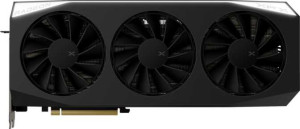
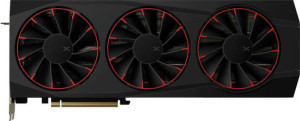
In terms of raw GPU performance, the XFX Mercury RX 9070 XT and the XFX Quicksilver RX 9070 XT Magnetic Air Edition are built on an identical silicon foundation. Every core performance metric — base clock of 1660 MHz, turbo clock of 2970 MHz, 48.66 TFLOPS of floating-point throughput, and a pixel rate of 380.2 GPixel/s — is exactly the same across both cards. This means neither card will outrender, out-compute, or out-shader the other under any workload.
The shader and rasterization architecture is equally mirrored: both feature 4096 shading units, 256 TMUs, and 128 ROPs. The TMU count directly drives texture throughput, which lands at 760.3 GTexels/s on both — a figure that translates to high-resolution texture handling in modern games without bottlenecking. The ROP count governs pixel output and anti-aliasing performance; 128 ROPs at this clock speed is competitive for 4K gaming workloads. Both cards also support Double Precision Floating Point, which matters for compute tasks like scientific simulation or certain AI workloads beyond standard gaming.
From a pure performance standpoint, these two cards are a dead tie. There is no clock speed advantage, no architectural edge, and no compute differential between them. Any decision between the Mercury and the Quicksilver Magnetic Air Edition must therefore hinge entirely on other factors — such as cooling design, acoustics, power delivery, or form factor — rather than GPU throughput.