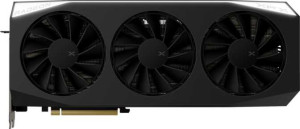
XFX Mercury Radeon RX 9070 XT Gaming Edition
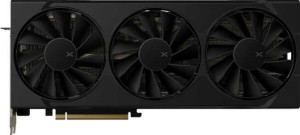
XFX Swift Radeon RX 9070 OC Triple Fan Gaming Edition

XFX Mercury Radeon RX 9070 XT Gaming Edition XFX Swift Radeon RX 9070 OC Triple Fan Gaming Edition

Overview

Welcome to our in-depth spec comparison between the XFX Mercury Radeon RX 9070 XT Gaming Edition and the XFX Swift Radeon RX 9070 OC Triple Fan Gaming Edition. Both cards share the same RDNA 4.0 architecture and 16GB GDDR6 memory pool, but they diverge in meaningful ways across raw compute performance, power consumption, and physical dimensions. Read on to see how these two AMD-based GPUs stack up across every key specification.

Common Features

  • GPU memory speed is 2518 MHz on both products.
  • Both products have 128 render output units (ROPs).
  • Double Precision Floating Point (DPFP) is supported on both products.
  • Effective memory speed is 20000 MHz on both products.
  • Maximum memory bandwidth is 640 GB/s on both products.
  • Both products have 16GB of VRAM.
  • Both products use GDDR6 memory.
  • Memory bus width is 256-bit on both products.
  • ECC memory is supported on both products.
  • Both products support DirectX 12 Ultimate.
  • OpenGL version is 4.6 on both products.
  • OpenCL version is 2.2 on both products.
  • Multi-display technology is supported on both products.
  • Ray tracing is supported on both products.
  • 3D is supported on both products.
  • DLSS is not supported on either product.
  • FSR4 is available on both products.
  • Both products have one HDMI output running version HDMI 2.1b.
  • Both products have 3 DisplayPort outputs and no USB-C, DVI, or mini DisplayPort outputs.
  • Both products are built on the RDNA 4.0 GPU architecture with PCIe 5 and 53900 million transistors, and carry a 3-year warranty.

Main Differences

  • GPU base clock speed is 1660 MHz on XFX Mercury Radeon RX 9070 XT Gaming Edition and 1440 MHz on XFX Swift Radeon RX 9070 OC Triple Fan Gaming Edition.
  • GPU turbo clock is 2970 MHz on XFX Mercury Radeon RX 9070 XT Gaming Edition and 2700 MHz on XFX Swift Radeon RX 9070 OC Triple Fan Gaming Edition.
  • Pixel rate is 380.2 GPixel/s on XFX Mercury Radeon RX 9070 XT Gaming Edition and 345.6 GPixel/s on XFX Swift Radeon RX 9070 OC Triple Fan Gaming Edition.
  • Floating-point performance is 48.66 TFLOPS on XFX Mercury Radeon RX 9070 XT Gaming Edition and 38.71 TFLOPS on XFX Swift Radeon RX 9070 OC Triple Fan Gaming Edition.
  • Texture rate is 760.3 GTexels/s on XFX Mercury Radeon RX 9070 XT Gaming Edition and 604.8 GTexels/s on XFX Swift Radeon RX 9070 OC Triple Fan Gaming Edition.
  • Shading units number 4096 on XFX Mercury Radeon RX 9070 XT Gaming Edition and 3584 on XFX Swift Radeon RX 9070 OC Triple Fan Gaming Edition.
  • Texture mapping units (TMUs) total 256 on XFX Mercury Radeon RX 9070 XT Gaming Edition and 224 on XFX Swift Radeon RX 9070 OC Triple Fan Gaming Edition.
  • Thermal Design Power (TDP) is 304W on XFX Mercury Radeon RX 9070 XT Gaming Edition and 220W on XFX Swift Radeon RX 9070 OC Triple Fan Gaming Edition.
  • Semiconductor size is 4 nm on XFX Mercury Radeon RX 9070 XT Gaming Edition and 5 nm on XFX Swift Radeon RX 9070 OC Triple Fan Gaming Edition.
  • Card width is 360 mm on XFX Mercury Radeon RX 9070 XT Gaming Edition and 325 mm on XFX Swift Radeon RX 9070 OC Triple Fan Gaming Edition.
  • Card height is 155 mm on XFX Mercury Radeon RX 9070 XT Gaming Edition and 150 mm on XFX Swift Radeon RX 9070 OC Triple Fan Gaming Edition.
Specs Comparison
XFX Mercury Radeon RX 9070 XT Gaming Edition

XFX Mercury Radeon RX 9070 XT Gaming Edition

XFX Swift Radeon RX 9070 OC Triple Fan Gaming Edition

XFX Swift Radeon RX 9070 OC Triple Fan Gaming Edition

Performance:
GPU clock speed 1660 MHz 1440 MHz
GPU turbo 2970 MHz 2700 MHz
pixel rate 380.2 GPixel/s 345.6 GPixel/s
floating-point performance 48.66 TFLOPS 38.71 TFLOPS
texture rate 760.3 GTexels/s 604.8 GTexels/s
GPU memory speed 2518 MHz 2518 MHz
shading units 4096 3584
texture mapping units (TMUs) 256 224
render output units (ROPs) 128 128
Has Double Precision Floating Point (DPFP)

The performance gap between these two cards is meaningful and consistent across every compute metric. The XFX Mercury RX 9070 XT operates at a base clock of 1660 MHz and boosts up to 2970 MHz, while the XFX Swift RX 9070 OC runs at 1440 MHz base and 2700 MHz boost — a roughly 10% clock speed advantage for the Mercury at peak. Combined with its larger shader array (4096 vs 3584 shading units) and more texture mapping units (256 vs 224 TMUs), the Mercury delivers noticeably higher throughput across the board.

Those architectural differences translate directly into the compute numbers that matter most: the Mercury posts 48.66 TFLOPS of floating-point performance against the Swift's 38.71 TFLOPS — a ~26% advantage that will be felt in GPU-limited scenarios, particularly at higher resolutions and with ray tracing or compute-heavy workloads. The texture fill rate tells the same story: 760.3 GTexels/s vs 604.8 GTexels/s, meaning the Mercury can push more textured geometry per second, benefiting complex, detail-rich scenes. The one area where both cards are perfectly matched is rasterization output and memory throughput — both share 128 ROPs and identical 2518 MHz memory speeds, so blending and framebuffer write performance are equivalent.

The verdict for this group is clear: the Mercury RX 9070 XT holds a significant and well-rounded performance advantage, driven by more shader processors, higher clocks, and substantially greater compute throughput. The Swift RX 9070 OC is not slow, but buyers who prioritize raw GPU performance should recognize they are trading roughly a quarter of the Mercury's compute headroom by choosing it.

Memory:
effective memory speed 20000 MHz 20000 MHz
maximum memory bandwidth 640 GB/s 640 GB/s
VRAM 16GB 16GB
GDDR version GDDR6 GDDR6
memory bus width 256-bit 256-bit
Supports ECC memory

When it comes to memory, these two cards are completely identical in every measurable way. Both carry 16GB of GDDR6 across a 256-bit bus, running at an effective speed of 20000 MHz and delivering a maximum bandwidth of 640 GB/s. There is no differentiation here whatsoever — a buyer choosing between these cards will get the exact same memory subsystem regardless of which they pick.

That said, the shared memory configuration is genuinely capable. A 256-bit bus at 640 GB/s provides ample headroom for high-resolution textures and large frame buffers, and 16GB of VRAM is well-suited for modern titles at 4K, as well as content creation workloads that benefit from holding large assets in GPU memory. ECC memory support on both cards is a minor but noteworthy feature, adding a layer of data integrity useful in semi-professional or compute contexts.

This group is a complete tie. Neither the Mercury RX 9070 XT nor the Swift RX 9070 OC holds any memory advantage over the other — the decision between them must rest entirely on other specification groups.

Features:
DirectX version DirectX 12 Ultimate DirectX 12 Ultimate
OpenGL version 4.6 4.6
OpenCL version 2.2 2.2
Supports multi-display technology
supports ray tracing
Supports 3D
supports DLSS
has FSR4
has XeSS (XMX)
AMD SAM / Intel Resizable BAR AMD SAM AMD SAM
has LHR
has RGB lighting
supported displays 4 4

Feature parity between these two cards is total. Both support DirectX 12 Ultimate and ray tracing, placing them on equal footing for modern gaming workloads that leverage hardware-accelerated lighting and shadows. Neither supports DLSS — an expected omission given these are AMD cards — but both include FSR4, AMD's latest upscaling technology, which provides a meaningful quality-per-frame boost in supported titles and partially closes the gap with competing upscaling solutions.

On the compute and API side, identical OpenCL 2.2 and OpenGL 4.6 support means developers and prosumers working with GPU-accelerated applications will see no difference between the two. AMD SAM (Smart Access Memory) is present on both, allowing a compatible AMD CPU and motherboard to access the full VRAM pool directly — a feature that can yield tangible performance gains in SAM-optimized titles at no additional cost. Both cards also top out at 4 simultaneous displays, which covers the vast majority of multi-monitor use cases.

Like the memory group, this is a complete tie. Every feature that matters — upscaling, ray tracing, API support, SAM, and multi-display capability — is shared identically. Prospective buyers should look to performance and design specifications to differentiate between the Mercury RX 9070 XT and the Swift RX 9070 OC.

Ports:
has an HDMI output
HDMI ports 1 1
HDMI version HDMI 2.1b HDMI 2.1b
DisplayPort outputs 3 3
USB-C ports 0 0
DVI outputs 0 0
mini DisplayPort outputs 0 0

Both cards ship with an identical port layout: one HDMI 2.1b and three DisplayPort outputs, totaling four connectors — which aligns precisely with the four-display limit noted in the features group. HDMI 2.1b is the current high-bandwidth standard, capable of driving 4K at high refresh rates or 8K displays, making it future-proof for most monitor and TV setups available today.

The three DisplayPort outputs give multi-monitor users plenty of flexibility, whether running a triple-display gaming rig or a mixed productivity and gaming setup. The absence of USB-C, DVI, and mini DisplayPort is unremarkable at this tier — legacy DVI has been phased out of modern GPUs entirely, and the lack of USB-C simply means neither card doubles as a direct connection point for USB-C monitors or VR headsets that rely on that interface.

No differentiation exists here: the port configuration is a complete tie, and connectivity should play no role in choosing between the Mercury RX 9070 XT and the Swift RX 9070 OC.

General info:
GPU architecture RDNA 4.0 RDNA 4.0
release date March 2025 March 2025
Thermal Design Power (TDP) 304W 220W
PCI Express (PCIe) version 5 5
semiconductor size 4 nm 5 nm
number of transistors 53900 million 53900 million
warranty period 3 years 3 years
Has air-water cooling
width 360 mm 325 mm
height 155 mm 150 mm

Both cards are built on the same RDNA 4.0 architecture and share an identical transistor count of 53,900 million, yet they diverge in two telling ways: process node and power consumption. The Mercury RX 9070 XT is fabbed on a 4 nm process versus the Swift RX 9070 OC's 5 nm, a generational step that typically enables higher clock speeds and better power efficiency — which helps explain how the Mercury sustains its significantly higher performance figures. The trade-off, however, is a considerably higher TDP of 304W against the Swift's 220W, an 84W difference that is far from trivial.

That 84W gap has real-world consequences. Builders will need to ensure their power supply has adequate headroom for the Mercury, and case airflow becomes more critical to manage thermals under sustained load. The Swift, by contrast, is a notably more system-friendly card — its lower TDP makes it easier to cool, quieter under typical workloads, and less demanding on PSU capacity, all without sacrificing the RDNA 4.0 feature set.

Physical size also separates the two: the Mercury measures 360 × 155 mm while the Swift is a more compact 325 × 150 mm, a 35mm length difference that could matter in smaller mid-tower or ITX-adjacent builds. On warranty and connectivity standard both are equal at 3 years and PCIe 5. Overall, the Swift holds a clear advantage for builders prioritizing power efficiency and case compatibility, while the Mercury's refined node gives it the architectural ceiling to run harder — at the cost of noticeably higher power draw and a larger footprint.
Comparison Summary & Verdict

After reviewing all the evidence, a clear picture emerges for each card. The XFX Mercury Radeon RX 9070 XT Gaming Edition holds a consistent lead in pure performance metrics, including a higher 48.66 TFLOPS floating-point output, a 2970 MHz turbo clock, and 4096 shading units, making it the stronger choice for users who demand maximum frame rates and compute headroom. However, that extra performance comes with a 304W TDP and a larger 360 mm footprint. The XFX Swift Radeon RX 9070 OC Triple Fan Gaming Edition counters with a notably lower 220W TDP and a more compact 325 mm length, which can matter greatly in smaller builds. Both cards are otherwise equal in memory, features, and connectivity, so the decision ultimately comes down to performance ambition versus system efficiency.

XFX Mercury Radeon RX 9070 XT Gaming Edition
Buy XFX Mercury Radeon RX 9070 XT Gaming Edition if...

Buy the XFX Mercury Radeon RX 9070 XT Gaming Edition if you want the highest possible GPU performance, with superior clock speeds, shading units, and floating-point throughput, and your system can accommodate its larger size and higher power draw.

XFX Swift Radeon RX 9070 OC Triple Fan Gaming Edition
Buy XFX Swift Radeon RX 9070 OC Triple Fan Gaming Edition if...

Buy the XFX Swift Radeon RX 9070 OC Triple Fan Gaming Edition if you need a more power-efficient and compact card, particularly for smaller cases or builds where a 220W TDP and a shorter 325 mm length are important constraints.