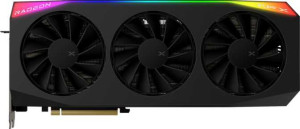
XFX Mercury Radeon RX 9070 XT OC Gaming Edition
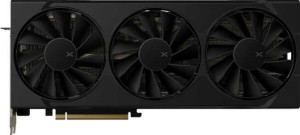
XFX Swift Radeon RX 9070 OC Triple Fan Gaming Edition

XFX Mercury Radeon RX 9070 XT OC Gaming Edition XFX Swift Radeon RX 9070 OC Triple Fan Gaming Edition

Overview

Welcome to our in-depth spec comparison between the XFX Mercury Radeon RX 9070 XT OC Gaming Edition and the XFX Swift Radeon RX 9070 OC Triple Fan Gaming Edition. Both cards share the same RDNA 4.0 architecture, 16GB of GDDR6 memory, and a rich feature set including ray tracing and FSR4, but they diverge meaningfully in raw compute performance, power consumption, and physical dimensions. Read on to see which card earns its place in your build.

Common Features

  • Both cards share a GPU memory speed of 2518 MHz.
  • Both cards have 128 render output units (ROPs).
  • Double Precision Floating Point (DPFP) is supported on both cards.
  • Both cards have an effective memory speed of 20000 MHz.
  • Both cards offer a maximum memory bandwidth of 640 GB/s.
  • Both cards are equipped with 16GB of VRAM.
  • Both cards use GDDR6 memory.
  • Both cards feature a 256-bit memory bus width.
  • ECC memory support is available on both cards.
  • Both cards support DirectX 12 Ultimate.
  • Both cards support OpenGL version 4.6.
  • Both cards support OpenCL version 2.2.
  • Multi-display technology is supported on both cards.
  • Ray tracing support is available on both cards.
  • 3D support is available on both cards.
  • DLSS support is not available on either card.
  • FSR4 support is available on both cards.
  • Both cards feature one HDMI 2.1b output.
  • Both cards have three DisplayPort outputs.
  • Neither card includes USB-C, DVI, or mini DisplayPort outputs.
  • Both cards are built on the RDNA 4.0 GPU architecture.
  • Both cards use PCIe version 5.
  • Both cards contain 53,900 million transistors.
  • Both cards carry a 3-year warranty.
  • Air-water cooling is not available on either card.

Main Differences

  • GPU base clock speed is 1870 MHz on XFX Mercury Radeon RX 9070 XT OC Gaming Edition and 1440 MHz on XFX Swift Radeon RX 9070 OC Triple Fan Gaming Edition.
  • GPU turbo clock speed is 3100 MHz on XFX Mercury Radeon RX 9070 XT OC Gaming Edition and 2700 MHz on XFX Swift Radeon RX 9070 OC Triple Fan Gaming Edition.
  • Pixel rate is 396.8 GPixel/s on XFX Mercury Radeon RX 9070 XT OC Gaming Edition and 345.6 GPixel/s on XFX Swift Radeon RX 9070 OC Triple Fan Gaming Edition.
  • Floating-point performance is 50.79 TFLOPS on XFX Mercury Radeon RX 9070 XT OC Gaming Edition and 38.71 TFLOPS on XFX Swift Radeon RX 9070 OC Triple Fan Gaming Edition.
  • Texture rate is 793.6 GTexels/s on XFX Mercury Radeon RX 9070 XT OC Gaming Edition and 604.8 GTexels/s on XFX Swift Radeon RX 9070 OC Triple Fan Gaming Edition.
  • Shading units total 4096 on XFX Mercury Radeon RX 9070 XT OC Gaming Edition and 3584 on XFX Swift Radeon RX 9070 OC Triple Fan Gaming Edition.
  • Texture mapping units (TMUs) number 256 on XFX Mercury Radeon RX 9070 XT OC Gaming Edition and 224 on XFX Swift Radeon RX 9070 OC Triple Fan Gaming Edition.
  • Thermal Design Power (TDP) is 304W on XFX Mercury Radeon RX 9070 XT OC Gaming Edition and 220W on XFX Swift Radeon RX 9070 OC Triple Fan Gaming Edition.
  • Semiconductor size is 4 nm on XFX Mercury Radeon RX 9070 XT OC Gaming Edition and 5 nm on XFX Swift Radeon RX 9070 OC Triple Fan Gaming Edition.
  • Card width is 360 mm on XFX Mercury Radeon RX 9070 XT OC Gaming Edition and 325 mm on XFX Swift Radeon RX 9070 OC Triple Fan Gaming Edition.
  • Card height is 155 mm on XFX Mercury Radeon RX 9070 XT OC Gaming Edition and 150 mm on XFX Swift Radeon RX 9070 OC Triple Fan Gaming Edition.
Specs Comparison
XFX Mercury Radeon RX 9070 XT OC Gaming Edition

XFX Mercury Radeon RX 9070 XT OC Gaming Edition

XFX Swift Radeon RX 9070 OC Triple Fan Gaming Edition

XFX Swift Radeon RX 9070 OC Triple Fan Gaming Edition

Performance:
GPU clock speed 1870 MHz 1440 MHz
GPU turbo 3100 MHz 2700 MHz
pixel rate 396.8 GPixel/s 345.6 GPixel/s
floating-point performance 50.79 TFLOPS 38.71 TFLOPS
texture rate 793.6 GTexels/s 604.8 GTexels/s
GPU memory speed 2518 MHz 2518 MHz
shading units 4096 3584
texture mapping units (TMUs) 256 224
render output units (ROPs) 128 128
Has Double Precision Floating Point (DPFP)

The most telling performance gap between the XFX Mercury RX 9070 XT and the XFX Swift RX 9070 lies in their raw compute and throughput figures. The 9070 XT delivers 50.79 TFLOPS of floating-point performance versus 38.71 TFLOPS on the 9070 — a roughly 31% advantage that translates directly into faster shader workloads, more responsive ray tracing, and headroom for higher resolutions or quality settings in demanding titles.

This gap is primarily driven by the 9070 XT′s larger shader array (4096 vs. 3584 shading units) and significantly higher boost clock (3100 MHz vs. 2700 MHz). The texture throughput difference is equally pronounced — 793.6 GTexels/s versus 604.8 GTexels/s — meaning the 9070 XT can push more detailed, high-resolution textures per frame, which is especially relevant at 4K or with texture-heavy game engines. Both cards share identical 128 ROPs and the same 2518 MHz memory speed, so pixel output and memory bandwidth are evenly matched, suggesting the 9070′s bottleneck under heavy load is compute and texture throughput rather than memory or fill rate.

Both GPUs support Double Precision Floating Point (DPFP), making either viable for light professional or compute workloads beyond gaming. Overall, the XFX Mercury RX 9070 XT holds a clear performance edge in this group — the higher clock speeds and larger execution resources give it a consistent and meaningful advantage across gaming and GPU-compute scenarios.

Memory:
effective memory speed 20000 MHz 20000 MHz
maximum memory bandwidth 640 GB/s 640 GB/s
VRAM 16GB 16GB
GDDR version GDDR6 GDDR6
memory bus width 256-bit 256-bit
Supports ECC memory

When it comes to memory, the XFX Mercury RX 9070 XT and the XFX Swift RX 9070 are in complete lockstep. Both cards ship with 16GB of GDDR6 across a 256-bit bus, delivering an identical 640 GB/s of peak memory bandwidth. For users, this means neither card has a memory-related edge in texture streaming, framebuffer capacity at 4K, or large asset workloads.

The shared 20000 MHz effective memory speed and bus width also mean that the bandwidth ceiling is the same for both — so any performance difference between the two cards in real-world gaming or compute tasks will come entirely from their GPU execution resources, not their memory subsystems. Both also support ECC memory, which marginally broadens their appeal for professional or compute use cases where data integrity matters.

This group is a clear tie. Memory configuration is essentially a non-factor in choosing between these two cards — buyers should look to other specification groups, particularly GPU performance, to differentiate them.

Features:
DirectX version DirectX 12 Ultimate DirectX 12 Ultimate
OpenGL version 4.6 4.6
OpenCL version 2.2 2.2
Supports multi-display technology
supports ray tracing
Supports 3D
supports DLSS
has FSR4
has XeSS (XMX)
AMD SAM / Intel Resizable BAR AMD SAM AMD SAM
has LHR
has RGB lighting
supported displays 4 4

Feature parity defines this category entirely. Both the XFX Mercury RX 9070 XT and the XFX Swift RX 9070 run on DirectX 12 Ultimate with full ray tracing support, meaning both can handle hardware-accelerated reflections, shadows, and global illumination in supported titles — neither card is left behind on modern rendering pipelines.

On the upscaling front, both cards support FSR4 (AMD′s latest upscaling technology) and lack DLSS and XeSS, which is expected for AMD hardware. FSR4 can meaningfully boost frame rates in supported games, and its availability on both cards ensures neither buyer misses out. AMD SAM (Smart Access Memory) is also present on both, allowing compatible AMD platforms to access the full GPU framebuffer and extract additional performance in supported titles. The shared cap of 4 simultaneous displays and RGB lighting on both cards round out a feature set that is effectively identical across the board.

This group is another tie — there is no feature-based reason to choose one card over the other. Both offer the same software ecosystem, the same API support, and the same connectivity flexibility. The decision remains rooted in raw performance differences found in other specification groups.

Ports:
has an HDMI output
HDMI ports 1 1
HDMI version HDMI 2.1b HDMI 2.1b
DisplayPort outputs 3 3
USB-C ports 0 0
DVI outputs 0 0
mini DisplayPort outputs 0 0

Port selection is identical across both cards. The XFX Mercury RX 9070 XT and the XFX Swift RX 9070 each offer 3 DisplayPort outputs and 1 HDMI 2.1b port, totaling four display connections — consistent with the four-display limit noted in their feature specs. HDMI 2.1b is the latest HDMI specification, supporting up to 4K at high refresh rates and 8K output, making both cards well-suited for modern high-performance monitors and TVs alike.

Neither card includes USB-C, DVI, or mini DisplayPort outputs, so users relying on older display interfaces will need an active adapter. That said, the combination of DisplayPort and HDMI 2.1b covers the vast majority of current monitor and display ecosystems without compromise.

Ports are a complete tie here. Connectivity options are identical in count, type, and version — this category offers no differentiation between the two cards whatsoever.

General info:
GPU architecture RDNA 4.0 RDNA 4.0
release date March 2025 March 2025
Thermal Design Power (TDP) 304W 220W
PCI Express (PCIe) version 5 5
semiconductor size 4 nm 5 nm
number of transistors 53900 million 53900 million
warranty period 3 years 3 years
Has air-water cooling
width 360 mm 325 mm
height 155 mm 150 mm

Both cards are built on AMD′s RDNA 4.0 architecture and share the same 53.9 billion transistor count, confirming they draw from the same silicon family. However, a notable process node difference emerges: the XFX Mercury RX 9070 XT is fabbed on a 4 nm process versus 5 nm for the XFX Swift RX 9070. The finer node on the 9070 XT enables higher clock speeds at a given power envelope, which directly explains the performance gap observed in the Performance group.

Power draw is where the two cards diverge most meaningfully for system builders. The 9070 XT carries a 304W TDP against the 9070′s considerably lower 220W — an 84W difference that has real implications. Users building compact systems, running modest PSUs, or prioritizing efficiency will find the 9070 notably easier to accommodate. The 9070 XT′s higher power demand will also contribute more heat to the chassis, potentially requiring better case airflow. Physically, the 9070 XT is also the larger card at 360 × 155 mm versus 325 × 150 mm, so case clearance should be verified before purchase. Both cards share PCIe 5.0 and a 3-year warranty, keeping platform compatibility and post-purchase support equal.

The XFX Swift RX 9070 holds a practical edge in this group for power-constrained or compact builds — its lower TDP and smaller footprint make it the more flexible option from a system integration standpoint. The 9070 XT′s advantages are real but come with a meaningful power and size cost.

Comparison Summary & Verdict

After examining every specification, a clear picture emerges for each card. The XFX Mercury Radeon RX 9070 XT OC Gaming Edition is the outright performance leader, delivering a 50.79 TFLOPS floating-point rating, a 3100 MHz turbo clock, and superior texture and pixel rates thanks to its 4096 shading units and 4 nm process node. It is the right pick for enthusiasts who demand the highest frame rates and headroom for demanding workloads, and who can accommodate its 304W TDP and slightly larger 360 mm footprint. The XFX Swift Radeon RX 9070 OC Triple Fan Gaming Edition, by contrast, offers a compelling balance: it retains the same 16GB GDDR6 memory pool, 640 GB/s bandwidth, and identical port configuration, while drawing only 220W and fitting into tighter cases at 325 mm. Both cards carry a 3-year warranty and support DirectX 12 Ultimate, ray tracing, and FSR4, so neither sacrifices features. Your choice ultimately comes down to peak performance versus efficiency and size.

XFX Mercury Radeon RX 9070 XT OC Gaming Edition
Buy XFX Mercury Radeon RX 9070 XT OC Gaming Edition if...

Buy the XFX Mercury Radeon RX 9070 XT OC Gaming Edition if you want maximum GPU performance, with higher clock speeds, more shading units, and greater floating-point throughput, and your case and power supply can handle a 304W card measuring 360 mm in length.

XFX Swift Radeon RX 9070 OC Triple Fan Gaming Edition
Buy XFX Swift Radeon RX 9070 OC Triple Fan Gaming Edition if...

Buy the XFX Swift Radeon RX 9070 OC Triple Fan Gaming Edition if you want a more power-efficient card at 220W with a smaller 325 mm footprint, while still enjoying the same 16GB GDDR6 memory, 640 GB/s bandwidth, and full feature parity including ray tracing and FSR4.