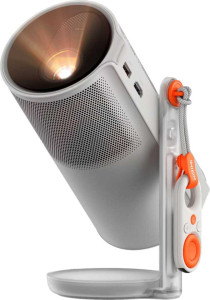
XGIMI MoGo 4
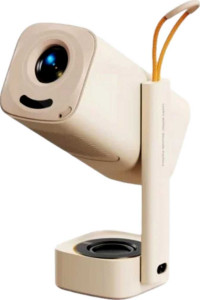
Yaber T1 Pro

XGIMI MoGo 4 Yaber T1 Pro

Overview

Welcome to our detailed spec comparison between the XGIMI MoGo 4 and the Yaber T1 Pro, two compact 1080p projectors vying for your living room or on-the-go setup. Both share a strong connectivity foundation with AirPlay, Chromecast, Miracast, and Dolby Atmos, yet they diverge in meaningful ways around projection size, audio power, and form factor. Read on to discover which projector best matches your needs.

Common Features

  • Neither product uses a laser light source.
  • Both products have a dedicated smartphone app.
  • Both products output at 1080p resolution.
  • HDR10+ support is not available on either product.
  • The minimum throw distance is 1 m on both products.
  • Both products have a 60Hz refresh rate.
  • Dolby Vision support is not available on either product.
  • HDR10 support is available on both products.
  • Both products have 1 HDMI port.
  • AirPlay support is available on both products.
  • Bluetooth is available on both products.
  • Wi-Fi support is available on both products.
  • Chromecast built-in is available on both products.
  • Neither product has a VGA connector.
  • Neither product has a DVI connector.
  • Miracast support is available on both products.
  • Both products have stereo speakers.
  • Neither product has vertical lens shift.
  • Neither product has horizontal lens shift.
  • Both products include a remote control.
  • Both products have a built-in smart TV.
  • Both products have a built-in speaker.
  • Dolby Atmos support is available on both products.

Main Differences

  • Width is 96.5 mm on XGIMI MoGo 4 and 106 mm on Yaber T1 Pro.
  • Height is 207.6 mm on XGIMI MoGo 4 and 228 mm on Yaber T1 Pro.
  • Thickness is 96.5 mm on XGIMI MoGo 4 and 116 mm on Yaber T1 Pro.
  • Weight is 1310 g on XGIMI MoGo 4 and 1180 g on Yaber T1 Pro.
  • Volume is 1933.2231 cm³ on XGIMI MoGo 4 and 2803.488 cm³ on Yaber T1 Pro.
  • Maximum projection size is 200″ on XGIMI MoGo 4 and 120″ on Yaber T1 Pro.
  • USB ports number 2 on XGIMI MoGo 4 and 1 on Yaber T1 Pro.
  • An S/PDIF Out port is present on Yaber T1 Pro but not available on XGIMI MoGo 4.
  • Audio output power is 2 x 6W on XGIMI MoGo 4 and 2 x 4W on Yaber T1 Pro.
  • Voice commands are supported on Yaber T1 Pro but not available on XGIMI MoGo 4.
Specs Comparison
XGIMI MoGo 4

XGIMI MoGo 4

Yaber T1 Pro

Yaber T1 Pro

General info:
has laser light source
release date June 2025 July 2025
width 96.5 mm 106 mm
height 207.6 mm 228 mm
thickness 96.5 mm 116 mm
weight 1310 g 1180 g
Has a dedicated smartphone app
volume 1933.2231 cm³ 2803.488 cm³

Both the XGIMI MoGo 4 and the Yaber T1 Pro share the same fundamental technology baseline: neither uses a laser light source, and both offer a dedicated smartphone app for control and setup. These shared traits mean neither projector has an inherent edge in light-source longevity from this data alone, and both promise a comparable level of mobile-friendly usability.

Where the two diverge meaningfully is in their physical footprint. The MoGo 4 is notably more compact, with a volume of roughly 1,933 cm³ compared to the T1 Pro's 2,803 cm³ — nearly 45% larger. In practical terms, the MoGo 4 will slip into a bag more easily and take up less shelf or table space, making it the stronger pick for users who prioritize portability or minimalist setups. The T1 Pro, however, counters with a 130 g weight advantage (1,180 g vs. 1,310 g), which is noticeable when carrying the unit by hand for extended periods, even if it doesn't offset the bulk difference in a bag.

On balance, the XGIMI MoGo 4 holds the edge in this category for portability-focused buyers: its significantly smaller volume makes it easier to pack and store, and the weight penalty over the T1 Pro is modest enough that most users will consider the compactness the more impactful trade-off. The T1 Pro's slight weight advantage is real but unlikely to be decisive for typical use cases.

Projection quality:
output resolution 1080p 1080p
maximum projection size 200" 120"
supports HDR10+
minimum throw distance 1 m 1 m
refresh rate 60Hz 60Hz
supports Dolby Vision
supports HDR10

At the core of their projection capabilities, the XGIMI MoGo 4 and Yaber T1 Pro are closely matched: both output at 1080p, run at 60Hz, share the same 1 m minimum throw distance, and support HDR10 while topping out there — neither reaches HDR10+ or Dolby Vision. For everyday movie watching and casual gaming, this shared foundation means image quality differences will be subtle and largely dependent on brightness and lens quality rather than resolution or HDR tier.

The one spec that meaningfully separates them is maximum projection size. The MoGo 4 can scale up to 200″, while the T1 Pro caps at 120″ — a difference that is far from trivial. A 200″ image has roughly 2.8 times the screen area of a 120″ image, which translates directly into a more cinematic, immersive experience in larger rooms. Achieving that size still depends on having adequate throw distance and ambient light control, but the ceiling the MoGo 4 sets is dramatically higher.

The XGIMI MoGo 4 holds a clear edge in this category. With an identical resolution, HDR support tier, and throw distance, the only differentiator is projection size — and a 200″ maximum versus 120″ is a gap large enough to matter significantly for home theater use cases. Buyers who want to go big have a definitive reason to favor the MoGo 4 here.

Connectivity:
HDMI ports 1 1
has AirPlay
Has Bluetooth
supports Wi-Fi
USB ports 2 1
has Chromecast built-in
has a VGA connector
has a DVI connector
supports Miracast
RJ45 ports 0 0
Has S/PDIF Out port

Wireless connectivity is a strong suit for both projectors, and the overlap is substantial: each supports Wi-Fi, Bluetooth, AirPlay, Chromecast built-in, and Miracast. In practice, this means users can stream directly from an iPhone, Android device, or laptop without a cable on either unit — a genuinely versatile foundation that covers the most common real-world casting scenarios.

The wired side is where the two diverge. The MoGo 4 comes with 2 USB ports versus the T1 Pro's single port — a practical advantage when you want to connect a USB drive and a dongle or peripheral simultaneously without unplugging anything. The T1 Pro responds with an S/PDIF optical audio output, which the MoGo 4 lacks entirely. S/PDIF allows the T1 Pro to connect directly to a soundbar or AV receiver with a digital optical cable, delivering lossless audio passthrough — a meaningful perk for users invested in a dedicated audio setup.

This category is a genuine trade-off rather than a clean win for either side. The XGIMI MoGo 4 is the better choice for users who regularly connect USB peripherals or storage devices, while the Yaber T1 Pro has the edge for home theater enthusiasts who want to route audio through an external sound system via a digital optical connection. Neither product's advantage is universally more important — it comes down entirely to the buyer's specific setup.

Features:
has stereo speakers
has lens shift (vertical)
has lens shift (horizontal)
has a remote control
has built-in smart TV
has a built-in speaker
audio output power 2 x 6W 2 x 4W
has Dolby Atmos
has voice commands

Feature parity is high between these two projectors: both pack stereo speakers with Dolby Atmos, a built-in smart TV platform, and a remote control, while neither offers lens shift in any direction. The absence of lens shift on both units means placement flexibility relies solely on physical positioning and any keystone correction available — a shared limitation worth noting for users with constrained room layouts.

Audio output is where the specs diverge most measurably. The MoGo 4 delivers 2 x 6W versus the T1 Pro's 2 x 4W — a 50% higher power rating per channel. In a compact projector context, that gap can translate to noticeably louder maximum volume and better headroom for dynamic audio content, particularly in larger rooms. Both units process audio through Dolby Atmos, so the spatial audio decoding is equivalent; the MoGo 4 simply has more raw power to express it. The T1 Pro counters with voice commands, a feature the MoGo 4 lacks entirely, enabling hands-free navigation and search — a genuine convenience for users who prefer not to reach for a remote.

On balance, the XGIMI MoGo 4 has the edge for audio performance thanks to its higher speaker output, which is a tangible, everyday differentiator for anyone using the projector as a primary entertainment device without an external sound system. However, the Yaber T1 Pro is the stronger pick for users who prioritize smart, hands-free interaction — voice commands add a layer of convenience that the MoGo 4 simply cannot match in this category.

Comparison Summary & Verdict

After reviewing all the specs, both projectors deliver 1080p resolution, HDR10, and a rich wireless connectivity suite, making either a solid choice for casual home use. However, the differences reveal two distinct profiles. The XGIMI MoGo 4 stands out with a significantly larger 200″ maximum projection size, stronger 2 x 6W stereo audio, and an extra USB port, making it the better pick for users who want a true big-screen cinematic experience. The Yaber T1 Pro, on the other hand, is lighter at 1180 g, more compact in volume, and adds voice command support and an S/PDIF Out port for external audio systems, appealing to users who value hands-free control and flexible audio routing in a smaller package.

XGIMI MoGo 4
Buy XGIMI MoGo 4 if...

Buy the XGIMI MoGo 4 if you want the largest possible projection size up to 200″ and more powerful 2 x 6W stereo audio output.

Yaber T1 Pro
Buy Yaber T1 Pro if...

Buy the Yaber T1 Pro if you prefer a lighter, more compact projector with voice command support and an S/PDIF Out port for connecting an external audio system.