Xiaomi Electric Scooter 5 Plus
Xiaomi Electric Scooter 5 Pro

Xiaomi Electric Scooter 5 Plus Xiaomi Electric Scooter 5 Pro

Overview

Welcome to our in-depth spec comparison between the Xiaomi Electric Scooter 5 Plus and the Xiaomi Electric Scooter 5 Pro. Both scooters share a strong common foundation — including a 477 Wh battery, 60 km range, and 25 km/h top speed — yet they diverge in meaningful ways when it comes to motor power, physical dimensions, and climbing capability. Read on to discover which model best suits your riding needs.

Common Features

  • Both scooters feature suspension.
  • A dedicated smartphone app is available on both scooters.
  • Both scooters are equipped with pneumatic tires.
  • Neither scooter comes with a seat.
  • Both scooters can be folded.
  • Neither scooter is designed for kids.
  • Both scooters have front lights.
  • Both scooters have rear lights.
  • The top speed is 25 km/h on both scooters.
  • Neither scooter has dual motors.
  • Both scooters are equipped with a rear brake.
  • Both scooters are equipped with a front brake.
  • The maximum weight capacity is 120 kg on both scooters.
  • The charge time is 9 hours on both scooters.
  • The maximum distance per charge is 60 km on both scooters.
  • A battery level indicator is present on both scooters.
  • Regenerative braking is available on both scooters.
  • Neither scooter has a removable battery.
  • The battery size is 477 Wh on both scooters.

Main Differences

  • Weight is 26600 g on Xiaomi Electric Scooter 5 Plus and 22400 g on Xiaomi Electric Scooter 5 Pro.
  • Wheel diameter is 12″ on Xiaomi Electric Scooter 5 Plus and 10″ on Xiaomi Electric Scooter 5 Pro.
  • Height is 1306 mm on Xiaomi Electric Scooter 5 Plus and 1271 mm on Xiaomi Electric Scooter 5 Pro.
  • Width is 1275.8 mm on Xiaomi Electric Scooter 5 Plus and 1192 mm on Xiaomi Electric Scooter 5 Pro.
  • Motor power is 900W on Xiaomi Electric Scooter 5 Plus and 1000W on Xiaomi Electric Scooter 5 Pro.
  • Climbing angle is 20° on Xiaomi Electric Scooter 5 Plus and 22° on Xiaomi Electric Scooter 5 Pro.
Specs Comparison
Xiaomi Electric Scooter 5 Plus

Xiaomi Electric Scooter 5 Plus

Xiaomi Electric Scooter 5 Pro

Xiaomi Electric Scooter 5 Pro

Design:
weight 26600 g 22400 g
has suspension
Has a dedicated smartphone app
has pneumatic tires
wheel diameter 12" 10"
has a seat
can be folded
is designed for kids
height 1306 mm 1271 mm
width 1275.8 mm 1192 mm
has front light(s)
has rear light(s)
Ingress Protection (IP) rating IPX5 IPX5
release date July 2025 January 2025

Both the Xiaomi Electric Scooter 5 Plus and 5 Pro share a solid design foundation: they fold for storage, feature suspension, run on pneumatic tires, and carry an IPX5 water-resistance rating — meaning both can handle rain splashes but should not be submerged. Front and rear lighting, a dedicated smartphone app, and an adult-oriented build are also common to both, so neither has an edge on these fronts.

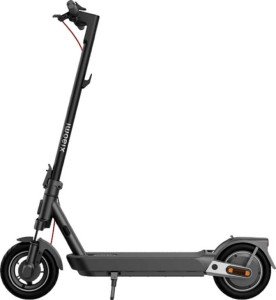
Where the two diverge meaningfully is in size and weight. The 5 Plus rolls on larger 12″ wheels compared to the Pro's 10″ wheels. In practice, bigger wheels absorb road imperfections more effectively and provide a more planted, stable ride — particularly on uneven urban surfaces. The trade-off is bulk: the 5 Plus is noticeably larger (1306 mm tall, 1275.8 mm wide) and significantly heavier at 26,600 g, versus the Pro's more compact 1271 mm height, 1192 mm width, and lighter 22,400 g frame. That roughly 4.2 kg difference is very noticeable when carrying the scooter upstairs or lifting it onto public transit.

The design edge depends on the rider's priorities. If ride comfort and wheel stability matter most, the 5 Plus has the advantage thanks to its larger wheel diameter. If portability and ease of handling are paramount, the 5 Pro wins clearly with its lighter weight and more compact footprint. Neither is designed for children, and both fold — but the Pro is simply easier to live with when you need to carry it.
Performance:
motor power 900W 1000W
top speed 25 km/h 25 km/h
has dual motors
climbing angle 20° 22°
has a rear brake
has a front brake
maximum weight capacity 120kg 120kg

On paper, the two scooters look nearly identical in performance — both are capped at 25 km/h, rely on a single motor, and share a 120 kg maximum rider capacity with dual front-and-rear braking. For the average urban commuter, these shared traits mean day-to-day riding feel will be broadly similar between the two.

The meaningful differences surface under load and on inclines. The 5 Pro edges ahead with a 1000W motor versus the Plus's 900W, and that extra output translates directly into a steeper climbing angle: 22° versus 20°. While 2° may sound trivial, climbing angle is an exponential challenge — a 22° grade is noticeably steeper than 20°, and in hilly cities or mixed terrain, this margin can be the difference between a confident ascent and a sluggish one, especially near the weight limit. The Pro's higher wattage also suggests it will sustain its top speed more readily on gradients rather than bleeding off as the motor strains.

For performance, the 5 Pro holds a clear edge. Riders who primarily commute on flat ground may never feel the difference, but anyone dealing with hills, heavier loads, or longer sustained climbs will benefit meaningfully from the Pro's stronger motor and superior climbing capability.

Battery:
charge time 9 hours 9 hours
maximum distance per charge 60 km 60 km
has a battery level indicator
Has regenerative braking
has a removable battery
battery size 477 Wh 477 Wh

Rare in a product comparison, the battery category is an exact tie across every single spec. Both scooters carry an identical 477 Wh battery pack, deliver a claimed range of 60 km per charge, and replenish fully in 9 hours — a charge time best suited to overnight topping-up rather than quick turnarounds during the day.

A 477 Wh capacity is genuinely substantial for a consumer scooter, supporting that 60 km range figure credibly under favorable conditions. Both models also include regenerative braking, which marginally recovers energy during deceleration and can extend real-world range in stop-and-go urban riding. Neither scooter offers a removable battery, so charging always requires access to the scooter itself rather than swapping a spare pack — a practical consideration for riders without easy outlet access near their parking spot.

There is no edge to declare here: the 5 Plus and 5 Pro are completely matched on battery. A buyer's decision should rest entirely on the design and performance differences covered in the other groups, as battery life and charging behavior will be indistinguishable between the two in everyday use.

Comparison Summary & Verdict

After examining the full specification set, both scooters prove to be well-matched in the areas that matter most to everyday riders: identical battery capacity, range, charge time, and top speed. However, the distinctions become clear when you dig deeper. The Xiaomi Electric Scooter 5 Pro edges ahead with a more powerful 1000W motor, a steeper 22° climbing angle, and a notably lighter 22400 g frame, making it the stronger choice for riders tackling hills or prioritizing portability. The Xiaomi Electric Scooter 5 Plus, with its larger 12″ wheels and wider build, offers a more stable and comfortable ride on varied terrain. Neither product is objectively superior — the right choice comes down to your personal riding environment and priorities.

Xiaomi Electric Scooter 5 Plus
Buy Xiaomi Electric Scooter 5 Plus if...

Buy the Xiaomi Electric Scooter 5 Plus if you prioritize larger 12″ wheels for a more stable and comfortable ride on varied or uneven terrain.

Xiaomi Electric Scooter 5 Pro
Buy Xiaomi Electric Scooter 5 Pro if...

Buy the Xiaomi Electric Scooter 5 Pro if you need a more powerful 1000W motor, a steeper 22° climbing angle, and a lighter frame that is easier to carry and maneuver.