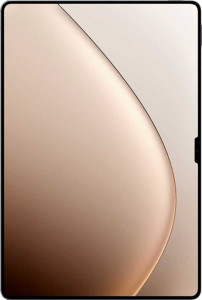
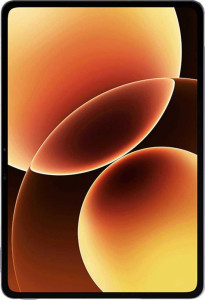
Panel technology is where these two tablets diverge most sharply. The Pad 7 Ultra uses an OLED/AMOLED panel on its 14-inch screen, delivering true blacks, infinite contrast, and vibrant color reproduction that LCD simply cannot match. The Pad 8 counters with an IPS LCD on an 11.2-inch screen — a fundamentally different viewing experience that tends to be brighter in direct sunlight but lacks the depth and punch of OLED. For HDR content, cinematic viewing, or anything color-critical, the Pad 7 Ultra's display technology holds a meaningful qualitative edge, further reinforced by its exclusive anti-reflection coating, which reduces glare in bright environments — a feature the Pad 8 omits entirely.
Despite the large size difference, both tablets share an identical resolution of 3200 × 2136 px, which produces a paradoxical result: the Pad 8's smaller screen actually yields a noticeably sharper image at 344 ppi, versus 275 ppi on the Pad 7 Ultra. In practice, 275 ppi is still a comfortably sharp result on a 14-inch display viewed at normal distances, but users who pixel-peep or use the tablet close-up will perceive greater clarity on the Pad 8. On the flip side, the Pad 7 Ultra's larger canvas makes text and UI elements bigger and easier to read without scaling.
Refresh rate is a minor point of difference: the Pad 8 edges ahead at 144Hz versus 120Hz, which can make scrolling and animations feel marginally smoother — though both share the same 240Hz touch sampling rate, so responsiveness to input is identical. Both also support Dolby Vision and HDR10. Overall, the Pad 7 Ultra has the stronger display package for immersive media thanks to OLED and anti-reflection glass; the Pad 8 wins narrowly on raw pixel density but its LCD panel and lack of anti-glare coating make it the lesser choice for display quality specifically.