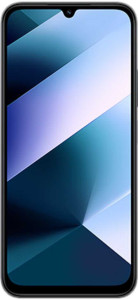
Most of the connectivity foundations are shared: both phones support dual SIM, Wi-Fi 5, NFC, USB Type-C, expandable storage, and fingerprint scanning. Neither offers 5G, and both top out at USB 2.0 speeds. Within that common framework, however, a few meaningful distinctions emerge. The Redmi Note 14 supports significantly faster cellular speeds — 650 Mbps download and 150 Mbps upload versus 300 Mbps and 100 Mbps on the Poco C85. In practice, this means the Note 14 can pull data from cell towers more quickly in areas with strong LTE coverage, which benefits large file downloads and sustained streaming on mobile data. The Poco C85 edges back with a slightly newer Bluetooth 5.4 versus the Note 14's 5.3, though the practical difference between these adjacent versions is negligible for most users.
Sensor availability is another area where the Note 14 pulls ahead. It includes both a gyroscope and an infrared sensor, neither of which is present on the C85. The gyroscope enables motion-sensitive gaming, AR applications, and more accurate navigation, while the infrared sensor allows the phone to function as a universal remote for TVs and other home appliances — a surprisingly useful everyday convenience. The C85's absence of a gyroscope in particular is a meaningful omission, as it locks users out of a growing category of apps and games that depend on it.
Taken together, the Redmi Note 14 holds the broader connectivity and features advantage — faster LTE throughput, a gyroscope for motion-aware applications, and an infrared blaster for device control. The C85's marginally newer Bluetooth version is the only counterpoint, but it is too minor to shift the overall balance.