Yaber L2 Plus
Yaber T1 Pro

Yaber L2 Plus Yaber T1 Pro

Overview

Choosing between the Yaber L2 Plus and the Yaber T1 Pro means navigating two distinctly different approaches to the home projector experience. While both models share a solid common ground — including 1080p output, a built-in smart TV platform, and support for AirPlay, Chromecast, and Dolby Atmos — they diverge notably when it comes to projection size, form factor, and smart capabilities. Read on as we put every specification side by side to help you decide which projector best suits your living room or on-the-go needs.

Common Features

  • Neither product uses a laser light source.
  • Both products have a dedicated smartphone app.
  • Both products output at 1080p resolution.
  • HDR10+ support is not available on either product.
  • Dolby Vision support is not available on either product.
  • Both products have 1 HDMI port.
  • AirPlay is supported on both products.
  • Bluetooth is available on both products.
  • Wi-Fi is supported on both products.
  • Both products have 1 USB port.
  • Chromecast is built-in on both products.
  • Neither product has a VGA connector.
  • Neither product has a DVI connector.
  • Both products have stereo speakers.
  • Vertical lens shift is not available on either product.
  • Horizontal lens shift is not available on either product.
  • Both products include a remote control.
  • Both products have a built-in smart TV.
  • Both products have a built-in speaker.
  • Dolby Atmos is supported on both products.

Main Differences

  • Width is 226.9 mm on Yaber L2 Plus and 106 mm on Yaber T1 Pro.
  • Height is 184 mm on Yaber L2 Plus and 228 mm on Yaber T1 Pro.
  • Thickness is 159 mm on Yaber L2 Plus and 116 mm on Yaber T1 Pro.
  • Weight is 2300 g on Yaber L2 Plus and 1180 g on Yaber T1 Pro.
  • Volume is 6638.1864 cm³ on Yaber L2 Plus and 2803.488 cm³ on Yaber T1 Pro.
  • Maximum projection size is 150″ on Yaber L2 Plus and 120″ on Yaber T1 Pro.
  • HDR10 support is present on Yaber T1 Pro but not available on Yaber L2 Plus.
  • Yaber L2 Plus has 1 RJ45 port while Yaber T1 Pro has no RJ45 port.
  • S/PDIF Out port is present on Yaber T1 Pro but not available on Yaber L2 Plus.
  • Audio output power is 2 x 8W on Yaber L2 Plus and 2 x 4W on Yaber T1 Pro.
  • Voice commands are supported on Yaber T1 Pro but not available on Yaber L2 Plus.
Specs Comparison
Yaber L2 Plus

Yaber L2 Plus

Yaber T1 Pro

Yaber T1 Pro

General info:
has laser light source
release date January 2025 July 2025
width 226.9 mm 106 mm
height 184 mm 228 mm
thickness 159 mm 116 mm
weight 2300 g 1180 g
Has a dedicated smartphone app
volume 6638.1864 cm³ 2803.488 cm³

Both the Yaber L2 Plus and the Yaber T1 Pro share two important baseline traits: neither uses a laser light source, and both offer a dedicated smartphone app for wireless control and setup. These commonalities mean users of either device can expect a similar ecosystem experience in terms of software interaction, with no advantage on that front.

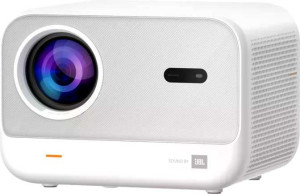
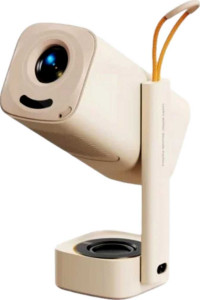
Where these two projectors diverge sharply is in their physical footprint. The T1 Pro is dramatically more compact, with a volume of roughly 2,803 cm³ compared to the L2 Plus's 6,638 cm³ — less than half the bulk. More practically, the T1 Pro weighs only 1,180 g versus the L2 Plus's 2,300 g, making it nearly half the weight. For a user who plans to move the projector between rooms, carry it for travel, or mount it in tight spaces, this difference is immediately felt. The L2 Plus, by contrast, has a wider, flatter profile (226.9 × 184 × 159 mm) suggesting a more traditional desktop form factor, while the T1 Pro's taller, narrower shell (106 × 228 × 116 mm) hints at a design optimized for vertical placement or portability.

On general physical characteristics, the T1 Pro holds a clear advantage: it occupies far less space and is significantly easier to carry and reposition. The L2 Plus's larger chassis may accommodate more internal hardware, but purely from a form-factor and portability standpoint, the T1 Pro is the more versatile option for users who do not intend to leave their projector in a fixed location.
Projection quality:
output resolution 1080p 1080p
maximum projection size 150" 120"
supports HDR10+
supports Dolby Vision
supports HDR10

At the resolution level, both projectors are evenly matched, each outputting at 1080p — a solid standard for home cinema use that delivers sharp, detailed images without requiring 4K source content. Neither product offers any upgrade path to higher native resolution, so this is a true tie.

The more meaningful distinctions emerge elsewhere. The L2 Plus supports a maximum projection size of 150″ versus the T1 Pro's 120″, a 25% larger ceiling that matters for users with big walls or dedicated home theater setups where image scale is a priority. On the other hand, the T1 Pro counters with support for HDR10, a standard that enables higher peak brightness and a wider color range when fed compatible content — something the L2 Plus entirely lacks. In practice, HDR10 can make a noticeable difference in scenes with bright highlights or deep shadows, delivering more visual depth and punch.

These two advantages pull in opposite directions, making the conclusion context-dependent. Users who prioritize raw screen size will favor the L2 Plus; those who care more about image quality and tonal richness from streaming or disc-based HDR content will find the T1 Pro's HDR10 support the more meaningful edge. On balance, HDR10 is a qualitative improvement to every compatible frame, while a larger maximum size is only relevant at the extremes of a room — giving the T1 Pro a slight advantage for most typical viewing environments.

Connectivity:
HDMI ports 1 1
has AirPlay
Has Bluetooth
supports Wi-Fi
USB ports 1 1
has Chromecast built-in
has a VGA connector
has a DVI connector
supports Miracast
RJ45 ports 1 0
Has S/PDIF Out port

The wireless connectivity story is essentially identical across both projectors. Each supports Wi-Fi, Bluetooth, AirPlay, Chromecast, and Miracast — a comprehensive suite that covers virtually every major screen-mirroring and streaming protocol. Whether a user is casting from an iPhone, an Android device, or a laptop, both projectors have the wireless bases covered equally well.

The wired side is where the two diverge. The L2 Plus includes an RJ45 (Ethernet) port, which the T1 Pro omits entirely. A wired network connection is a meaningful reliability advantage in permanent or semi-permanent installations — it eliminates Wi-Fi congestion, reduces latency, and ensures a stable stream regardless of wireless conditions. Conversely, the T1 Pro features an S/PDIF optical audio output, absent on the L2 Plus. S/PDIF allows users to pass digital audio directly to a soundbar, AV receiver, or external DAC, bypassing the projector's internal speakers entirely for a cleaner, higher-fidelity audio chain.

These two exclusive ports reflect different use-case priorities. The L2 Plus's Ethernet jack suits users building a reliable, network-integrated home theater setup. The T1 Pro's S/PDIF output appeals to those investing in a dedicated external audio system. Neither advantage is universal, so the edge depends entirely on the user's setup — making this category effectively a draw between two meaningfully different but equally valid trade-offs.

Features:
has stereo speakers
has lens shift (vertical)
has lens shift (horizontal)
has a remote control
has built-in smart TV
has a built-in speaker
audio output power 2 x 8W 2 x 4W
has Dolby Atmos
has voice commands

Shared features form a strong common foundation here: both projectors deliver stereo sound with Dolby Atmos support, include a remote control, and run a built-in smart TV platform — meaning neither requires an external streaming stick to access apps directly. For most users, this shared feature set will cover the daily essentials without compromise.

The audio output power is where a tangible gap appears. The L2 Plus drives its stereo speakers at 2 × 8W, compared to the T1 Pro's 2 × 4W — double the rated output. In practice, higher wattage translates to greater headroom for volume and dynamics, particularly in larger rooms or when reproducing Dolby Atmos content with wider dynamic range. The T1 Pro's 4W per channel is adequate for smaller spaces but may feel underpowered when pushing to fill a larger room. That said, both units support Dolby Atmos, so the format's spatial audio processing is available regardless — the L2 Plus simply has more amplifier muscle behind it.

Flipping the script, the T1 Pro adds voice command support, which the L2 Plus lacks entirely. For users who rely on hands-free control — whether through a connected voice assistant ecosystem or the projector's own built-in interface — this is a genuine convenience advantage. Weighing both sides, the L2 Plus edges ahead on audio power, which is a more consistently impactful spec, while the T1 Pro's voice commands are a quality-of-life bonus that will matter more to some users than others.

Comparison Summary & Verdict

Both the Yaber L2 Plus and the Yaber T1 Pro are well-rounded projectors that share a strong feature set, including 1080p resolution, Dolby Atmos audio, AirPlay, Chromecast, and a built-in smart TV experience. That said, their differences point clearly to two distinct user profiles. The Yaber L2 Plus is built for the dedicated home cinema enthusiast: it delivers a larger 150-inch maximum projection, punchier 2x8W stereo speakers, and a wired RJ45 port for rock-solid network stability. The Yaber T1 Pro appeals to users who prioritize versatility and modern conveniences — it is substantially lighter at 1180g, adds HDR10 support for richer picture quality, offers voice commands for hands-free control, and includes an S/PDIF Out port for pairing with external audio systems. Choose the L2 Plus for raw screen size and audio power; choose the T1 Pro for portability, smarter controls, and flexible connectivity.

Yaber L2 Plus
Buy Yaber L2 Plus if...

Buy the Yaber L2 Plus if you want a larger projection of up to 150 inches and more powerful 2x8W stereo audio for a dedicated home cinema setup with a stable wired network connection.

Yaber T1 Pro
Buy Yaber T1 Pro if...

Choose the Yaber T1 Pro if you prefer a lighter, more compact projector with HDR10 support, voice commands, and an S/PDIF Out port for connecting external audio equipment.