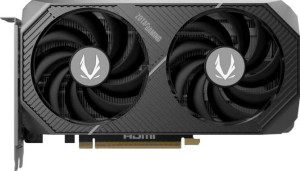
Zotac Gaming GeForce RTX 5060 Ti AMP 16GB
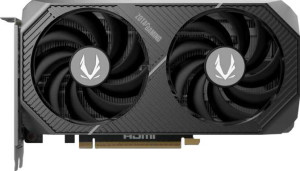
Zotac Gaming GeForce RTX 5060 Ti Twin Edge 16GB

Zotac Gaming GeForce RTX 5060 Ti AMP 16GB Zotac Gaming GeForce RTX 5060 Ti Twin Edge 16GB

Overview

Welcome to our in-depth specification comparison of the Zotac Gaming GeForce RTX 5060 Ti AMP 16GB and the Zotac Gaming GeForce RTX 5060 Ti Twin Edge 16GB. Both cards are built on the same Blackwell architecture and share an identical memory configuration, yet they diverge in a few key performance metrics. This page breaks down every shared trait and notable difference, focusing on areas like GPU turbo clock speed, pixel rate, and floating-point performance, to help you decide which variant best suits your needs.

Common Features

  • Both cards share a base GPU clock speed of 2407 MHz.
  • Both cards have a GPU memory speed of 1750 MHz.
  • Both cards feature 4608 shading units.
  • Both cards include 144 texture mapping units (TMUs).
  • Both cards have 48 render output units (ROPs).
  • Double Precision Floating Point (DPFP) is supported on both cards.
  • Both cards have an effective memory speed of 28000 MHz.
  • Both cards offer a maximum memory bandwidth of 448 GB/s.
  • Both cards come with 16GB of VRAM.
  • Both cards use GDDR7 memory.
  • Both cards use a 128-bit memory bus width.
  • ECC memory is supported on both cards.
  • Both cards support DirectX 12 Ultimate.
  • Both cards support OpenGL version 4.6.
  • Both cards support OpenCL version 3.
  • Multi-display technology is supported on both cards.
  • Ray tracing is supported on both cards.
  • 3D support is available on both cards.
  • DLSS support is available on both cards.
  • XeSS (XMX) support is not available on either card.
  • Both cards include one HDMI 2.1b output.
  • Both cards feature three DisplayPort outputs.
  • Neither card has USB-C, DVI, or mini DisplayPort outputs.
  • Both cards are built on the Blackwell GPU architecture.
  • Both cards have a Thermal Design Power (TDP) of 180W.
  • Both cards use PCIe version 5.
  • Both cards are manufactured on a 5 nm semiconductor process.
  • Both cards contain 21900 million transistors.
  • Air-water cooling is not available on either card.
  • Both cards share the same width of 220.5 mm and height of 120.3 mm.

Main Differences

  • GPU turbo clock speed is 2632 MHz on the Zotac Gaming GeForce RTX 5060 Ti AMP 16GB and 2572 MHz on the Zotac Gaming GeForce RTX 5060 Ti Twin Edge 16GB.
  • Pixel rate is 126.3 GPixel/s on the Zotac Gaming GeForce RTX 5060 Ti AMP 16GB and 123.5 GPixel/s on the Zotac Gaming GeForce RTX 5060 Ti Twin Edge 16GB.
  • Floating-point performance is 24.26 TFLOPS on the Zotac Gaming GeForce RTX 5060 Ti AMP 16GB and 23.7 TFLOPS on the Zotac Gaming GeForce RTX 5060 Ti Twin Edge 16GB.
  • Texture rate is 379 GTexels/s on the Zotac Gaming GeForce RTX 5060 Ti AMP 16GB and 370.4 GTexels/s on the Zotac Gaming GeForce RTX 5060 Ti Twin Edge 16GB.
Specs Comparison
Zotac Gaming GeForce RTX 5060 Ti AMP 16GB

Zotac Gaming GeForce RTX 5060 Ti AMP 16GB

Zotac Gaming GeForce RTX 5060 Ti Twin Edge 16GB

Zotac Gaming GeForce RTX 5060 Ti Twin Edge 16GB

Performance:
GPU clock speed 2407 MHz 2407 MHz
GPU turbo 2632 MHz 2572 MHz
pixel rate 126.3 GPixel/s 123.5 GPixel/s
floating-point performance 24.26 TFLOPS 23.7 TFLOPS
texture rate 379 GTexels/s 370.4 GTexels/s
GPU memory speed 1750 MHz 1750 MHz
shading units 4608 4608
texture mapping units (TMUs) 144 144
render output units (ROPs) 48 48
Has Double Precision Floating Point (DPFP)

Both cards share an identical foundation: the same 2407 MHz base clock, 4608 shading units, 144 TMUs, 48 ROPs, and 1750 MHz memory speed. This means they draw from exactly the same silicon and memory subsystem, and any performance gap between them comes down entirely to how aggressively each card boosts under load.

That gap centers on the GPU turbo clock. The AMP reaches 2632 MHz versus 2572 MHz on the Twin Edge — a 60 MHz (roughly 2.3%) advantage. While that delta sounds modest, it cascades directly into every derived throughput metric: the AMP delivers 24.26 TFLOPS of floating-point performance against 23.7 TFLOPS, a 126.3 GPixel/s pixel fill rate versus 123.5 GPixel/s, and a 379 GTexels/s texture rate against 370.4 GTexels/s. In practice, these differences translate to a small but consistent frame-rate ceiling advantage for the AMP in GPU-bound scenarios, particularly at higher resolutions where fill rate and texture throughput become bottlenecks.

The AMP holds a clear, if narrow, performance edge in this group. It is the better-clocked card out of the box, and users who want every frame the hardware can offer without manual overclocking will find it the stronger choice. The Twin Edge is not a slow card by any measure — its deficit is under 3% across the board — but on pure performance metrics, the AMP wins.

Memory:
effective memory speed 28000 MHz 28000 MHz
maximum memory bandwidth 448 GB/s 448 GB/s
VRAM 16GB 16GB
GDDR version GDDR7 GDDR7
memory bus width 128-bit 128-bit
Supports ECC memory

On memory, these two cards are indistinguishable. Both carry 16GB of GDDR7 running at an effective 28000 MHz across a 128-bit bus, yielding identical 448 GB/s of peak bandwidth. That is a meaningful generational step — GDDR7 delivers substantially higher bandwidth per pin than GDDR6X, helping offset what is a relatively narrow 128-bit bus for a card at this tier.

The 448 GB/s bandwidth figure matters most in memory-intensive workloads: high-resolution texture streaming, large frame buffers in 4K gaming, and AI inference tasks that shuffle significant data between VRAM and the compute units. The 16GB VRAM capacity is equally relevant here — it comfortably clears the threshold that modern titles and creative applications increasingly demand, reducing the risk of spilling to system RAM. ECC memory support is also present on both, which is a minor but noteworthy feature for users doing precision compute work alongside gaming.

This group is a complete tie. Every memory specification is identical across the AMP and the Twin Edge, so memory performance will not be a differentiating factor between them in any workload. Buyers should look to other spec groups — particularly GPU clocks and thermal/power design — to distinguish between the two.

Features:
DirectX version DirectX 12 Ultimate DirectX 12 Ultimate
OpenGL version 4.6 4.6
OpenCL version 3 3
Supports multi-display technology
supports ray tracing
Supports 3D
supports DLSS
has XeSS (XMX)
AMD SAM / Intel Resizable BAR Intel Resizable BAR Intel Resizable BAR
has LHR
has RGB lighting
supported displays 4 4

Feature parity is total between these two cards. Both support DirectX 12 Ultimate — the current gold standard for modern gaming, enabling hardware ray tracing, variable rate shading, and mesh shaders — alongside ray tracing and DLSS, NVIDIA's AI-driven upscaling technology that can recover significant frame rates in supported titles with minimal visual cost. These are not trivial checkboxes; DLSS in particular has become one of the most practically useful features in PC gaming today.

Both cards also support up to 4 simultaneous displays and Intel Resizable BAR, the latter allowing the CPU to access the full VRAM pool at once rather than in small chunks — a feature that delivers measurable frame-rate gains in a number of titles when enabled in the system BIOS. Neither card carries LHR (Lite Hash Rate) restrictions, which is relevant for users with mixed compute and gaming workloads.

As with the memory group, this is an unambiguous tie. There is no feature present on one card that is absent from the other, and no specification here gives either the AMP or the Twin Edge any functional advantage. A buyer's decision remains entirely a matter of clock speeds, cooling design, and price.

Ports:
has an HDMI output
HDMI ports 1 1
HDMI version HDMI 2.1b HDMI 2.1b
DisplayPort outputs 3 3
USB-C ports 0 0
DVI outputs 0 0
mini DisplayPort outputs 0 0

The port configuration is identical on both cards: 3 DisplayPort outputs and 1 HDMI 2.1b port, totaling four outputs — which aligns neatly with the four-display limit noted in the Features group. HDMI 2.1b is the most current HDMI specification, supporting up to 4K at high refresh rates and 8K output, making it future-proof for virtually any consumer display on the market today.

The three DisplayPort outputs are particularly useful for multi-monitor setups, allowing users to run a mixed configuration — say, a primary gaming display plus two productivity screens — without needing adapters. The absence of USB-C is worth noting for users who own USB-C or Thunderbolt-connected monitors, as they would need an active adapter, but this is a common trade-off at this product tier and neither card differentiates itself here.

This group is a complete tie. Port selection and display connectivity are entirely matched between the AMP and the Twin Edge, and neither card offers any advantage for single- or multi-monitor users over the other.

General info:
GPU architecture Blackwell Blackwell
release date April 2025 April 2025
Thermal Design Power (TDP) 180W 180W
PCI Express (PCIe) version 5 5
semiconductor size 5 nm 5 nm
number of transistors 21900 million 21900 million
Has air-water cooling
width 220.5 mm 220.5 mm
height 120.3 mm 120.3 mm

At the silicon level, the AMP and Twin Edge are the same card. Both are built on the Blackwell architecture using a 5 nm process with 21.9 billion transistors — the same die, the same generational leap in compute density that Blackwell represents over its predecessors. Neither card uses exotic cooling methods such as liquid cooling, relying instead on conventional air cooling solutions.

The 180W TDP is shared across both, which matters for system builders: it sets the power supply headroom required and determines how much heat the cooler needs to dissipate. A 180W envelope is relatively modest for a card at this performance tier, meaning both should run comfortably in mid-range cases with adequate airflow. Both also use PCIe 5.0, ensuring maximum available bandwidth on current-generation platforms while remaining backward compatible with PCIe 4.0 and 3.0 slots.

Physically, the cards are identical in both width (220.5 mm) and height (120.3 mm), so case compatibility and slot clearance are a non-issue when choosing between them. This group is another complete tie — the differentiators between the AMP and Twin Edge lie purely in cooling implementation and clock speeds, not in the underlying hardware platform or power requirements.

Comparison Summary & Verdict

After a thorough review of the specifications, it is clear that both cards are extremely closely matched. They share the same 16GB GDDR7 memory with a 128-bit bus and 448 GB/s bandwidth, identical port configurations, full support for ray tracing and DLSS, and the same 180W TDP. The meaningful distinctions lie entirely in raw performance headroom: the Zotac Gaming GeForce RTX 5060 Ti AMP 16GB edges ahead with a higher GPU turbo clock of 2632 MHz, a pixel rate of 126.3 GPixel/s, a texture rate of 379 GTexels/s, and floating-point performance of 24.26 TFLOPS, whereas the Twin Edge 16GB trails slightly at 2572 MHz turbo, 123.5 GPixel/s, 370.4 GTexels/s, and 23.7 TFLOPS. For enthusiasts who want every last frame, the AMP is the stronger pick, while the Twin Edge remains a compelling option for those who prioritize value within the same feature set.

Zotac Gaming GeForce RTX 5060 Ti AMP 16GB
Buy Zotac Gaming GeForce RTX 5060 Ti AMP 16GB if...

Buy the Zotac Gaming GeForce RTX 5060 Ti AMP 16GB if you want the highest possible GPU turbo clock speed and peak floating-point performance between these two cards.

Zotac Gaming GeForce RTX 5060 Ti Twin Edge 16GB
Buy Zotac Gaming GeForce RTX 5060 Ti Twin Edge 16GB if...

Buy the Zotac Gaming GeForce RTX 5060 Ti Twin Edge 16GB if you want the same core feature set and memory configuration at a potentially lower cost, and the small performance gap is not a priority for you.