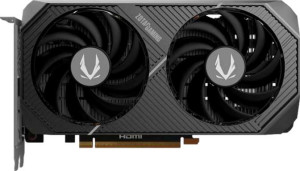
Sharing the same Blackwell architecture, 5 nm process node, and PCIe 5.0 interface, both cards come from the same hardware generation — so neither has a platform-level advantage over the other. The process node and architecture parity means both benefit from the same generational efficiency and feature improvements. Where they diverge is in silicon scale: the RTX 5070 Solid OC packs 31,100 million transistors versus 21,900 million on the RTX 5060 Twin Edge OC, a ~42% larger die. This directly underpins the performance gap seen in other groups — more transistors means more compute, more memory controllers, and more silicon dedicated to rendering.
That larger die comes with a proportionally higher power demand. The 5070 carries a 250W TDP compared to the 5060's 145W — a difference of 105W. In practical terms, this means the 5070 requires a more capable PSU, generates more heat, and places greater demands on case airflow. For small form factor or power-constrained builds, the 5060's significantly lower thermal footprint is a real advantage. Physically, the 5070 is also notably longer at 304.4 mm versus 220.5 mm, which could be a fitment concern in compact cases.
Neither card holds a generational or platform edge here — both are modern, well-fabricated GPUs on the same node. However, the 5060 Twin Edge OC has a tangible practical advantage for users prioritizing power efficiency and compact builds, while the 5070 Solid OC's larger die is the necessary cost of its higher performance tier.