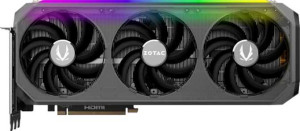
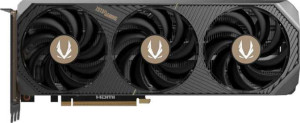
At the foundation, both cards share an identical hardware configuration: 8960 shading units, 280 TMUs, 96 ROPs, and the same base clock of 2295 MHz with memory running at 1750 MHz. This means the two GPUs are built on the same silicon with the same theoretical ceiling for parallelism — any performance gap between them comes down entirely to sustained boost clocks rather than architectural differences.
The real differentiator is the GPU turbo clock. The AMP Extreme Infinity boosts to 2512 MHz versus 2482 MHz on the Solid Core OC — a 30 MHz advantage that flows directly into every derived metric: floating-point performance lands at 45.02 TFLOPS versus 44.48 TFLOPS, texture throughput at 703.4 GTexels/s versus 695 GTexels/s, and pixel fill rate at 241.2 GPixel/s versus 238.3 GPixel/s. In practice, a ~1.2% clock advantage translates to a similarly slim real-world performance delta — one that will rarely be perceptible in gaming frame rates, but could matter slightly in sustained compute-heavy workloads or content creation tasks where every TFLOP counts over long render times.
In this group, the AMP Extreme Infinity holds a narrow but consistent edge across all throughput metrics, driven solely by its higher turbo clock. Both cards support Double Precision Floating Point, so neither has an advantage for professional or scientific compute. For pure gaming, the gap is negligible; only users pushing the card in sustained compute or rendering pipelines will notice the difference — making the AMP Extreme Infinity the marginal winner here, with the Solid Core OC essentially matching it in any real-world scenario.