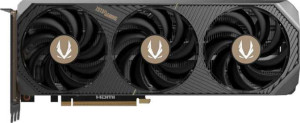
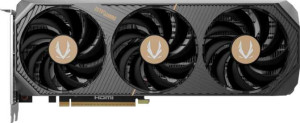
At their core, both cards share an identical foundation: the same 2295 MHz base clock, 8960 shading units, 280 TMUs, 96 ROPs, and 1750 MHz memory speed. This means the two GPUs are built on the exact same silicon with the same theoretical throughput ceiling — the differences between them come down entirely to how aggressively each card is tuned to reach that ceiling.
The single meaningful differentiator in this group is boost clock: the Solid Core OC reaches 2482 MHz under turbo, while the Solid SFF tops out at 2452 MHz — a gap of 30 MHz, or roughly 1.2%. That small frequency advantage cascades into slightly higher derived figures: the Solid Core OC edges ahead with 44.48 TFLOPS of floating-point performance versus 43.94 TFLOPS, and a marginally higher pixel rate of 238.3 GPixel/s compared to 235.4 GPixel/s. In practice, a sub-2% gap in compute throughput will be imperceptible in real gaming workloads — frame-time differences at this scale are well within noise.
The Solid Core OC holds a narrow technical edge in raw performance on paper, but the advantage is effectively academic for gameplay. The more meaningful distinction between these two cards almost certainly lies outside this spec group — in thermals, power delivery, and form factor — since the SFF designation suggests a compact cooling solution that would explain its slightly conservative boost target. For pure performance metrics alone, consider these cards functionally equivalent.