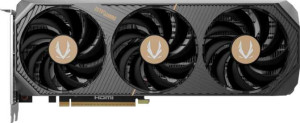
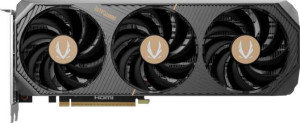
At their core, both the Zotac Gaming RTX 5070 Ti Solid SFF and its OC variant share an identical architectural foundation: the same 8960 shading units, 280 TMUs, 96 ROPs, identical base clock of 2295 MHz, and the same 1750 MHz memory speed. This means the two cards are built from the same silicon and will behave identically under sustained, thermally-constrained workloads where boost clocks cannot be maintained.
The only meaningful divergence lies in the GPU turbo (boost) clock: the standard model tops out at 2452 MHz, while the OC edition reaches 2482 MHz — a difference of just 30 MHz, or roughly 1.2%. This modest frequency bump cascades into proportionally small gains across every derived throughput metric: floating-point performance moves from 43.94 TFLOPS to 44.48 TFLOPS, texture rate from 686.6 GTexels/s to 695 GTexels/s, and pixel rate from 235.4 GPixel/s to 238.3 GPixel/s. In practice, these deltas fall well within the margin of run-to-run benchmark variance and would be imperceptible in real-world gaming or rendering scenarios.
The OC edition holds a technical edge in this group, but it is a marginal one that is unlikely to translate into a noticeable difference in frame rates or compute tasks. Buyers prioritizing peak-on-paper performance should lean toward the OC model, but those focused on value should weigh whether the factory overclock justifies any price premium, given how negligible the real-world gap is.