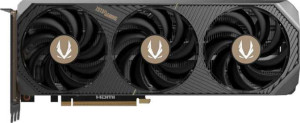
Zotac Gaming GeForce RTX 5070 Ti Solid
Zotac Gaming GeForce RTX 5070 Ti Solid Core OC

Zotac Gaming GeForce RTX 5070 Ti Solid Zotac Gaming GeForce RTX 5070 Ti Solid Core OC

Overview

Choosing between the Zotac Gaming GeForce RTX 5070 Ti Solid and the Zotac Gaming GeForce RTX 5070 Ti Solid Core OC means navigating a subtle but meaningful rivalry within the same GPU family. Both cards share the same Blackwell architecture and identical memory setup, yet they diverge on boost clock speeds, calculated performance figures, and notably their physical dimensions. This in-depth comparison examines every specification to help you decide which RTX 5070 Ti variant is the right fit for your build.

Common Features

  • Both cards share a base GPU clock speed of 2295 MHz.
  • Both cards have a GPU memory speed of 1750 MHz.
  • Both cards feature 8960 shading units.
  • Both cards include 280 texture mapping units (TMUs).
  • Both cards have 96 render output units (ROPs).
  • Double Precision Floating Point (DPFP) is supported on both cards.
  • Both cards have an effective memory speed of 28000 MHz.
  • Both cards offer a maximum memory bandwidth of 896 GB/s.
  • Both cards come with 16GB of VRAM.
  • Both cards use GDDR7 memory.
  • Both cards feature a 256-bit memory bus width.
  • ECC memory is supported on both cards.
  • Both cards support DirectX 12 Ultimate.
  • Both cards support OpenGL version 4.6.
  • Both cards support OpenCL version 3.
  • Multi-display technology is supported on both cards.
  • Ray tracing is supported on both cards.
  • 3D support is available on both cards.
  • DLSS is supported on both cards.
  • XeSS (XMX) is not available on either card.
  • Both cards feature one HDMI 2.1b output.
  • Both cards include three DisplayPort outputs.
  • Neither card has USB-C ports, DVI outputs, or mini DisplayPort outputs.
  • Both cards are based on the Blackwell GPU architecture.
  • Both cards have a Thermal Design Power (TDP) of 300W.
  • Both cards use PCIe version 5.
  • Both cards are manufactured on a 5 nm process.
  • Both cards feature 45600 million transistors.
  • Neither card has air-water cooling.

Main Differences

  • GPU turbo clock speed is 2452 MHz on the Zotac Gaming GeForce RTX 5070 Ti Solid and 2482 MHz on the Zotac Gaming GeForce RTX 5070 Ti Solid Core OC.
  • Pixel rate is 235.4 GPixel/s on the Zotac Gaming GeForce RTX 5070 Ti Solid and 238.3 GPixel/s on the Zotac Gaming GeForce RTX 5070 Ti Solid Core OC.
  • Floating-point performance is 43.94 TFLOPS on the Zotac Gaming GeForce RTX 5070 Ti Solid and 44.48 TFLOPS on the Zotac Gaming GeForce RTX 5070 Ti Solid Core OC.
  • Texture rate is 686.6 GTexels/s on the Zotac Gaming GeForce RTX 5070 Ti Solid and 695 GTexels/s on the Zotac Gaming GeForce RTX 5070 Ti Solid Core OC.
  • Card width is 329.7 mm on the Zotac Gaming GeForce RTX 5070 Ti Solid and 303.5 mm on the Zotac Gaming GeForce RTX 5070 Ti Solid Core OC.
  • Card height is 137.8 mm on the Zotac Gaming GeForce RTX 5070 Ti Solid and 115.8 mm on the Zotac Gaming GeForce RTX 5070 Ti Solid Core OC.
Specs Comparison
Zotac Gaming GeForce RTX 5070 Ti Solid

Zotac Gaming GeForce RTX 5070 Ti Solid

Zotac Gaming GeForce RTX 5070 Ti Solid Core OC

Zotac Gaming GeForce RTX 5070 Ti Solid Core OC

Performance:
GPU clock speed 2295 MHz 2295 MHz
GPU turbo 2452 MHz 2482 MHz
pixel rate 235.4 GPixel/s 238.3 GPixel/s
floating-point performance 43.94 TFLOPS 44.48 TFLOPS
texture rate 686.6 GTexels/s 695 GTexels/s
GPU memory speed 1750 MHz 1750 MHz
shading units 8960 8960
texture mapping units (TMUs) 280 280
render output units (ROPs) 96 96
Has Double Precision Floating Point (DPFP)

At their core, both cards share an identical foundation: the same 2295 MHz base clock, 8960 shading units, 280 TMUs, 96 ROPs, and 1750 MHz memory speed. This means the two cards are built on the exact same silicon configuration, and any performance difference between them comes down entirely to how aggressively the boost clock is tuned.

The one tangible differentiator is the GPU turbo clock: the Solid Core OC reaches 2482 MHz versus 2452 MHz on the standard Solid — a 30 MHz advantage. This carries through to every derived throughput metric: floating-point performance comes in at 44.48 TFLOPS vs 43.94 TFLOPS, texture rate at 695 vs 686.6 GTexels/s, and pixel rate at 238.3 vs 235.4 GPixel/s. In practice, a ~1.2% boost clock advantage translates to a similarly marginal ~1.2% uplift across all compute and rendering throughput figures — a gap that falls well within normal frame-to-frame variance in real gaming workloads.

The Solid Core OC holds a technical edge in this group, but it is a narrow one. Both cards support Double Precision Floating Point, and their architectural parity means the performance gap will rarely be perceptible in games or typical GPU-accelerated tasks. The OC variant's advantage is real on paper, but buyers should weigh it against any price premium — the Solid is essentially the same card running at a fractionally more conservative boost target.

Memory:
effective memory speed 28000 MHz 28000 MHz
maximum memory bandwidth 896 GB/s 896 GB/s
VRAM 16GB 16GB
GDDR version GDDR7 GDDR7
memory bus width 256-bit 256-bit
Supports ECC memory

Memory is a complete dead heat between these two cards — every single spec is identical. Both carry 16GB of GDDR7 across a 256-bit bus, running at an effective 28000 MHz for a peak bandwidth of 896 GB/s. That bandwidth figure is particularly significant: it reflects a meaningful generational step forward enabled by GDDR7, delivering substantially higher throughput than GDDR6X solutions at equivalent bus widths.

In practical terms, 16GB of VRAM is well-suited for high-resolution gaming and content creation workloads in 2025 and beyond — comfortably handling 4K texture assets and large AI inference models without the memory pressure that tighter VRAM budgets can introduce. The 256-bit bus ensures that bandwidth is delivered efficiently, avoiding bottlenecks even in memory-intensive scenarios. ECC memory support is a bonus for users running compute or professional workloads where data integrity matters, though it has no bearing on gaming performance.

There is no winner to declare here — this group is an absolute tie. Whichever card a buyer chooses, they are getting an identical memory subsystem with no trade-offs on either side.

Features:
DirectX version DirectX 12 Ultimate DirectX 12 Ultimate
OpenGL version 4.6 4.6
OpenCL version 3 3
Supports multi-display technology
supports ray tracing
Supports 3D
supports DLSS
has XeSS (XMX)
AMD SAM / Intel Resizable BAR Intel Resizable BAR Intel Resizable BAR
has LHR
has RGB lighting
supported displays 4 4

Feature parity is total between these two cards — the spec sheet for this group is a mirror image across both. The headlining capability is DirectX 12 Ultimate support, which unlocks the full suite of modern rendering features including hardware-accelerated ray tracing, mesh shaders, and variable-rate shading. Combined with DLSS support, users get access to Nvidia's AI-driven upscaling and frame generation pipeline, which can dramatically boost effective frame rates in supported titles without a proportional increase in rendering load.

On the practical side, both cards support up to 4 simultaneous displays and include Intel Resizable BAR, which allows the CPU to access the full GPU frame buffer at once rather than in small chunks — a feature that can yield meaningful performance gains in some titles. The absence of LHR (Lite Hash Rate) on both is a non-issue for gaming buyers, and RGB lighting is present on each for those building an aesthetically coordinated system.

This group is an unambiguous tie. Not a single feature differentiates the Solid from the Solid Core OC — buyers can make their choice entirely on price, cooling, or the clock speed difference covered elsewhere, knowing the feature set they get will be completely identical.

Ports:
has an HDMI output
HDMI ports 1 1
HDMI version HDMI 2.1b HDMI 2.1b
DisplayPort outputs 3 3
USB-C ports 0 0
DVI outputs 0 0
mini DisplayPort outputs 0 0

Both cards sport an identical port configuration: 3 DisplayPort outputs and 1 HDMI 2.1b port, totalling four display connections — which aligns with the four-display limit noted in the Features group. The combination is well-chosen for a card at this tier, covering the most common monitor and TV connection standards without compromise.

The HDMI 2.1b implementation is worth highlighting for home theater and high-refresh-rate users: it supports the bandwidth necessary for 4K at high refresh rates and 8K output, making either card a capable choice for driving a modern television alongside a gaming monitor. The triple DisplayPort layout, meanwhile, is ideal for multi-monitor desktop setups. The absence of USB-C, DVI, and mini DisplayPort outputs is unremarkable — these are largely legacy or niche connectors at this product level, and their omission has no practical impact for the vast majority of buyers.

Another clean tie. The port layout is identical on both cards, so connectivity should play no part in the decision between the Solid and the Solid Core OC.

General info:
GPU architecture Blackwell Blackwell
release date February 2025 February 2025
Thermal Design Power (TDP) 300W 300W
PCI Express (PCIe) version 5 5
semiconductor size 5 nm 5 nm
number of transistors 45600 million 45600 million
Has air-water cooling
width 329.7 mm 303.5 mm
height 137.8 mm 115.8 mm

Underneath, both cards are built on the same Blackwell architecture, fabbed on a 5nm process with an identical 45.6 billion transistors and a shared 300W TDP. The PCIe 5.0 interface ensures neither card will face any bandwidth bottleneck on a modern platform. In short, the silicon story is identical — same chip, same power envelope.

Where this group gets interesting is physical size. The Solid measures 329.7 × 137.8 mm, while the Solid Core OC comes in at a noticeably more compact 303.5 × 115.8 mm — that is roughly 26mm shorter in length and 22mm slimmer in height. For a card with an identical TDP, this is a meaningful engineering difference: the Solid Core OC manages to dissipate the same 300W within a significantly smaller cooler footprint. Practically, this makes it a friendlier fit for tighter mid-tower cases and chassis with restricted GPU clearance.

The Solid Core OC holds a clear advantage in this group. It delivers the same power draw and architectural foundation in a more compact form factor, which is genuinely useful for system builders working within space constraints. The standard Solid's larger dimensions offer no compensating benefit based on the provided data — its size is simply greater without any corresponding gain.

Comparison Summary & Verdict

After examining all available specifications, both the Zotac Gaming GeForce RTX 5070 Ti Solid and the Zotac Gaming GeForce RTX 5070 Ti Solid Core OC prove to be extremely capable cards sharing the same Blackwell architecture, 16GB GDDR7 memory, 256-bit bus, 300W TDP, and full support for ray tracing and DLSS. The meaningful edge belongs to the Solid Core OC, which achieves a higher boost clock of 2482 MHz versus 2452 MHz, translating into slightly better pixel rate, texture rate, and floating-point throughput. Crucially, the Solid Core OC also has a more compact footprint at 303.5 x 115.8 mm compared to the Solid at 329.7 x 137.8 mm. If you want every bit of out-of-the-box performance and easier case compatibility, the Solid Core OC is the stronger choice. The Solid suits buyers who are less constrained by size and find the base configuration fully sufficient for their needs.

Zotac Gaming GeForce RTX 5070 Ti Solid
Buy Zotac Gaming GeForce RTX 5070 Ti Solid if...

Buy the Zotac Gaming GeForce RTX 5070 Ti Solid if you have a spacious case with no size constraints and are comfortable with its slightly lower boost clock of 2452 MHz.

Zotac Gaming GeForce RTX 5070 Ti Solid Core OC
Buy Zotac Gaming GeForce RTX 5070 Ti Solid Core OC if...

Buy the Zotac Gaming GeForce RTX 5070 Ti Solid Core OC if you want a higher boost clock of 2482 MHz and a more compact card that fits more PC cases.