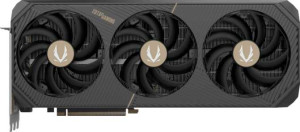
Zotac Gaming GeForce RTX 5070 Ti Solid
Zotac Gaming GeForce RTX 5070 Ti Solid OC

Zotac Gaming GeForce RTX 5070 Ti Solid Zotac Gaming GeForce RTX 5070 Ti Solid OC

Overview

Welcome to our in-depth specification comparison between the Zotac Gaming GeForce RTX 5070 Ti Solid and the Zotac Gaming GeForce RTX 5070 Ti Solid OC. Both cards are built on the same Blackwell architecture and share an identical memory configuration, yet they diverge in key clock speeds and throughput metrics that may matter to demanding users. Read on as we break down every spec to help you decide which card best fits your needs.

Common Features

  • Both cards share a base GPU clock speed of 2295 MHz.
  • Both cards have a GPU memory speed of 1750 MHz.
  • Both cards feature 8960 shading units.
  • Both cards include 280 texture mapping units (TMUs).
  • Both cards have 96 render output units (ROPs).
  • Double Precision Floating Point (DPFP) is supported on both cards.
  • Both cards have an effective memory speed of 28000 MHz.
  • Both cards offer a maximum memory bandwidth of 896 GB/s.
  • Both cards are equipped with 16GB of VRAM.
  • Both cards use GDDR7 memory.
  • Both cards have a 256-bit memory bus width.
  • ECC memory is supported on both cards.
  • Both cards support DirectX 12 Ultimate.
  • Both cards support OpenGL version 4.6.
  • Both cards support OpenCL version 3.
  • Multi-display technology is supported on both cards.
  • Ray tracing is supported on both cards.
  • 3D support is available on both cards.
  • DLSS is supported on both cards.
  • XeSS (XMX) is not available on either card.
  • Both cards feature one HDMI 2.1b output.
  • Both cards include three DisplayPort outputs.
  • Neither card includes USB-C or DVI outputs.
  • Both cards are built on the Blackwell GPU architecture.
  • Both cards have a Thermal Design Power (TDP) of 300W.
  • Both cards use PCIe version 5.
  • Both cards are manufactured on a 5 nm semiconductor process.
  • Both cards contain 45,600 million transistors.
  • Air-water cooling is not available on either card.
  • Both cards share the same dimensions of 329.7 mm width and 137.8 mm height.

Main Differences

  • GPU turbo clock speed is 2452 MHz on Zotac Gaming GeForce RTX 5070 Ti Solid and 2482 MHz on Zotac Gaming GeForce RTX 5070 Ti Solid OC.
  • Pixel rate is 235.4 GPixel/s on Zotac Gaming GeForce RTX 5070 Ti Solid and 238.3 GPixel/s on Zotac Gaming GeForce RTX 5070 Ti Solid OC.
  • Floating-point performance is 43.94 TFLOPS on Zotac Gaming GeForce RTX 5070 Ti Solid and 44.48 TFLOPS on Zotac Gaming GeForce RTX 5070 Ti Solid OC.
  • Texture rate is 686.6 GTexels/s on Zotac Gaming GeForce RTX 5070 Ti Solid and 695 GTexels/s on Zotac Gaming GeForce RTX 5070 Ti Solid OC.
Specs Comparison
Zotac Gaming GeForce RTX 5070 Ti Solid

Zotac Gaming GeForce RTX 5070 Ti Solid

Zotac Gaming GeForce RTX 5070 Ti Solid OC

Zotac Gaming GeForce RTX 5070 Ti Solid OC

Performance:
GPU clock speed 2295 MHz 2295 MHz
GPU turbo 2452 MHz 2482 MHz
pixel rate 235.4 GPixel/s 238.3 GPixel/s
floating-point performance 43.94 TFLOPS 44.48 TFLOPS
texture rate 686.6 GTexels/s 695 GTexels/s
GPU memory speed 1750 MHz 1750 MHz
shading units 8960 8960
texture mapping units (TMUs) 280 280
render output units (ROPs) 96 96
Has Double Precision Floating Point (DPFP)

Both cards share an identical foundation: the same 2295 MHz base clock, 8960 shading units, 280 TMUs, 96 ROPs, and 1750 MHz memory speed. This means the underlying GPU silicon and memory subsystem are functionally equivalent, and any performance delta between the two comes down entirely to how aggressively the boost clock is tuned from the factory.

The sole but meaningful differentiator is the GPU turbo clock: the standard Solid peaks at 2452 MHz, while the OC variant pushes to 2482 MHz — a 30 MHz advantage. That gap cascades directly into every throughput metric: the OC pulls ahead with 44.48 TFLOPS of floating-point performance versus 43.94 TFLOPS, a 695 GTexels/s texture fill rate against 686.6 GTexels/s, and a 238.3 GPixel/s pixel rate compared to 235.4 GPixel/s. In relative terms, the OC is roughly 1.2–1.4% faster across all derived throughput figures.

In practice, a ~1.3% performance gap is imperceptible in any real workload — no benchmark or game frame-time will meaningfully separate these two cards. Both support double-precision floating point, making them equally capable for compute tasks. The OC edition holds the technical edge on paper, but the advantage is marginal enough that the buying decision should hinge on price, cooling, and noise characteristics rather than raw GPU performance.

Memory:
effective memory speed 28000 MHz 28000 MHz
maximum memory bandwidth 896 GB/s 896 GB/s
VRAM 16GB 16GB
GDDR version GDDR7 GDDR7
memory bus width 256-bit 256-bit
Supports ECC memory

On memory, these two cards are completely identical — there is no differentiator to speak of. Both carry 16GB of GDDR7 across a 256-bit bus, running at an effective 28000 MHz to deliver 896 GB/s of memory bandwidth. ECC memory support is also present on both.

The specifications here are genuinely impressive in absolute terms. GDDR7 is the current leading consumer GPU memory standard, and 896 GB/s of bandwidth is substantial — enough to feed even the most texture- and resolution-heavy workloads, including 4K gaming, generative AI inference, and large model fine-tuning tasks where VRAM capacity is often the hard ceiling. The 16GB pool is also meaningfully future-proof for high-resolution gaming and creative workloads that are increasingly pushing past the 12GB threshold.

This category is a dead tie. Since every memory specification is shared down to the last detail, the memory subsystem contributes nothing to any buying decision between these two cards. Shoppers should look entirely at other spec groups — particularly price and cooling — to differentiate them.

Features:
DirectX version DirectX 12 Ultimate DirectX 12 Ultimate
OpenGL version 4.6 4.6
OpenCL version 3 3
Supports multi-display technology
supports ray tracing
Supports 3D
supports DLSS
has XeSS (XMX)
AMD SAM / Intel Resizable BAR Intel Resizable BAR Intel Resizable BAR
has LHR
has RGB lighting
supported displays 4 4

Feature parity is absolute between these two cards — every capability listed is shared identically. The most consequential of these is DirectX 12 Ultimate support, which unlocks the full suite of modern rendering features including hardware-accelerated ray tracing and mesh shaders, ensuring both cards are compatible with the current and near-future generation of graphically demanding titles.

DLSS support is particularly valuable here, as it allows the GPU to use AI-based upscaling to render at lower internal resolutions and reconstruct a higher-quality image — effectively boosting frame rates with minimal visual cost. Combined with ray tracing, this pairing is the practical backbone of modern high-fidelity gaming. Intel Resizable BAR support further allows the CPU to access the full GPU framebuffer simultaneously rather than in small chunks, which can yield measurable frame rate improvements in CPU-bound scenarios. Both cards also support up to 4 displays simultaneously, making either a capable option for multi-monitor productivity or gaming setups.

With no feature present on one card but absent on the other, this category is an unambiguous tie. Whichever card a buyer chooses, they get an identical software and API feature set. The decision remains firmly in the territory of price, thermals, and the marginal clock speed difference covered elsewhere.

Ports:
has an HDMI output
HDMI ports 1 1
HDMI version HDMI 2.1b HDMI 2.1b
DisplayPort outputs 3 3
USB-C ports 0 0
DVI outputs 0 0
mini DisplayPort outputs 0 0

The port configuration is identical across both cards: 3 DisplayPort outputs and 1 HDMI 2.1b port, totaling four physical outputs — which aligns with the four-display limit noted in the features group. There are no USB-C, DVI, or mini DisplayPort connectors on either card.

HDMI 2.1b is the most capable consumer HDMI standard available, supporting 4K at high refresh rates and 8K output, making either card a solid pairing for modern televisions and high-end monitors alike. The triple DisplayPort arrangement is equally practical for multi-monitor desktop setups, and having four usable outputs in total gives users genuine flexibility without needing a hub or adapter in most configurations.

There is nothing to separate these two cards here — the port layout is a complete tie. Connectivity should play no role in the buying decision between the Solid and the Solid OC.

General info:
GPU architecture Blackwell Blackwell
release date February 2025 February 2025
Thermal Design Power (TDP) 300W 300W
PCI Express (PCIe) version 5 5
semiconductor size 5 nm 5 nm
number of transistors 45600 million 45600 million
Has air-water cooling
width 329.7 mm 329.7 mm
height 137.8 mm 137.8 mm

At the foundational level, these two cards are cut from precisely the same cloth. Both are built on the Blackwell architecture using a 5nm process node packing 45.6 billion transistors, and both connect via PCIe 5.0 — the current standard that ensures maximum bandwidth between the GPU and CPU with no bottleneck at the slot level.

Thermally and physically, the story is equally uniform. A shared 300W TDP means both cards impose identical demands on a system's power supply and case airflow, and builders should plan accordingly — this is a high-draw card that requires adequate PSU headroom and ventilation. The physical footprint is also the same at 329.7 × 137.8 mm, so case compatibility is a non-issue when choosing between the two; either card will fit or fail to fit in the same chassis.

This group produces yet another complete tie. Shared architecture, process node, transistor count, TDP, PCIe generation, and dimensions leave no angle from which one card distinguishes itself from the other here. The cumulative picture across all spec groups continues to point to the boost clock as the only real variable between the Solid and the Solid OC.

Comparison Summary & Verdict

After examining both cards thoroughly, it is clear that the Zotac Gaming GeForce RTX 5070 Ti Solid and the Zotac Gaming GeForce RTX 5070 Ti Solid OC are nearly identical in design, memory, features, and build quality. The meaningful separation lies in the GPU turbo clock (2452 MHz vs 2482 MHz), floating-point performance (43.94 TFLOPS vs 44.48 TFLOPS), pixel rate, and texture rate, all of which edge slightly higher on the OC variant. Gamers and creators who want every last drop of factory-tuned performance will appreciate the OC model, while those who prioritize value and have no interest in a modest factory overclock will find the standard Solid an equally capable and well-rounded card with no compromises on memory bandwidth, features, or port selection.

Zotac Gaming GeForce RTX 5070 Ti Solid
Buy Zotac Gaming GeForce RTX 5070 Ti Solid if...

Buy the Zotac Gaming GeForce RTX 5070 Ti Solid if you want the same core architecture, memory, and feature set at the base factory clock speed and have no need for the marginal performance uplift of an overclock.

Zotac Gaming GeForce RTX 5070 Ti Solid OC
Buy Zotac Gaming GeForce RTX 5070 Ti Solid OC if...

Buy the Zotac Gaming GeForce RTX 5070 Ti Solid OC if you want the highest factory-tuned GPU turbo clock, pixel rate, texture rate, and floating-point performance available between these two cards.