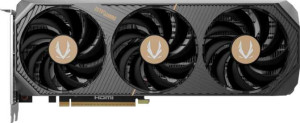
Zotac Gaming GeForce RTX 5070 Ti Solid
Zotac Gaming GeForce RTX 5070 Ti Solid SFF

Zotac Gaming GeForce RTX 5070 Ti Solid Zotac Gaming GeForce RTX 5070 Ti Solid SFF

Overview

Welcome to our in-depth specification comparison between the Zotac Gaming GeForce RTX 5070 Ti Solid and the Zotac Gaming GeForce RTX 5070 Ti Solid SFF. Both cards are built on the same Blackwell architecture and share an impressive set of features, yet they take different approaches when it comes to physical form factor. If chassis compatibility and build space are part of your decision, this comparison will help you find the right fit.

Common Features

  • GPU clock speed is 2295 MHz on both products.
  • GPU turbo speed is 2452 MHz on both products.
  • Pixel rate is 235.4 GPixel/s on both products.
  • Floating-point performance is 43.94 TFLOPS on both products.
  • Texture rate is 686.6 GTexels/s on both products.
  • GPU memory speed is 1750 MHz on both products.
  • Both products have 8960 shading units.
  • Both products have 280 texture mapping units (TMUs).
  • Effective memory speed is 28000 MHz on both products.
  • Maximum memory bandwidth is 896 GB/s on both products.
  • Both products feature 16GB of VRAM.
  • Both products use GDDR7 memory.
  • Memory bus width is 256-bit on both products.
  • ECC memory support is available on both products.
  • Both products support DirectX 12 Ultimate.
  • OpenGL version is 4.6 on both products.
  • OpenCL version is 3 on both products.
  • Multi-display technology support is available on both products.
  • Ray tracing support is available on both products.
  • DLSS support is available on both products.
  • XeSS (XMX) support is not available on either product.
  • Both products include one HDMI 2.1b output.
  • Both products have three DisplayPort outputs.
  • Neither product has USB-C, DVI, or mini DisplayPort outputs.
  • Both products are based on the Blackwell GPU architecture.
  • Thermal Design Power (TDP) is 300W on both products.
  • Both products use PCIe version 5.
  • Semiconductor size is 5 nm on both products.
  • Both products feature 45600 million transistors.
  • Air-water cooling is not available on either product.

Main Differences

  • Width is 329.7 mm on Zotac Gaming GeForce RTX 5070 Ti Solid and 304.4 mm on Zotac Gaming GeForce RTX 5070 Ti Solid SFF.
  • Height is 137.8 mm on Zotac Gaming GeForce RTX 5070 Ti Solid and 115.8 mm on Zotac Gaming GeForce RTX 5070 Ti Solid SFF.
Specs Comparison
Zotac Gaming GeForce RTX 5070 Ti Solid

Zotac Gaming GeForce RTX 5070 Ti Solid

Zotac Gaming GeForce RTX 5070 Ti Solid SFF

Zotac Gaming GeForce RTX 5070 Ti Solid SFF

Performance:
GPU clock speed 2295 MHz 2295 MHz
GPU turbo 2452 MHz 2452 MHz
pixel rate 235.4 GPixel/s 235.4 GPixel/s
floating-point performance 43.94 TFLOPS 43.94 TFLOPS
texture rate 686.6 GTexels/s 686.6 GTexels/s
GPU memory speed 1750 MHz 1750 MHz
shading units 8960 8960
texture mapping units (TMUs) 280 280
render output units (ROPs) 96 96
Has Double Precision Floating Point (DPFP)

When it comes to raw GPU performance, the Zotac Gaming GeForce RTX 5070 Ti Solid and the Solid SFF are, in every measurable way, identical twins. Both share the same 2295 MHz base clock and 2452 MHz boost clock, meaning neither card has a factory overclock advantage over the other — they both run the GPU silicon at exactly the same frequencies under load.

This clock-for-clock parity cascades through every derived metric: pixel fill rate (235.4 GPixel/s), texture rate (686.6 GTexels/s), and floating-point throughput (43.94 TFLOPS) are all identical. The shader, TMU, and ROP counts — 8960 shading units, 280 TMUs, and 96 ROPs — confirm these two cards are built around the exact same GPU configuration with no binning or hardware differences. Memory speed is equally matched at 1750 MHz, so bandwidth-sensitive workloads like high-resolution texture streaming will behave identically on both.

The performance verdict for this group is a complete tie. A user choosing between the Solid and the Solid SFF will experience no difference whatsoever in gaming frame rates, compute throughput, or rendering workloads based on these specs alone. The decision between them should therefore rest entirely on other factors — form factor, cooling solution, and physical dimensions — rather than performance, where neither card holds any edge.

Memory:
effective memory speed 28000 MHz 28000 MHz
maximum memory bandwidth 896 GB/s 896 GB/s
VRAM 16GB 16GB
GDDR version GDDR7 GDDR7
memory bus width 256-bit 256-bit
Supports ECC memory

The memory subsystem is one of the most consequential aspects of a modern GPU, and here both the Solid and the Solid SFF arrive with an identical and highly capable configuration. Both cards feature 16GB of GDDR7 running across a 256-bit bus, delivering a peak bandwidth of 896 GB/s. That figure is particularly significant — it sits well above what GDDR6X configurations at the same bus width could achieve, thanks to GDDR7's generational efficiency gains. In practice, this bandwidth headroom translates to smoother 4K texture streaming, faster asset loading in open-world titles, and reduced stuttering in memory-intensive workloads.

The 16GB VRAM capacity deserves a mention in context: it comfortably handles modern AAA games at high resolutions with demanding texture packs, and it provides meaningful runway for AI-accelerated workloads and creative applications that increasingly push VRAM limits. The added support for ECC memory is a subtle but noteworthy inclusion — while rarely relevant for pure gaming, it matters for users running compute tasks or professional workflows where data integrity under sustained load is a priority.

As with performance, memory is a complete tie between these two cards. Every specification — capacity, speed, bus width, bandwidth, and ECC support — is identical. Buyers should not factor memory into their decision at all; both cards will behave in exactly the same way in every memory-bound scenario imaginable.

Features:
DirectX version DirectX 12 Ultimate DirectX 12 Ultimate
OpenGL version 4.6 4.6
OpenCL version 3 3
Supports multi-display technology
supports ray tracing
Supports 3D
supports DLSS
has XeSS (XMX)
AMD SAM / Intel Resizable BAR Intel Resizable BAR Intel Resizable BAR
has LHR
has RGB lighting
supported displays 4 4

Feature parity continues to define this comparison. Both the Solid and the Solid SFF support DirectX 12 Ultimate and ray tracing, which together unlock the full suite of modern rendering techniques — hardware-accelerated reflections, shadows, and global illumination — in any title that supports them. Equally important for competitive and quality-focused gaming alike is DLSS support, Nvidia's AI-driven upscaling technology that can dramatically boost frame rates with minimal visual penalty, a meaningful advantage over GPU-agnostic upscalers.

On the multi-monitor front, both cards drive up to 4 displays simultaneously, which is sufficient for virtually any productivity or gaming multi-screen setup. Intel Resizable BAR support is also shared, allowing the CPU to access the full GPU frame buffer at once rather than in small chunks — a feature that can yield measurable frame rate gains in select titles when the host system supports it. The presence of RGB lighting on both cards is worth noting for builders who care about aesthetic cohesion inside a windowed case, though it carries no functional weight.

There is no differentiator to call out here — the feature set is a complete tie across every data point provided. Whichever variant a buyer chooses, they get the same software ecosystem, the same API support, and the same display capabilities. As with performance and memory, the choice between these two cards must be driven by physical and thermal considerations, not features.

Ports:
has an HDMI output
HDMI ports 1 1
HDMI version HDMI 2.1b HDMI 2.1b
DisplayPort outputs 3 3
USB-C ports 0 0
DVI outputs 0 0
mini DisplayPort outputs 0 0

Port selection is an area where both the Solid and the Solid SFF offer a practical and modern layout: one HDMI 2.1b output paired with three DisplayPort outputs, for a total of four simultaneous display connections. This aligns perfectly with the four-display limit established in the Features group, meaning every available port can be put to use at once without any bottleneck on the I/O side.

The inclusion of HDMI 2.1b is the headline here. It supports the bandwidth needed for 4K at high refresh rates and 8K output, making either card a future-ready choice for users investing in next-generation displays or home theater setups. The triple DisplayPort outputs, meanwhile, are the natural choice for multi-monitor productivity rigs and high-refresh gaming arrays. The absence of USB-C is worth noting for users who own USB-C or Thunderbolt-based displays — an adapter would be required in those cases — but this is a common configuration at this tier and not a drawback unique to either card.

Predictably, this group yields another complete tie. The port layout is identical across both variants, so connectivity cannot factor into a purchase decision here. Both cards will serve the same display configurations equally well, regardless of whether the buyer opts for the standard or SFF form factor.

General info:
GPU architecture Blackwell Blackwell
release date February 2025 March 2025
Thermal Design Power (TDP) 300W 300W
PCI Express (PCIe) version 5 5
semiconductor size 5 nm 5 nm
number of transistors 45600 million 45600 million
Has air-water cooling
width 329.7 mm 304.4 mm
height 137.8 mm 115.8 mm

After four groups of perfect parity, General Info is where this comparison finally surfaces a meaningful differentiator. Both cards share the same Blackwell architecture, the same 5nm process node, and an identical 300W TDP — confirming they are thermally and electrically equivalent demands on any system. PCIe 5.0 support is shared as well, though real-world bandwidth gains over PCIe 4.0 remain marginal for GPU workloads at this time.

The one area where these two cards genuinely diverge is physical size. The standard Solid measures 329.7 mm × 137.8 mm, while the Solid SFF comes in noticeably more compact at 304.4 mm × 115.8 mm — that is a reduction of roughly 25mm in length and 22mm in height. For builders working with full-size ATX towers, this distinction is largely academic. But for anyone targeting a smaller mid-tower, an ITX build, or a case with tight GPU clearance constraints, the SFF variant's reduced footprint could be the deciding factor that makes installation possible at all.

This group hands a contextual edge to the Solid SFF. It delivers the exact same architecture, power envelope, and silicon at a meaningfully smaller physical size — which is precisely the point of an SFF variant. Buyers with spacious cases lose nothing by choosing either card, but those with constrained builds gain real flexibility by opting for the SFF without sacrificing any performance or features.

Comparison Summary & Verdict

After examining every specification, it is clear that the Zotac Gaming GeForce RTX 5070 Ti Solid and the Zotac Gaming GeForce RTX 5070 Ti Solid SFF are functionally identical cards, sharing the same 43.94 TFLOPS of floating-point performance, 16GB of GDDR7 memory on a 256-bit bus, a 300W TDP, and full support for ray tracing and DLSS. The only measurable distinction between them lies in their physical dimensions: the standard Solid measures 329.7 x 137.8 mm, while the Solid SFF is more compact at 304.4 x 115.8 mm. Choose the Zotac Gaming GeForce RTX 5070 Ti Solid if your case has no size restrictions and standard card dimensions are a non-issue. Opt for the Zotac Gaming GeForce RTX 5070 Ti Solid SFF if you are building in a smaller or tighter enclosure where a more compact footprint is a priority.

Zotac Gaming GeForce RTX 5070 Ti Solid
Buy Zotac Gaming GeForce RTX 5070 Ti Solid if...

Buy the Zotac Gaming GeForce RTX 5070 Ti Solid if you are building in a standard full-size case where physical dimensions are not a concern.

Zotac Gaming GeForce RTX 5070 Ti Solid SFF
Buy Zotac Gaming GeForce RTX 5070 Ti Solid SFF if...

Buy the Zotac Gaming GeForce RTX 5070 Ti Solid SFF if you need a more compact card that fits into smaller enclosures without sacrificing any performance.