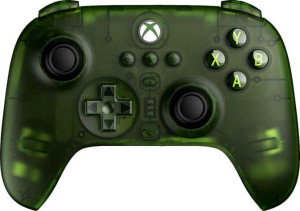
8bitdo Ultimate 3 mode specifications and in-depth review

8bitdo Ultimate 3 mode

Manufacturer: 8bitdo

The 8bitdo Ultimate 3 mode is a full-featured game controller built around an asymmetrical layout and a fairly substantial 250 g frame. It supports three connection modes — Bluetooth, 2.4GHz wireless, and wired USB — making it adaptable to different setups without requiring additional hardware. The controller ships with a charging dock included, and its internal rechargeable battery is rated for up to 20 hours of use per charge.

On the technical side, the 8bitdo Ultimate 3 mode uses hall effect sensors for both its thumbsticks and triggers, which rely on magnetic fields rather than physical contact to register input. It offers 16 buttons in total, includes paddle buttons, and supports full button mapping alongside three onboard memory profiles for storing custom configurations. Dual force feedback rumble is present, and a 3.5 mm headset jack is built in, though there is no integrated microphone or speaker. The controller polls at 250 Hz and measures 147 mm wide, 104 mm tall, and 61 mm thick.

Pros
  • Hall effect sensors on both thumbsticks and triggers reduce wear over time and provide more consistent input registration
  • Three connection modes — Bluetooth, 2.4GHz wireless, and USB — offer flexibility across different setups without additional adapters
  • A charging dock is included, allowing the controller to be stored and recharged without needing to manage cables separately
  • Three onboard memory profiles let users save and switch between different button configurations directly on the device
  • Paddle buttons and full button mapping support allow for a high degree of input customization
  • Dual force feedback rumble and a 3.5 mm headset jack add tactile and audio options without relying on external accessories
Cons
  • Thumbsticks are not interchangeable, limiting the ability to swap out worn or differently shaped sticks
  • No gyroscopic aiming support, which some users rely on for motion-based input in compatible games
  • Adaptive triggers are absent, meaning resistance-based feedback found on some controllers is not available
  • No built-in microphone or speaker, so voice communication requires an external headset connected via the 3.5 mm jack
  • A travel bag is not included despite the controller shipping with a dock, leaving portability accessories to the user
  • The 250 Hz polling rate is on the lower end for controllers targeting responsive or competitive use cases
Who is this for?

This controller is well suited to users who prioritize input reliability and customization, particularly those who game across multiple platforms or devices. The three connection modes (Bluetooth, 2.4GHz, and USB) make it a practical choice for players who switch between a PC and other compatible setups regularly. Those who prefer a tailored control scheme will benefit from the paddle buttons, full button mapping, and three onboard memory profiles, while the included charging dock suits users who want a tidy, cable-free storage solution at a fixed gaming station.

Who is this NOT for?

Users who rely on gyroscopic or motion-based aiming will find this controller lacking, as that feature is absent entirely. It is also a poor fit for players who want adaptive trigger resistance for immersive feedback in supported titles. Those who game frequently on the move may find the lack of a travel bag and the controller's 250 g weight less convenient, and anyone who needs to swap thumbstick modules for ergonomic or wear-related reasons will be limited by the fixed, non-interchangeable sticks.

Design:

Joystick positioning Asymmetrical
has textured triggers/bumpers
controller weight 250 g
width 147 mm
height 104 mm
thickness 61 mm

The controller follows an asymmetrical joystick layout, placing the two thumbsticks in offset positions rather than side by side. It weighs 250 g and has physical dimensions of 147 mm wide, 104 mm tall, and 61 mm thick, giving it a moderately sized footprint. The triggers and bumpers do not feature a textured surface finish.

Buttons:

number of buttons 16
has paddle buttons
has button mapping
Thumbstick type Hall effect
has hall effect triggers
has interchangeable thumbsticks
has adaptive triggers
has an integrated touchpad

The controller includes 16 buttons in total, with paddle buttons present and full button mapping supported for custom input configurations. Both the thumbsticks and triggers use hall effect sensors, which detect position through magnetic fields rather than mechanical contact. The thumbsticks are not interchangeable, and the controller lacks both adaptive triggers and an integrated touchpad.

Power & Connectivity:

Power type Internal rechargeable battery
connection type Bluetooth, 2.4GHz wireless, USB
compatibility Xbox, PC
Battery life 20 hours

The controller is powered by an internal rechargeable battery rated for up to 20 hours of use per charge. It supports three connection methods — Bluetooth, 2.4GHz wireless, and USB — allowing it to be used in both wired and wireless configurations. Compatibility is listed for Xbox and PC.

Features:

polling rate 250 Hz
has gyroscopic aiming
includes a charging dock
travel bag is included
Has dual force feedback
onboard memory profiles 3
has a built-in speaker
has a built-in microphone
has a socket for a 3.5 mm audio jack

The controller operates at a polling rate of 250 Hz and includes dual force feedback rumble along with three onboard memory profiles for storing custom settings. A charging dock is included in the box, though no travel bag is provided. Audio connectivity is handled through a 3.5 mm headset jack, while a built-in speaker and microphone are both absent. Gyroscopic aiming is not supported.

Final Verdict

The 8bitdo Ultimate 3 mode is a controller built around flexibility and input precision, with its hall effect thumbsticks and triggers standing out as a core technical strength that benefits long-term reliability and consistent performance. The combination of three wireless connection modes, customizable button mapping, paddle buttons, and onboard memory profiles gives it a feature set that caters well to users who want meaningful control over how they play. That said, the absence of gyroscopic aiming, adaptive triggers, and interchangeable thumbsticks means it will not satisfy every type of player, and those needs should be weighed carefully. For users whose requirements align with what it offers, the 8bitdo Ultimate 3 mode presents a well-rounded and functionally capable option within the game controller category.