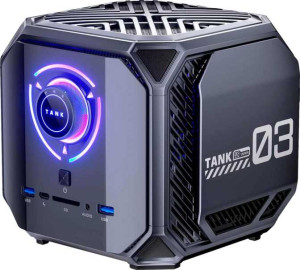
The Acemagic M1A Pro Plus uses a Micro-ATX form factor and comes equipped with a 4000GB NVMe SSD, offering substantial local storage with the faster data transfer speeds that NVMe technology provides over traditional SATA drives.
The CPU runs 16 cores at a base speed of 3 GHz with a turbo clock reaching 5.1 GHz, and supports multithreading for a total of 32 threads. It carries a TDP of 55W and includes integrated graphics, while operating within a maximum CPU temperature of 100 °C. The cache hierarchy consists of 1280 KB of L1, 16 MB of L2 at 1 MB per core, and 64 MB of L3 cache at 4 MB per core, and the processor supports 64-bit computing with a clock multiplier of 30, though the multiplier is locked and cannot be adjusted for overclocking.
The graphics card delivers 14.85 TFLOPS of floating-point performance, with a base clock of 1295 MHz that boosts up to 2900 MHz in turbo mode, and is built on a 4 nm semiconductor process. It features 2560 shading units, 160 texture mapping units, and 64 render output units, producing a texture rate of 464 GTexels/s and a pixel rate of 185.6 GPixel/s. The GPU supports ray tracing, Double Precision Floating Point, and connects via PCIe 5, while being compatible with DirectX 12 Ultimate, OpenGL 4.6, and OpenCL 2.1, with support for up to four simultaneous displays.
The system is equipped with 128GB of DDR5 RAM, providing a substantial amount of memory for handling memory-intensive tasks and multitasking workloads.
Wireless connectivity covers Wi-Fi 7 (802.11be) along with backward-compatible support for Wi-Fi 4, 5, 6, and 6E, paired with Bluetooth 5.2 for short-range connections. On the wired side, there are 2 USB 3.2 Gen 2 USB-A ports, 4 USB 3.2 Gen 1 USB-A ports, and 1 USB 3.2 Gen 2 USB-C port, while USB 2.0, USB 4, Thunderbolt 3, and Thunderbolt 4 are not present. Display output is handled by 3 DisplayPort outputs and 1 HDMI 2.1 port, supporting up to four screens, with no VGA connector available. The unit also includes 1 RJ45 port for wired networking, a 3.5 mm audio jack, but no S/PDIF output.
In CPU benchmarks, the system scores 54021 in PassMark multi-core and 4142 in the single-core PassMark test, rising to 57021 when overclocked. Geekbench 6 results come in at 17698 for multi-core and 2774 for single-core. On the graphics side, the PassMark G3D test returns a score of 17936, while the PassMark DirectCompute result stands at 9076.
The Radeon 8060S GPU is based on the RDNA 3.5 architecture and supports stereoscopic 3D, though it does not include XeSS (XMX). The processor is rated for both laptop and desktop use, supports ECC memory, and does not use big.LITTLE technology. RAM speed reaches up to 8000 MHz with a maximum supported capacity of 128GB, and there is no external memory slot available. The CPU includes the NX bit for hardware-level security and supports a range of instruction sets including MMX, AES, AVX, AVX2, FMA3, F16C, SSE 4.1, and SSE 4.2. The product comes with a 1-year warranty.