Acemagic V1 specifications and in-depth review

Acemagic V1

Manufacturer: AceMagic

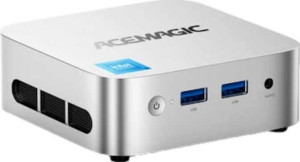
The Acemagic V1 is a compact mini PC built around a low-power mobile-class processor housed in a Micro-ATX form factor measuring just 100 × 100 × 33 mm. Weighing in at a total volume of 330 cm³, it targets users who need a space-efficient desktop solution without sacrificing everyday functionality. The unit ships with a 1TB NVMe SSD, offering solid read and write headroom for typical workloads, alongside 16GB of DDR4 memory running at 3200 MHz.

On the connectivity side, the V1 provides a practical selection of ports including two USB 2.0 and two USB 3.2 Gen 2 Type-A ports, one HDMI 2.0 output, one DisplayPort, and a single RJ45 Ethernet jack, with a 3.5 mm audio socket rounding out the rear panel. Wireless connectivity covers Wi-Fi 6 and Bluetooth 5.2. The integrated GPU supports up to three displays simultaneously, runs DirectX 12 Ultimate and OpenGL 4.6, and carries 24 execution units built on a 10 nm process. CPU performance is reflected in a PassMark score of 5416, with a single-core result of 1906, and the system carries a one-year warranty.

Pros
  • Supports Wi-Fi 6 alongside older Wi-Fi standards, covering a wide range of wireless network environments
  • Bluetooth 5.2 enables reliable connections to modern wireless peripherals
  • Integrated graphics can drive up to three displays simultaneously, supporting multi-monitor setups
  • Ships with a 1TB NVMe SSD, providing substantial storage capacity for a compact mini PC
  • Compact Micro-ATX form factor with a volume of just 330 cm³ makes it easy to place in space-constrained environments
  • DirectX 12 Ultimate and OpenGL 4.6 support covers a broad range of graphics workloads
Cons
  • 6W TDP and modest base clock speeds limit the CPU to light workloads only
  • No USB-C ports of any kind, including no Thunderbolt support, restricting peripheral compatibility
  • Multithreading is not supported, which reduces efficiency when handling parallel processing tasks
  • Maximum memory is capped at 16GB with no expandability beyond that limit
  • No external memory slot available for additional or removable storage
  • The clock multiplier is locked, so there is no overclocking capability
Who is this for?

The Acemagic V1 is well suited to users who need a compact desktop for everyday computing tasks such as web browsing, document editing, and light media consumption. Its 330 cm³ form factor makes it a practical fit for tight desk setups, home offices, or living room environments where space is limited. The ability to connect up to three displays simultaneously, combined with Wi-Fi 6 and Bluetooth 5.2, also makes it a reasonable choice for users who want a tidy, cable-light multi-monitor workstation for productivity or casual use.

Who is this NOT for?

This product is not well suited to users with demanding processing or multitasking needs, as the 6W TDP, locked clock multiplier, and lack of multithreading support leave little headroom for sustained heavy workloads. Content creators, developers, or anyone running resource-intensive applications will find the CPU performance inadequate. Similarly, the absence of any USB-C or Thunderbolt ports makes it a poor fit for users who rely on modern high-speed peripherals, external GPUs, or fast data transfer workflows that depend on those interfaces.

General info:

SSD storage capacity 1000GB
form factor Micro-ATX
Is an NVMe SSD
thickness 100 mm
height 33 mm
width 100 mm
volume 330 cm³

The Acemagic V1 follows a Micro-ATX form factor and occupies a notably small footprint, measuring 100 mm in both width and thickness with a height of just 33 mm, resulting in a total volume of 330 cm³. Storage is handled by a 1TB NVMe SSD, which uses flash-based technology for faster data access compared to traditional drives.

CPU:

Thermal Design Power (TDP) 6W
CPU speed 4 x 0.1 GHz
turbo clock speed 3.6GHz
CPU threads 4 threads
Has integrated graphics
uses multithreading
L3 cache 6 MB
L3 core 1.5 MB/core
clock multiplier 1
Has an unlocked multiplier
Supports 64-bit
CPU temperature 105 °C

The processor in the Acemagic V1 is a 4-core, 4-thread unit with a TDP of just 6W, reflecting its mobile-class, energy-efficient design. Base clock speeds are modest, but a turbo clock of 3.6 GHz allows the CPU to handle short bursts of more demanding tasks. It does not support multithreading and carries a fixed clock multiplier with no overclocking capability. The chip includes 6 MB of L3 cache — 1.5 MB per core — along with integrated graphics, full 64-bit support, and a maximum operating temperature of 105 °C.

Graphics card:

GPU turbo 1000 MHz
PCI Express (PCIe) version 3
DirectX version DirectX 12 Ultimate
OpenGL version 4.6
OpenCL version 3
semiconductor size 10 nm
supported displays 3

The integrated graphics solution in the Acemagic V1 operates at a turbo frequency of 1000 MHz and is built on a 10 nm semiconductor process. It connects via PCIe 3 and supports DirectX 12 Ultimate, along with OpenGL 4.6 and OpenCL 3, covering a broad range of graphics and compute workloads. One practical highlight is its ability to drive up to three displays simultaneously, making it a capable option for multi-monitor desktop setups within its class.

Memory:

RAM 16GB
RAM speed 3200 MHz
DDR memory version 4

The Acemagic V1 comes equipped with 16GB of DDR4 RAM running at 3200 MHz, providing a reasonable amount of memory for everyday multitasking and general productivity workloads within its compact form factor.

Connectivity:

Wi-Fi version Wi-Fi 6 (802.11ax), Wi-Fi 5 (802.11ac), Wi-Fi 4 (802.11n)
supports Wi-Fi
Has Bluetooth
Bluetooth version 5.2
USB 2.0 ports 2
USB 3.2 Gen 2 ports (USB-A) 2
USB 3.2 Gen 1 ports (USB-A) 0
USB 3.2 Gen 2 ports (USB-C) 0
USB 4 40Gbps ports 0
USB 4 20Gbps ports 0
USB 3.2 Gen 2x2 ports 0
USB 3.2 Gen 1 ports (USB-C) 0
Thunderbolt 4 ports 0
Thunderbolt 3 ports 0
DisplayPort outputs 1
HDMI version HDMI 2.0
HDMI ports 1
RJ45 ports 1
has a socket for a 3.5 mm audio jack
has a VGA connector
Has S/PDIF Out port

The Acemagic V1 supports Wi-Fi 6 (802.11ax) along with backwards-compatible Wi-Fi 5 and Wi-Fi 4 standards, and includes Bluetooth 5.2 for wireless peripherals. Wired USB connectivity consists of two USB 2.0 ports and two USB 3.2 Gen 2 Type-A ports; there are no USB-C, Thunderbolt, or higher-generation USB 4 ports of any kind. For display output, the unit offers one HDMI 2.0 port and one DisplayPort, while a single RJ45 jack handles wired Ethernet. A 3.5 mm headset jack is present, though there is no VGA connector and no S/PDIF audio output.

Benchmarks:

PassMark result 5416
PassMark result (single) 1906
PassMark result (overclocked) 5754

In PassMark testing, the Acemagic V1 achieves a multi-core score of 5416 and a single-core result of 1906, giving a reasonable indication of its day-to-day processing capability. An overclocked PassMark result of 5754 is also recorded, representing a modest uplift over the standard score.

Miscellaneous:

maximum memory amount 16GB
has an external memory slot
Type Laptop
Uses big.LITTLE technology
instruction sets MMX, F16C, FMA3, AES, AVX, SSE 4.1, AVX2, SSE 4.2
Has NX bit
GPU execution units 24
Supports ECC memory
memory channels 0
RAM speed (max) 4800 MHz
warranty period 1 years
Uses flash storage

The Acemagic V1 uses a laptop-type CPU and caps system memory at 16GB, with the RAM theoretically capable of speeds up to 4800 MHz. It does not support ECC memory, has no external memory slot, and does not use flash storage as a separate component. The processor supports a range of instruction sets including MMX, AVX2, AES, FMA3, F16C, SSE 4.1, and SSE 4.2, and includes NX bit support for hardware-level security. The GPU carries 24 execution units, and the chip does not employ big.LITTLE heterogeneous core architecture. The unit comes with a one-year warranty.
Final Verdict

The Acemagic V1 is a purpose-built mini PC that delivers a clear and consistent proposition: a genuinely compact desktop solution for users whose workloads stay within the bounds of everyday computing. Its three-display support, Wi-Fi 6, and 1TB NVMe SSD give it a practical edge for space-conscious home office and light productivity setups, and the Micro-ATX chassis at just 330 cm³ reinforces its role as an unobtrusive, low-footprint machine. That said, the low-wattage CPU, absence of multithreading, and limited port selection mean it is firmly positioned for light use — anyone stepping beyond routine tasks will quickly encounter its ceiling. For the right user, the V1 is a coherent and well-specified option within its niche; for anyone with more demanding requirements, its hardware boundaries will prove a consistent constraint.