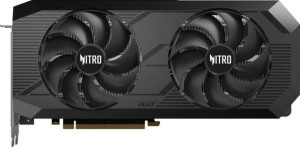
Acer Nitro Radeon RX 7800 XT OC specifications and in-depth review

Acer Nitro Radeon RX 7800 XT OC

Manufacturer: Acer

The Acer Nitro Radeon RX 7800 XT OC is a mid-to-high-range graphics card designed around AMD's RDNA 3.0 architecture, manufactured on a 5 nm process with 28,100 million transistors. It features a base GPU clock of 1295 MHz that climbs to 2599 MHz in boost mode, paired with 3,840 shading units and 240 texture mapping units to handle demanding rendering workloads. RGB lighting is included, and the card supports up to four simultaneous displays.

On the memory side, the card is equipped with 16GB of GDDR6 VRAM across a 256-bit bus, reaching an effective speed of 19,500 MHz and a maximum bandwidth of 624.1 GB/s. It delivers 39.92 TFLOPS of floating-point performance alongside a pixel rate of 249.5 GPixel/s and a texture rate of 623.8 GTexels/s. Connectivity is covered by one HDMI 2.1 port and three DisplayPort outputs, with no USB-C or DVI options present. The card supports DirectX 12 Ultimate, OpenGL 4.6, OpenCL 2.2, ray tracing, AMD SAM, and ECC memory, while operating within a 263W TDP via a PCIe 4.0 interface.

Pros
  • The 16GB GDDR6 VRAM across a 256-bit bus provides substantial memory capacity for memory-intensive rendering and high-resolution workloads
  • A maximum memory bandwidth of 624.1 GB/s and an effective memory speed of 19,500 MHz support fast data throughput during demanding tasks
  • Support for ray tracing and DirectX 12 Ultimate enables access to modern real-time lighting and graphics pipeline features
  • With three DisplayPort outputs and one HDMI 2.1 port, the card can drive up to four displays simultaneously
  • AMD SAM support allows the CPU to access the full VRAM pool, which can benefit frame rates in compatible system configurations
  • RGB lighting is built into the card for users who prioritize visual customization within their build
Cons
  • A 263W TDP places significant power demands on the system, requiring a capable power supply and adequate case airflow
  • Air-water cooling is not included, leaving thermal management entirely dependent on the card's air cooler in all configurations
  • DLSS and XeSS upscaling technologies are not supported, limiting upscaling options to AMD's own ecosystem
  • There are no USB-C or DVI outputs, which restricts compatibility with certain monitors and display adapters
Who is this for?

This card is well-suited to users who work with high-resolution gaming or content rendering, where the 16GB GDDR6 VRAM and 624.1 GB/s memory bandwidth provide enough headroom to handle large textures and complex scenes without memory bottlenecks. The support for ray tracing and DirectX 12 Ultimate makes it a practical fit for those who want access to modern real-time lighting pipelines, while the ability to drive up to four displays simultaneously via HDMI 2.1 and three DisplayPort outputs makes it appealing for multi-monitor setups used in creative or productivity-heavy environments. Users building AMD-based systems will also benefit from AMD SAM support for compatible configurations.

Who is this NOT for?

Users who rely on DLSS or XeSS upscaling technologies will find this card incompatible, as neither is supported — making it a poor fit for those whose workflow or gaming habits depend on these specific upscaling solutions. The 263W TDP makes it unsuitable for compact or low-power builds where thermal headroom and power supply capacity are limited, as the card demands robust airflow and a capable PSU. Additionally, users needing USB-C display output or DVI connectivity for legacy monitors will find the port selection restrictive, as neither interface is present on this model.

Performance:

GPU clock speed 1295 MHz
GPU turbo 2599 MHz
pixel rate 249.5 GPixel/s
floating-point performance 39.92 TFLOPS
texture rate 623.8 GTexels/s
GPU memory speed 2438 MHz
shading units 3840
texture mapping units (TMUs) 240
render output units (ROPs) 96
Has Double Precision Floating Point (DPFP)

The Acer Nitro Radeon RX 7800 XT OC operates at a base GPU clock of 1295 MHz, with a boost frequency reaching 2599 MHz under load. It carries 3,840 shading units alongside 240 texture mapping units and 96 render output units, contributing to a texture rate of 623.8 GTexels/s and a pixel rate of 249.5 GPixel/s. The card delivers 39.92 TFLOPS of floating-point performance and includes support for Double Precision Floating Point, while the GPU memory itself runs at 2438 MHz.

Memory:

effective memory speed 19500 MHz
maximum memory bandwidth 624.1 GB/s
VRAM 16GB
GDDR version GDDR6
memory bus width 256-bit
Supports ECC memory

The card comes equipped with 16GB of GDDR6 VRAM running across a 256-bit memory bus, reaching an effective memory speed of 19,500 MHz and delivering a maximum bandwidth of 624.1 GB/s. ECC memory support is also included, adding a layer of data integrity for workloads that benefit from error correction.

Features:

DirectX version DirectX 12 Ultimate
OpenGL version 4.6
OpenCL version 2.2
Supports multi-display technology
supports ray tracing
Supports 3D
supports DLSS
has XeSS (XMX)
AMD SAM / Intel Resizable BAR AMD SAM
has LHR
has RGB lighting
supported displays 4

The card supports DirectX 12 Ultimate, OpenGL 4.6, and OpenCL 2.2, covering a broad range of graphics and compute workloads. Ray tracing and stereoscopic 3D are both supported, and multi-display technology allows connection to up to four screens simultaneously. AMD SAM is available for memory access optimization, while RGB lighting is present on the card itself. DLSS and XeSS (XMX) are not supported, and the card does not feature LHR.

Ports:

has an HDMI output
HDMI ports 1
HDMI version HDMI 2.1
DisplayPort outputs 3
USB-C ports 0
DVI outputs 0
mini DisplayPort outputs 0

The card's output configuration consists of one HDMI 2.1 port and three DisplayPort outputs, providing a total of four video connections. There are no USB-C, DVI, or mini DisplayPort outputs present on this model.

General info:

GPU architecture RDNA 3.0
Thermal Design Power (TDP) 263W
PCI Express (PCIe) version 4
semiconductor size 5 nm
number of transistors 28100 million
Has air-water cooling

Built on AMD's RDNA 3.0 architecture, the card is fabricated using a 5 nm process and integrates 28,100 million transistors. It connects via a PCIe 4.0 interface and carries a Thermal Design Power rating of 263W. Air-water cooling is not included with this model.

Final Verdict

The Acer Nitro Radeon RX 7800 XT OC presents a well-rounded specification set for users seeking a capable graphics card built on AMD's RDNA 3.0 architecture. Its most compelling attribute is the 16GB GDDR6 VRAM paired with 624.1 GB/s of memory bandwidth, which positions it comfortably for high-resolution rendering and multi-display workflows. Ray tracing support, DirectX 12 Ultimate compatibility, and AMD SAM round out a feature set that covers the expectations of modern gaming and creative workloads. That said, its 263W power draw and the absence of DLSS and XeSS upscaling mean it is best suited to users operating within AMD-compatible ecosystems and those with adequately specced systems to support it. Overall, the RX 7800 XT OC is a technically coherent option for users whose priorities align with its strengths in memory capacity, display connectivity, and modern API support.