Acer Nitro V 15 (2023) 15.6" Intel Core i5-13420H 2.1GHz / Nvidia GeForce RTX 3050 Laptop / 16GB RAM / 512GB SSD specifications and in-depth review

Acer Nitro V 15 (2023) 15.6" Intel Core i5-13420H 2.1GHz / Nvidia GeForce RTX 3050 Laptop / 16GB RAM / 512GB SSD

Manufacturer: Acer

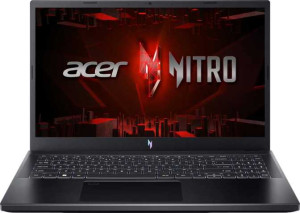
The Acer Nitro V 15 (2023) is a gaming-oriented laptop built around a 15.6-inch IPS display and a mid-range hardware configuration aimed at users who want a capable gaming machine in a relatively slim 23mm chassis. Weighing in at 2,113g, it strikes a reasonable balance between portability and functionality for a device in this category. The 144Hz refresh rate display at 1920 x 1080 resolution ensures smoother on-screen motion during gaming sessions, and the backlit keyboard adds a practical touch for low-light use. The laptop runs on an Intel Core i5-13420H processor paired with an Nvidia GeForce RTX 3050 GPU, supporting both ray tracing and DLSS for enhanced visual output in compatible titles.

On the performance side, the system ships with 16GB of DDR5 RAM at 5200 MHz and a 512GB NVMe SSD, with memory expandable up to 96GB. The CPU operates across 12 threads using big.LITTLE architecture, with a turbo clock speed reaching 4.6GHz, while the RTX 3050 delivers 4.329 TFLOPS of floating-point performance with 4GB of GDDR6 VRAM on a 128-bit memory bus. Connectivity includes one USB 3.2 Gen 2 Type-C port, three USB 3.2 Gen 1 Type-A ports, an HDMI output, RJ45 Ethernet, and Wi-Fi 6 support. Battery life is rated at 8 hours, and the laptop also includes a front camera, stereo speakers, and a 3.5mm audio jack.

Pros
  • The 144Hz IPS display provides noticeably smoother motion, which is well suited to gaming use at this screen size
  • Support for ray tracing and DLSS expands visual rendering options in compatible titles
  • DDR5 RAM at 5200 MHz and an NVMe SSD contribute to responsive system performance during everyday and gaming workloads
  • Wi-Fi 6 support ensures faster and more reliable wireless connectivity compared to older standards
  • Three USB 3.2 Gen 1 Type-A ports plus one USB 3.2 Gen 2 Type-C port offer a reasonable range of peripheral options
  • At 23mm thick and 2,113g, the chassis is manageable for a gaming laptop with active cooling
Cons
  • The GPU comes with only 4GB of VRAM, which may limit performance in more demanding or higher-resolution workloads
  • No DisplayPort output is available, restricting external display options to a single HDMI port
  • The display lacks an anti-reflection coating, which can cause visibility issues in brighter environments
  • No fingerprint scanner or facial recognition is included, leaving the laptop without biometric authentication options
  • Battery life is rated at 8 hours, which may fall short during intensive gaming sessions away from a power source
  • There is no external memory card slot, limiting quick file transfer options for users working with camera media or similar storage
Who is this for?

This laptop is a practical fit for users who want to engage in everyday gaming at 1080p, where the 144Hz IPS display, RTX 3050 with ray tracing and DLSS support, and DDR5 RAM work together to deliver a capable gaming experience within a portable form factor. The 23mm thin chassis and 2,113g weight make it reasonable to carry between locations, and the 8-hour battery rating supports use through a standard day of lighter tasks away from a desk. It also suits students or general users who want a capable machine for multitasking and productivity workloads, given the 16GB of fast RAM, NVMe SSD, and a CPU that reaches 4.6GHz on turbo with 12 threads.

Who is this NOT for?

Users targeting graphically demanding titles at high or ultra settings may find the 4GB GDDR6 VRAM limiting, as more intensive workloads can quickly saturate that capacity. The laptop is equally unsuitable for those requiring a robust external display setup, since video output is restricted to a single HDMI port with no DisplayPort available. Creative professionals who rely on color-accurate workflows will also find the display lacking, as there is no mention of color calibration support or a wide color gamut, and the absence of an anti-reflection coating makes the screen less practical in brightly lit environments.

Design:

Type Gaming
weight 2113 g
Uses a fanless design
Has a backlit keyboard
volume 1987.062 cm³
width 363 mm
height 238 mm
thickness 23 mm
is weather-sealed (splashproof)

Classified as a gaming laptop, this machine measures 363mm wide, 238mm tall, and 23mm thick, keeping its profile relatively slim for the category. It weighs 2,113g, making it manageable for transport despite its gaming focus. The chassis uses an active cooling design rather than a fanless setup, and it is not weather-sealed or splashproof. A backlit keyboard is included, which adds usability in dimly lit environments.

Display:

screen size 15.6"
resolution 1920 x 1080 px
pixel density 141 ppi
Display type LCD, IPS
has a touch screen
refresh rate 144Hz
has anti-reflection coating
supported displays 4

The laptop features a 15.6-inch LCD IPS panel running at a resolution of 1920 x 1080 pixels, resulting in a pixel density of 141 ppi. A 144Hz refresh rate provides noticeably smoother motion, which is particularly relevant for gaming use. The display does not include a touchscreen or an anti-reflection coating. Up to 4 displays can be supported simultaneously via the available video outputs.

Performance:

RAM 16GB
RAM speed 5200 MHz
Uses flash storage
internal storage 512GB
CPU speed 4 x 2.1 & 4 x 1.5 GHz
CPU threads 12 threads
VRAM 4GB
floating-point performance 4.329 TFLOPS
GDDR version GDDR6
texture rate 67.65 GTexels/s
pixel rate 42.28 GPixel/s
Is an NVMe SSD
DirectX version DirectX 12 Ultimate
GPU clock speed 712 MHz
uses multithreading
maximum memory amount 96GB
DDR memory version 5
turbo clock speed 4.6GHz
GPU turbo 1740 MHz
PCI Express (PCIe) version 4
semiconductor size 8 nm
has XeSS (XMX)
Supports 64-bit

The system is equipped with 16GB of DDR5 RAM at 5200 MHz, expandable up to 96GB, alongside a 512GB NVMe SSD for flash-based storage. The CPU runs across 12 threads with core speeds of 4 x 2.1GHz and 4 x 1.5GHz, reaching a turbo frequency of 4.6GHz, though hardware-level multithreading is not enabled. On the graphics side, the GPU operates at a base clock of 712 MHz with a turbo of 1740 MHz, backed by 4GB of GDDR6 VRAM and delivering 4.329 TFLOPS of floating-point performance, a texture rate of 67.65 GTexels/s, and a pixel rate of 42.28 GPixel/s. The GPU supports DirectX 12 Ultimate and connects via PCIe 4, while XeSS is not supported. The processor is built on an 8nm semiconductor process and supports 64-bit computing.

Benchmarks:

PassMark (G3D) result 9278
PassMark result 17409
PassMark result (single) 3396

In synthetic benchmark testing, the system achieves an overall PassMark score of 17,409 and a single-core PassMark result of 3,396, reflecting the CPU's general and per-core processing capability. The GPU records a PassMark G3D score of 9,278, indicating its relative standing in graphics workload performance.

Connectivity:

USB 3.2 Gen 2 ports (USB-C) 1
USB 3.2 Gen 2 ports (USB-A) 0
USB 4 20Gbps ports 0
USB 4 40Gbps ports 0
Thunderbolt 4 ports 0
USB 3.2 Gen 1 ports (USB-C) 0
USB 3.2 Gen 1 ports (USB-A) 3
Thunderbolt 3 ports 0
has an HDMI output
Has USB Type-C
supports Wi-Fi
Wi-Fi version Wi-Fi 6 (802.11ax), Wi-Fi 5 (802.11ac), Wi-Fi 4 (802.11n)
has an external memory slot
RJ45 ports 1
HDMI ports 1
DisplayPort outputs 0
has AirPlay
mini DisplayPort outputs 0
has a VGA connector

The laptop provides one USB 3.2 Gen 2 Type-C port and three USB 3.2 Gen 1 Type-A ports for peripheral connectivity, with no Thunderbolt 3 or 4, USB 4, or additional USB-C Gen 1 ports present. Video output is handled through a single HDMI port, while DisplayPort, mini DisplayPort, and VGA outputs are absent. Wired networking is available via one RJ45 Ethernet port, and wireless connectivity covers Wi-Fi 6 (802.11ax) alongside Wi-Fi 5 and Wi-Fi 4. AirPlay is supported, though there is no external memory card slot.

Battery:

Battery life 8 hours
Has sleep-and-charge USB ports
Has a MagSafe power adapter

Battery life is rated at 8 hours on a single charge. The laptop does not include sleep-and-charge USB ports or a MagSafe power adapter.

Features:

has stereo speakers
has a socket for a 3.5 mm audio jack
supports ray tracing
supports DLSS
has Dolby Atmos
Stylus included
Has a fingerprint scanner
number of microphones 1
Uses 3D facial recognition
has voice commands
has a front camera
Has S/PDIF Out port
has a gyroscope
has GPS
has an accelerometer
has a compass
Has an optical disc drive

The laptop supports ray tracing and DLSS, enabling enhanced visual rendering and upscaling in compatible games. Audio output is handled through built-in stereo speakers and a 3.5mm headset jack, though Dolby Atmos and S/PDIF output are not available. A front camera and a single microphone are included for video calls, while fingerprint scanning, 3D facial recognition, and voice commands are absent. The device does not feature a stylus, optical disc drive, or any motion and location sensors such as a gyroscope, accelerometer, compass, or GPS.

Miscellaneous:

clock multiplier 21
has LHR
Supports ECC memory
Has Double Precision Floating Point (DPFP)
Has air-water cooling
Thermal Design Power (TDP) 75W
Supports 3D
OpenCL version 3
OpenGL version 4.6
memory bus width 128-bit
effective memory speed 12000 MHz
maximum memory bandwidth 192 GB/s
render output units (ROPs) 40
texture mapping units (TMUs) 64
shading units 2048
GPU memory speed 1500 MHz
AMD SAM / Intel Resizable BAR Intel Resizable BAR
GPU architecture Ampere
GPU name Iris Xe Graphics 80EU
Type Laptop
Has an unlocked multiplier
L2 cache 8 MB
L3 cache 12 MB
Has NX bit
CPU temperature 100 °C
GPU execution units 48
Has integrated graphics
memory channels 2
Uses big.LITTLE technology
instruction sets SSE 4.2, SSE 4.1, AVX, AES, FMA3, F16C, MMX
RAM speed (max) 5200 MHz

The CPU has a clock multiplier of 21, a maximum operating temperature of 100°C, and a thermal design power of 75W, with the multiplier locked and no air-water cooling present. It employs big.LITTLE technology, supports ECC memory, and includes 8MB of L2 cache and 12MB of L3 cache, alongside instruction set support for SSE 4.1, SSE 4.2, AVX, AES, FMA3, F16C, and MMX. The processor also features an NX bit and Double Precision Floating Point support, operating across 2 memory channels with a maximum RAM speed of 5200 MHz. On the graphics side, the Ampere-architecture GPU features 2048 shading units, 64 texture mapping units, 40 ROPs, and 48 execution units, running on a 128-bit memory bus at an effective memory speed of 12000 MHz and delivering up to 192 GB/s of memory bandwidth. The system supports OpenCL 3, OpenGL 4.6, stereoscopic 3D, and Intel Resizable BAR, and also includes integrated Iris Xe Graphics 80EU alongside the discrete GPU. LHR is not present, and the GPU memory speed is rated at 1500 MHz.
Final Verdict

The Acer Nitro V 15 (2023) is a focused entry into the gaming laptop segment, built around a configuration that serves 1080p gaming and general productivity without overreaching. Its 144Hz IPS display paired with RTX 3050 ray tracing and DLSS support gives it a genuine gaming identity, while the DDR5 memory, NVMe storage, and Wi-Fi 6 round out a spec sheet that holds up well for daily use. Where it shows its boundaries — limited VRAM, a single video output, and no biometric security — the trade-offs are consistent with its intended positioning rather than surprising shortcomings. For users seeking a portable, gaming-capable machine suited to everyday tasks and moderate gaming sessions, the Acer Nitro V 15 (2023) represents a well-defined and coherent option within its category.