Acer Nitro V 15 (2024) 15.6" Intel Core i5-13420H 2.1GHz / Nvidia GeForce RTX 4050 Laptop / 16GB RAM / 512GB SSD specifications and in-depth review

Acer Nitro V 15 (2024) 15.6" Intel Core i5-13420H 2.1GHz / Nvidia GeForce RTX 4050 Laptop / 16GB RAM / 512GB SSD

Manufacturer: Acer

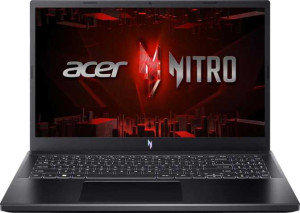
The Acer Nitro V 15 (2024) is a 15.6″ gaming laptop built around Intel's Core i5-13420H processor and Nvidia's GeForce RTX 4050 Laptop GPU. Weighing 2,110 g with a 23 mm profile, it strikes a balance between portability and gaming capability. The machine ships with 16GB of DDR5 RAM running at 5,200 MHz, a 512GB NVMe SSD, and a backlit keyboard, rounding out a configuration aimed at everyday gaming use.

The IPS panel delivers a 1920 x 1080 resolution at 141 ppi with a 144Hz refresh rate and a typical brightness of 241 nits. On the graphics side, the RTX 4050 carries 6GB of GDDR6 VRAM across a 96-bit bus, reaches a GPU turbo of 2,370 MHz, and posts 12.13 TFLOPS of floating-point performance with support for ray tracing and DLSS. Connectivity includes one USB 3.2 Gen 2 Type-C port, three USB 3.2 Gen 1 Type-A ports, an HDMI output, an RJ45 Ethernet jack, and Wi-Fi 6, while a 57 Wh battery provides up to 8 hours of rated runtime.

Pros
  • The 144Hz IPS display provides smoother motion during fast-paced gaming content compared to standard 60Hz panels
  • DDR5 RAM running at 5,200 MHz across two slots supports up to 96GB, leaving room for future memory upgrades
  • The NVMe SSD using PCIe 4.0 offers faster storage throughput than older PCIe 3.0 configurations
  • Ray tracing and DLSS are both supported, enabling more advanced rendering options in compatible games
  • Wi-Fi 6 support ensures faster and more reliable wireless connectivity on compatible networks
  • A fingerprint scanner is included for biometric login without requiring a separate peripheral
Cons
  • At 241 nits typical brightness, the display may struggle with visibility in well-lit environments
  • The screen lacks an anti-reflection coating, which can make it harder to use in brightly lit spaces
  • With only a 96-bit memory bus on the GPU, memory bandwidth is narrower than wider-bus configurations
  • The 57 Wh battery is relatively modest for a gaming laptop and may limit unplugged usage under load
  • Bluetooth 5.1 is present but there are no Thunderbolt 3 or 4 ports, limiting high-speed peripheral and display options
  • There is no external memory card slot, restricting quick file transfers from cameras or other storage devices
Who is this for?

This laptop suits users who engage in casual to mid-range gaming, where the RTX 4050 with ray tracing and DLSS support, combined with a 144Hz IPS display, delivers a smooth and visually capable experience. Students or home users who also handle everyday productivity tasks will benefit from the 16GB of DDR5 RAM, fast NVMe SSD, and the flexibility of Wi-Fi 6 connectivity. The fingerprint scanner and front camera make it practical for those who need secure, everyday use in a fixed workspace, while the four-display output support accommodates users who occasionally work across multiple screens.

Who is this NOT for?

Users who require a high-brightness display for use in bright or outdoor environments will find the 241-nit panel limiting, especially given the absence of an anti-reflection coating. The 115W TDP and active cooling design make this a poor fit for those needing a quiet, fanless machine, and the 2,110 g weight combined with a 57 Wh battery makes it less practical for users who depend on extended portable use away from a power source. Creative professionals or developers who rely on Thunderbolt for fast external storage, high-resolution displays, or specialized peripherals will also find the connectivity options insufficient for their workflow.

Design:

Type Gaming
weight 2110 g
Uses a fanless design
Has a backlit keyboard
volume 1989.914 cm³
width 362 mm
height 239 mm
thickness 23 mm
is weather-sealed (splashproof)

The Acer Nitro V 15 (2024) is classified as a gaming laptop and carries a weight of 2,110 g with overall dimensions of 362 mm wide, 239 mm deep, and 23 mm thick, giving it a volume of approximately 1,989.9 cm³. It includes a backlit keyboard for use in low-light conditions, while active cooling is present as the design does not use a fanless configuration. The chassis is not weather-sealed, so it offers no splash protection.

Display:

screen size 15.6"
resolution 1920 x 1080 px
pixel density 141 ppi
Display type LCD, LED-backlit, IPS
has a touch screen
brightness (typical) 241 nits
refresh rate 144Hz
has anti-reflection coating
supported displays 4

The laptop features a 15.6″ IPS panel with an LED-backlit LCD construction, rendering a 1920 x 1080 px resolution at a pixel density of 141 ppi. Its 144Hz refresh rate makes motion notably smoother during fast-paced content, while typical brightness sits at 241 nits. The screen does not include a touch layer or an anti-reflection coating, and the system supports up to 4 connected displays simultaneously.

Performance:

RAM 16GB
RAM speed 5200 MHz
Uses flash storage
internal storage 512GB
CPU speed 4 x 2.1 & 4 x 1.5 GHz
CPU threads 12 threads
VRAM 6GB
floating-point performance 12.13 TFLOPS
GDDR version GDDR6
texture rate 204.8 GTexels/s
pixel rate 113.76 GPixel/s
Is an NVMe SSD
DirectX version DirectX 12 Ultimate
GPU clock speed 1605 MHz
uses multithreading
maximum memory amount 96GB
DDR memory version 5
turbo clock speed 4.6GHz
GPU turbo 2370 MHz
memory slots 2
PCI Express (PCIe) version 4
semiconductor size 4 nm
has XeSS (XMX)
Supports 64-bit

The processor runs eight cores across 12 threads with a base configuration of 4 x 2.1 GHz and 4 x 1.5 GHz, reaching a turbo clock of 4.6 GHz, and is built on a 4 nm semiconductor process with multithreading enabled and full 64-bit support. System memory consists of 16GB of DDR5 RAM at 5,200 MHz across two slots, expandable to a maximum of 96GB. Storage is handled by a 512GB NVMe SSD using PCIe 4.0 flash technology. On the graphics side, the GPU carries 6GB of GDDR6 VRAM, operates at a base clock of 1,605 MHz with a turbo of 2,370 MHz, and delivers 12.13 TFLOPS of floating-point performance alongside a texture rate of 204.8 GTexels/s, a pixel rate of 113.76 GPixel/s, and support for DirectX 12 Ultimate; XeSS (XMX) is not supported.

Benchmarks:

PassMark (G3D) result 17148
PassMark result 17409
PassMark result (single) 3396

In PassMark testing, the system achieves an overall score of 17,409, with the GPU-focused G3D result coming in at 17,148. The single-core PassMark result stands at 3,396, reflecting the per-core output of the processor.

Connectivity:

USB 3.2 Gen 2 ports (USB-C) 1
USB 3.2 Gen 2 ports (USB-A) 0
USB 4 20Gbps ports 0
USB 4 40Gbps ports 0
Thunderbolt 4 ports 0
USB 3.2 Gen 1 ports (USB-C) 0
USB 3.2 Gen 1 ports (USB-A) 3
Thunderbolt 3 ports 0
has an HDMI output
Has USB Type-C
supports Wi-Fi
Wi-Fi version Wi-Fi 6 (802.11ax), Wi-Fi 5 (802.11ac), Wi-Fi 4 (802.11n)
has an external memory slot
Bluetooth version 5.1
RJ45 ports 1
HDMI ports 1
DisplayPort outputs 0
has AirPlay
mini DisplayPort outputs 0
has a VGA connector

Wired connectivity includes one USB 3.2 Gen 2 Type-C port, three USB 3.2 Gen 1 Type-A ports, one HDMI output, and one RJ45 Ethernet jack; there are no Thunderbolt 3 or 4 ports, no DisplayPort or mini DisplayPort outputs, no VGA connector, and no external memory slot. Wireless connectivity covers Wi-Fi 6 (802.11ax) along with backward-compatible Wi-Fi 5 and Wi-Fi 4 standards, paired with Bluetooth 5.1. AirPlay is also supported.

Battery:

Battery life 8 hours
battery size 57 Wh
Has sleep-and-charge USB ports
Has a MagSafe power adapter

The laptop is equipped with a 57 Wh battery rated for up to 8 hours of use. It does not include sleep-and-charge USB ports, nor does it use a MagSafe power adapter.

Features:

has stereo speakers
has a socket for a 3.5 mm audio jack
supports ray tracing
supports DLSS
has Dolby Atmos
Stylus included
Has a fingerprint scanner
number of microphones 1
Uses 3D facial recognition
has voice commands
has a front camera
Has S/PDIF Out port
has a gyroscope
has GPS
has an accelerometer
has a compass
Has an optical disc drive

Audio output comes through stereo speakers with a 3.5 mm headset jack available, though Dolby Atmos and S/PDIF output are not included. A single microphone and a front camera are built in, while the fingerprint scanner handles biometric authentication; 3D facial recognition and voice commands are not supported. On the graphics feature side, the laptop supports both ray tracing and DLSS. No stylus is included, and the device lacks an optical disc drive, GPS, gyroscope, accelerometer, and compass.

Miscellaneous:

USB 3.0 ports 0
clock multiplier 21
number of transistors 18900 million
AMD SAM / Intel Resizable BAR Intel Resizable BAR
has LHR
Thermal Design Power (TDP) 115W
Supports 3D
Supports multi-display technology
OpenCL version 3
OpenGL version 4.6
Supports ECC memory
memory bus width 96-bit
effective memory speed 16000 MHz
maximum memory bandwidth 192 GB/s
render output units (ROPs) 48
texture mapping units (TMUs) 80
shading units 2560
Has Double Precision Floating Point (DPFP)
GPU memory speed 2000 MHz
GPU architecture Ada Lovelace
GPU name Iris Xe Graphics 80EU
Type Laptop
Has an unlocked multiplier
L2 cache 8 MB
L3 cache 12 MB
Has NX bit
CPU temperature 100 °C
GPU execution units 48
Has integrated graphics
memory channels 2
Uses big.LITTLE technology
instruction sets SSE 4.2, SSE 4.1, AVX, AES, FMA3, F16C, MMX
RAM speed (max) 5200 MHz

The CPU carries a clock multiplier of 21, a TDP of 115W, a maximum operating temperature of 100 °C, and uses big.LITTLE technology alongside multithreading; the multiplier is locked. It includes 8 MB of L2 cache and 12 MB of L3 cache, supports the NX bit, and is compatible with instruction sets including SSE 4.1, SSE 4.2, AVX, AES, FMA3, F16C, and MMX. Integrated graphics are present alongside the discrete GPU, which is built on the Ada Lovelace architecture with 2,560 shading units, 80 TMUs, 48 ROPs, and 48 execution units running at a memory speed of 2,000 MHz over a 96-bit bus, reaching an effective memory speed of 16,000 MHz and a maximum bandwidth of 192 GB/s. The system supports Intel Resizable BAR, ECC memory, stereoscopic 3D, multi-display output, Double Precision Floating Point, OpenCL 3, and OpenGL 4.6, while LHR is not present and no legacy USB 3.0 ports are included. The processor contains 18,900 million transistors, operates across 2 memory channels with a maximum RAM speed of 5,200 MHz, and the GPU name listed for integrated graphics is Iris Xe Graphics 80EU.
Final Verdict

The Acer Nitro V 15 (2024) positions itself as a capable entry point into gaming laptops, combining an Intel Core i5-13420H processor with an RTX 4050 GPU that supports both ray tracing and DLSS, backed by DDR5 RAM and a fast PCIe 4.0 NVMe SSD. Its 144Hz IPS display is one of its most practical strengths for the gaming audience it targets, keeping motion smooth without requiring a premium panel. That said, the modest display brightness, narrower GPU memory bus, and relatively compact battery mean it performs best when used near a power outlet in a controlled lighting environment. For users whose needs align with those boundaries, it delivers a well-rounded hardware package; those requiring more demanding performance headroom or greater portability flexibility may find its specifications fall short of their expectations.

Popular Comparisons

Acer Nitro V 15 (2024) 15.6" Intel Core i5-13420H 2.1GHz / Nvidia GeForce RTX 4050 Laptop / 16GB RAM / 512GB SSD
VS
Asus TUF Gaming F16 (2025) FX608 16"