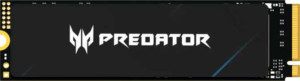
Acer Predator GM9000 4TB specifications and in-depth review

Acer Predator GM9000 4TB

Manufacturer: Acer

The Acer Predator GM9000 4TB is a high-capacity M.2 NVMe solid-state drive built around the PCIe 5.0 interface, positioning it among the faster storage options available in its category. With 4TB of internal storage and a DRAM cache onboard, it is designed to handle demanding workloads where both capacity and throughput matter. The drive carries a five-year warranty and a rated MTBF of 1.5 million hours, reflecting a focus on long-term reliability.

On the performance side, the GM9000 is rated for sequential read and write speeds of 14000 MB/s and 13000 MB/s respectively, while random access reaches up to 2,000,000 read IOPS and 1,600,000 write IOPS. These figures are driven by the Silicon Motion SM2508 controller operating across eight channels, paired with TLC NAND storage. The drive conforms to NVMe version 2 and carries a total endurance rating of 3200 TBW. It does not include an integrated heatsink or hardware-level AES encryption support, and it features no RGB lighting.

Pros
  • Sequential read and write speeds of 14000 MB/s and 13000 MB/s respectively indicate substantial sustained throughput for large file operations
  • Random read performance of 2,000,000 IOPS and random write of 1,600,000 IOPS reflect strong capability for workloads involving frequent small file access
  • A 4TB storage capacity provides ample room for large application libraries, datasets, or media collections
  • The DRAM cache supports more consistent access speeds under sustained load compared to cacheless designs
  • A TBW rating of 3200 and an MTBF of 1.5 million hours point to solid long-term endurance
  • A five-year warranty offers meaningful coverage over the product's expected lifespan
Cons
  • No integrated heatsink is included, which may require separate thermal management solutions in heat-sensitive builds
  • Hardware AES encryption is not supported, limiting options for users who require drive-level data security
  • The PCIe 5.0 interface requires a compatible motherboard slot, restricting use to relatively recent platforms only
Who is this for?

This drive is well-suited to users who regularly handle large file transfers or data-intensive workloads, such as video editors working with high-resolution footage, software developers managing sizable codebases, or content creators needing fast, reliable storage for production pipelines. The 4TB capacity combined with high sequential throughput makes it a practical fit for workstation builds where both space and speed matter. Users with PCIe 5.0 compatible motherboards who want to take full advantage of the interface will find this drive a natural match, and the 3200 TBW endurance rating alongside the five-year warranty makes it appropriate for those running sustained write-heavy operations over extended periods.

Who is this NOT for?

This drive is not a good fit for users seeking hardware-level data encryption, as it offers no AES encryption support, making it unsuitable for security-sensitive environments where drive-level protection is a requirement. Users building systems on older platforms without a PCIe 5.0 slot will be unable to use this drive at its intended specifications, limiting its practical value in legacy or budget motherboard configurations. Additionally, those working in thermally constrained builds who rely on a manufacturer-supplied heatsink will need to source separate thermal management, since no integrated heatsink is included.

Read speed:

sequential read speed 14000 MB/s
random read speed 2000000 IOPS

The Acer Predator GM9000 4TB delivers a sequential read speed of 14000 MB/s, allowing large files to be transferred at a substantial throughput rate. For workloads that involve accessing many small files simultaneously, the drive is rated at 2,000,000 random read IOPS, indicating strong performance in latency-sensitive scenarios where rapid access to scattered data is required.

Write speed:

sequential write speed 13000 MB/s
random write speed 1600000 IOPS

The Acer Predator GM9000 4TB is rated for a sequential write speed of 13000 MB/s, enabling large volumes of data to be committed to storage at a considerable sustained rate. In terms of random write performance, the drive reaches up to 1,600,000 IOPS, which reflects its capability to handle write-intensive workloads where numerous small operations are issued concurrently.

Benchmarks:

General info:

type M2
SSD cache DRAM cache
Is an NVMe SSD
NVMe version 2
internal storage 4000GB
controller Silicon Motion SM2508
SSD storage type TLC
PCI Express (PCIe) version 5
Controller channels 8
Terabytes Written (TBW) 3200
MTBF 1.5million hours
warranty period 5 years
Has an integrated heatsink
bits of encryption supported 0
has RGB lighting

The Acer Predator GM9000 4TB is an M.2 NVMe SSD conforming to NVMe version 2 and using a PCIe 5.0 interface, with 4000GB of internal storage built on TLC NAND. It relies on the Silicon Motion SM2508 controller operating across 8 channels and includes a DRAM cache to support consistent data access. Endurance is rated at 3200 TBW alongside an MTBF of 1.5 million hours, and the drive is backed by a five-year warranty. It does not feature an integrated heatsink, hardware AES encryption, or RGB lighting.

Final Verdict

The Acer Predator GM9000 4TB is a well-specified M.2 NVMe drive that makes a strong case for users building high-throughput storage solutions on modern PCIe 5.0 platforms. Its combination of substantial sequential speeds and 4TB capacity with 3200 TBW endurance positions it as a credible choice for workstation and content creation environments where both space and sustained performance are non-negotiable. That said, the absence of hardware encryption and an integrated heatsink means prospective buyers should ensure their platform and use case align with these limitations before committing. For those with compatible hardware and no hard requirement for drive-level security, the GM9000 4TB represents a technically coherent option backed by a five-year warranty and meaningful long-term reliability ratings.