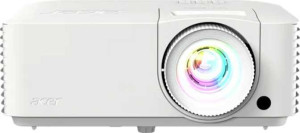
Acer Vero HL1820 specifications and in-depth review

Acer Vero HL1820

Manufacturer: Acer

The Acer Vero HL1820 is a compact laser projector built around a 4K output resolution, making it a straightforward option for users who want high-definition projection without relying on a traditional lamp-based light source. It weighs 2900 g and measures 286 mm wide by 216 mm deep, keeping its physical footprint relatively manageable. The unit includes stereo speakers rated at 2 x 7.5W along with a remote control, and a 3.5 mm headphone jack is available for direct audio output.

On the projection side, the HL1820 delivers 2000 ANSI lumens and supports both HDR10 and Dolby Vision for a range of high dynamic range content. The laser light source carries an eco-mode rating of 30000 hours, which is considerably longer than conventional lamp lifespans. Connectivity is handled through two HDMI ports and two USB ports, though the projector does not include Wi-Fi, Bluetooth, Chromecast, AirPlay, or any other wireless streaming capability. There is no built-in smart TV platform, so an external source device is required for media playback. The warranty period covers one year.

Pros
  • Laser light source rated for 30000 hours in eco mode, reducing the need for maintenance over extended use
  • 4K output resolution delivers fine image detail for a projector in this class
  • Supports both HDR10 and Dolby Vision, covering two widely used HDR formats
  • Built-in stereo speakers rated at 2 x 7.5W remove the immediate need for an external audio setup
  • Two HDMI ports and two USB ports allow multiple wired source devices to be connected simultaneously
  • Includes a 3.5 mm headphone jack for flexible audio output options
Cons
  • No Wi-Fi, Bluetooth, AirPlay, Chromecast, Miracast, or DLNA support means all content sources must be physically connected
  • No built-in smart TV platform, requiring a separate media player or streaming device for independent use
  • HDR10+ is not supported, limiting compatibility with content encoded in that specific format
  • No external memory slot, so direct playback from storage cards or similar media is not possible
  • No voice command support, limiting hands-free control options
  • Warranty period covers only one year
Who is this for?

This projector is well suited to users who want a dedicated wired home cinema setup, where all source devices such as media players, game consoles, or streaming sticks are connected via HDMI. The 4K resolution combined with HDR10 and Dolby Vision support makes it a reasonable fit for environments where image quality and HDR content compatibility are priorities. The laser light source with its 30000-hour eco-mode rating also makes it a practical choice for users who value low-maintenance, long-term operation without worrying about lamp replacements.

Who is this NOT for?

This projector is not well suited to users who expect wireless connectivity, as it lacks Wi-Fi, Bluetooth, AirPlay, Chromecast, Miracast, and DLNA — anyone wanting to stream content directly from a phone, tablet, or network storage will find it severely limited. It is equally unsuitable for users looking for a self-contained smart projector, since there is no built-in smart TV platform and no external memory slot, making independent media playback impossible without an attached source device. Users who rely on HDR10+ encoded content will also find that format unsupported, which may be a drawback depending on their content library.

General info:

has laser light source
lamp life (eco mode) 30000 h
width 286 mm
height 115.5 mm
thickness 216 mm
weight 2900 g
Has a dedicated smartphone app
volume 7135.128 cm³
warranty period 1 years

The Acer Vero HL1820 uses a laser light source with an eco-mode rated lifespan of 30000 hours, eliminating the need for periodic lamp replacements. The unit measures 286 mm wide, 216 mm deep, and 115.5 mm tall, with a total volume of 7135.128 cm³ and a weight of 2900 g, giving it a moderately compact form for a projector in this category. It does not include a dedicated smartphone app, and the warranty period covers one year.

Projection quality:

ANSI lumens 2000 lumens
output resolution 4K
supports HDR10+
supports Dolby Vision
supports HDR10

The projector delivers a 4K output resolution at a brightness of 2000 ANSI lumens, covering a solid range of HDR formats through support for both HDR10 and Dolby Vision. HDR10+ is not supported, so content encoded exclusively in that format will not be rendered in its native HDR profile.

Connectivity:

HDMI ports 2
has AirPlay
Has Bluetooth
supports Wi-Fi
USB ports 2
has Chromecast built-in
has a VGA connector
is DLNA-certified
has a DVI connector
supports Miracast
RJ45 ports 0
Has S/PDIF Out port

Wired connectivity is handled through two HDMI ports and two USB ports, while there are no RJ45, VGA, DVI, or S/PDIF connections available. The projector has no wireless capabilities whatsoever — it does not support Wi-Fi, Bluetooth, AirPlay, Chromecast, Miracast, or DLNA, meaning all source devices must be connected physically.

Features:

has stereo speakers
has a remote control
has built-in smart TV
has a built-in speaker
audio output power 2 x 7.5W
has a socket for a 3.5 mm audio jack
has Dolby Atmos
has an external memory slot
has voice commands

The projector includes built-in stereo speakers rated at 2 x 7.5W, along with a 3.5 mm headphone jack for routing audio to external headphones or speakers. A remote control is included in the package. There is no Dolby Atmos support, no external memory slot, and no voice command functionality. The unit also lacks a built-in smart TV platform, so media playback depends entirely on a connected external source device.

Final Verdict

The Acer Vero HL1820 is a straightforward laser projector that delivers where it counts for a wired home cinema setup — its 4K resolution with HDR10 and Dolby Vision support, backed by a laser light source rated for 30000 hours in eco mode, gives it a solid and low-maintenance projection foundation. That said, the complete absence of any wireless connectivity and the lack of a built-in smart platform mean it functions strictly as a display device dependent on external sources. For users who already have a dedicated media setup and simply need a reliable, high-resolution projection endpoint, the HL1820 fits that role well; for those expecting a more self-sufficient or wirelessly integrated experience, its limitations will be immediately apparent.