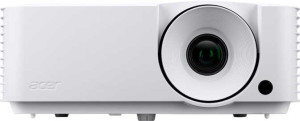
Acer Vero XL2320p specifications and in-depth review

Acer Vero XL2320p

Manufacturer: Acer

The Acer Vero XL2320p is a business-oriented projector built around a laser light source, which contributes to its rated lamp life of up to 30,000 hours in eco mode — a figure that reduces the need for frequent maintenance in long-term installations. It produces 4000 ANSI lumens of brightness at WXGA output resolution, making it suitable for well-lit environments where a large image is required. The unit operates at 29 dB under standard conditions, dropping to 27 dB in eco mode, keeping acoustic intrusion relatively low during use.

On the connectivity side, the Acer Vero XL2320p includes one HDMI port, two USB ports, and one RJ45 port, covering basic wired input needs without offering wireless options such as Wi-Fi, Bluetooth, AirPlay, or Miracast. It features a built-in mono speaker rated at 15W along with a 3.5 mm audio jack for headphone or external audio output. The projector does not include a remote control, smart TV functionality, or support for HDR formats, and its minimum throw distance starts at 1.5 m, which is worth accounting for when planning room placement.

Pros
  • Laser light source rated for up to 30,000 hours in eco mode, reducing maintenance needs over extended use
  • Delivers 4000 ANSI lumens, making it well-suited for use in ambient or well-lit environments
  • Supports a maximum projection size of 300″, enabling very large image display
  • Includes a built-in 15W speaker and a 3.5 mm audio jack, allowing audio output without requiring additional equipment
  • Operates at a relatively low 27 dB in eco mode, keeping noise levels minimal during quieter settings
  • RJ45 port provides a wired network connection option alongside HDMI and USB inputs
Cons
  • No remote control included, requiring manual operation directly on the unit
  • Lacks Wi-Fi, Bluetooth, AirPlay, Miracast, and Chromecast, limiting all connectivity to physical cables
  • Does not support HDR10, HDR10+, or Dolby Vision, restricting high dynamic range content playback
  • No stereo speakers; audio output is limited to a single mono 15W channel
  • 3D content with glasses is not supported
  • No external memory slot, preventing direct local media playback from storage devices
Who is this for?

This projector is well-matched for corporate or educational environments where large-screen presentations are a regular requirement, given its 4000 ANSI lumens output and support for image sizes up to 300″. The laser light source with a 30,000-hour eco-mode lifespan makes it a practical choice for installations that run frequently and where minimal maintenance is a priority. Its wired connectivity via HDMI and RJ45 also suits fixed, managed setups where network integration and stable input sources are the norm.

Who is this NOT for?

Users looking for a home cinema or entertainment-focused setup will find this projector lacking, as it offers no HDR support in any form — including HDR10, HDR10+, or Dolby Vision — and does not handle 3D content. The absence of wireless connectivity options such as Wi-Fi, Bluetooth, AirPlay, or Miracast makes it a poor fit for anyone who relies on streaming or screen-mirroring from mobile devices. Additionally, the lack of a remote control and a dedicated smartphone app means it is not well-suited to users who expect flexible, hands-free operation.

General info:

audible noise 29 dB
has laser light source
audible noise (eco) 27 dB
lamp life (eco mode) 30000 h
Has a dedicated smartphone app

The Acer Vero XL2320p uses a laser light source, which supports a lamp life of up to 30,000 hours in eco mode, reducing the need for regular lamp replacements over extended use. Audible noise sits at 29 dB during standard operation and drops slightly to 27 dB when running in eco mode, keeping the unit reasonably quiet in either configuration. The projector does not have a dedicated smartphone app, so there is no companion mobile application available for control or setup.

Projection quality:

ANSI lumens 4000 lumens
output resolution WXGA
displays 3D with glasses
maximum projection size 300"
supports HDR10+
minimum throw distance 1.5 m
supports Dolby Vision
supports HDR10

The projector outputs 4000 ANSI lumens at a WXGA resolution, and can produce images up to 300″ in size with a minimum throw distance of 1.5 m. It does not support 3D content with glasses, and none of the HDR formats — HDR10, HDR10+, or Dolby Vision — are available on this unit.

Connectivity:

HDMI ports 1
has AirPlay
Has Bluetooth
supports Wi-Fi
USB ports 2
has Chromecast built-in
has a VGA connector
is DLNA-certified
has a DVI connector
supports Miracast
RJ45 ports 1
Has S/PDIF Out port

Wired connectivity is limited to one HDMI port, two USB ports, and one RJ45 port, covering the essentials for a basic wired setup. There is no VGA, DVI, or S/PDIF output available. On the wireless side, the projector lacks Wi-Fi, Bluetooth, AirPlay, Chromecast, Miracast, and DLNA support, meaning all content delivery relies entirely on its physical connections.

Features:

has stereo speakers
has a remote control
has built-in smart TV
has a built-in speaker
audio output power 1 x 15W
has a socket for a 3.5 mm audio jack
has Dolby Atmos
has an external memory slot
has voice commands

The projector includes a built-in mono speaker rated at 15W along with a 3.5 mm audio jack for routing sound to headphones or an external audio device, though stereo speakers and Dolby Atmos are not on offer. It does not come with a remote control, voice command support, or built-in smart TV functionality, and there is no external memory slot for local media playback.

Final Verdict

The Acer Vero XL2320p is a projector built with a clear focus on fixed, professional installations rather than versatile consumer use. Its laser light source rated for 30,000 hours in eco mode, combined with 4000 ANSI lumens of brightness and a maximum projection size of 300″, makes it a dependable choice for conference rooms, lecture halls, or similar environments where consistent, large-scale image output is the primary demand. However, the absence of wireless connectivity, HDR support, a remote control, and smart features means it suits only those operating within a defined, wired infrastructure. For that specific context, it delivers on its core purpose reliably; outside of it, its limitations become difficult to overlook.