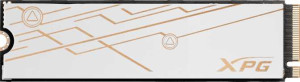
Adata XPG Mars 980 Blade 4TB specifications and in-depth review

Adata XPG Mars 980 Blade 4TB

Manufacturer: Adata

The Adata XPG Mars 980 Blade 4TB is a high-capacity M.2 solid-state drive built around the NVMe 2.0 protocol and a PCIe 5.0 interface, positioning it among the more recent generations of consumer and prosumer storage hardware. It carries a 4TB usable capacity alongside a DRAM cache, which assists in sustaining consistent performance during extended read and write workloads. The drive ships without an integrated heatsink and forgoes RGB lighting, keeping its physical profile straightforward.

Performance figures for the Mars 980 Blade 4TB include a sequential read speed of 14000 MB/s and a sequential write speed of 13000 MB/s, while random operations reach 1,950,000 read IOPS and 1,650,000 write IOPS. The Silicon Motion SM2508 controller manages data flow across 8 channels using TLC NAND storage. Endurance is rated at 2,960 TBW with a mean time between failures of 2 million hours, and Adata backs the drive with a 5-year warranty. The drive recorded a PassMark score of 87,610 and does not include hardware-level AES encryption support.

Pros
  • Sequential read and write speeds of 14,000 MB/s and 13,000 MB/s respectively indicate very fast data transfer for large file operations
  • Random read performance of 1,950,000 IOPS and random write performance of 1,650,000 IOPS support demanding multitasking and application workloads
  • The 4TB capacity provides substantial storage space within a single M.2 drive
  • A DRAM cache helps maintain consistent throughput during sustained read and write sessions
  • A TBW rating of 2,960 and an MTBF of 2 million hours point to a solid endurance and reliability profile
  • The 5-year warranty offers meaningful long-term coverage for the drive
Cons
  • No integrated heatsink is included, which may require separate thermal management in high-load environments or thermally constrained cases
  • Hardware AES encryption is not supported, limiting built-in data security options
  • PCIe 5.0 requires a compatible motherboard slot, restricting usability on older or budget platforms
Who is this for?

This drive is well-suited for users who work with large file transfers and data-intensive workloads, such as video editors, 3D rendering professionals, and content creators who regularly move substantial amounts of data. The 4TB capacity combined with high sequential throughput makes it a practical choice for those needing both space and speed in a single M.2 slot. Its high random IOPS figures also make it a strong fit for workstation environments running demanding applications simultaneously, and the 2,960 TBW endurance rating accommodates heavy daily write cycles over an extended period.

Who is this NOT for?

Users with motherboards that lack a PCIe 5.0 compatible M.2 slot will not be able to take full advantage of the drive's rated speeds, as older platforms cannot support the required interface bandwidth. The absence of an integrated heatsink makes this drive a less straightforward fit for systems with poor airflow or thermally constrained enclosures, where additional cooling solutions would be needed. Additionally, users or organizations with requirements for hardware-level AES encryption will find this drive unsuitable, as it offers no built-in encryption support.

Read speed:

sequential read speed 14000 MB/s
random read speed 1950000 IOPS

The Adata XPG Mars 980 Blade 4TB delivers a sequential read speed of 14,000 MB/s, making it well-suited for large file transfers and data-intensive workloads. On the random side, it reaches 1,950,000 read IOPS, reflecting strong performance when handling the numerous small, scattered read operations typical of operating system tasks and application loading.

Write speed:

sequential write speed 13000 MB/s
random write speed 1650000 IOPS

The drive is rated for a sequential write speed of 13,000 MB/s, supporting fast data ingestion across large, contiguous file operations. For random writes, it reaches 1,650,000 IOPS, indicating capable handling of fragmented write patterns commonly encountered during multitasking and database-style workloads.

Benchmarks:

PassMark result 87610

In standardized testing, the Adata XPG Mars 980 Blade 4TB achieved a PassMark score of 87,610, providing a quantified reference point for evaluating its overall storage performance as measured by that benchmark suite.

General info:

type M2
SSD cache DRAM cache
Is an NVMe SSD
NVMe version 2
internal storage 4000GB
controller Silicon Motion SM2508
SSD storage type TLC
PCI Express (PCIe) version 5
Controller channels 8
Terabytes Written (TBW) 2960
MTBF 2million hours
warranty period 5 years
Has an integrated heatsink
bits of encryption supported 0
has RGB lighting

The Adata XPG Mars 980 Blade 4TB is an M.2 form factor SSD that uses the NVMe 2.0 protocol over a PCIe 5.0 interface, and it comes equipped with a DRAM cache to support sustained data throughput. It offers 4,000GB of internal storage built on TLC NAND, managed by the Silicon Motion SM2508 controller operating across 8 channels. Endurance is rated at 2,960 TBW with an MTBF of 2 million hours, and the drive is covered by a 5-year warranty. It does not include an integrated heatsink, hardware AES encryption, or RGB lighting.

Final Verdict

The Adata XPG Mars 980 Blade 4TB is a technically well-specified M.2 NVMe drive built around the PCIe 5.0 interface, and its combination of 14,000 MB/s sequential read throughput and 4TB capacity makes it a compelling option for professionals and power users who need both speed and storage density in a single drive. Its high random IOPS figures, DRAM cache, and strong endurance rating further reinforce its suitability for sustained, demanding workloads. That said, prospective users should be mindful of platform requirements and the absence of a built-in heatsink and hardware encryption before committing. Taken as a whole, the Mars 980 Blade 4TB is a capable, high-throughput storage solution that performs best when paired with a fully compatible, thermally adequate system.