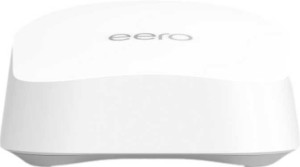
The Amazon Eero 7 has a compact, square form factor measuring 130 mm × 130 mm × 64.1 mm with a total volume of 1083.29 cm³, making it relatively unobtrusive on a shelf or desk. It includes 2 LAN ports and 2 WAN ports, while USB connectivity is absent entirely. The unit has no external or removable antennas, and it is not rated for outdoor use. There are no external memory expansion options through USB, and the device comes with a 1-year warranty.
The Eero 7 supports a wide range of Wi-Fi standards, including Wi-Fi 4, Wi-Fi 5, Wi-Fi 6, Wi-Fi 6E, and Wi-Fi 7, while operating on a dual-band configuration with a combined wireless speed of 1800 Mb/s. Processing is handled by a quad-core CPU clocked at 4 × 1.1 GHz, complemented by 1 GB of RAM and 4 GB of internal storage. The router also includes an external memory slot, providing some flexibility for expanded storage needs.
The Eero 7 comes with a broad set of security features, starting with a built-in network firewall and support for WPA3, WPA2, and WPA wireless security protocols. It includes SPI intrusion protection, MAC address filtering, URL filtering, port filtering, and a Network Services Filter, giving administrators meaningful control over traffic and access. On the network management side, the router supports NAT, static IP, automatic IP, PPTP Passthrough, PPTP server, L2TP Passthrough, and IPsec Passthrough, while parental controls are also available for managing content access across connected devices.
The Eero 7 supports mesh Wi-Fi and can operate wirelessly as a node, making it straightforward to extend network coverage across a home. It includes MU-MIMO and beamforming for more efficient wireless communication, along with IPv6 support, Network Time Protocol, UPnP, and both dynamic and static routing. The router is also compatible with the Matter smart home standard and is managed through a dedicated smartphone app. Inter-VLAN routing is present, though VLAN tagging itself is not supported, and the device lacks both a WPS button and DLNA certification.