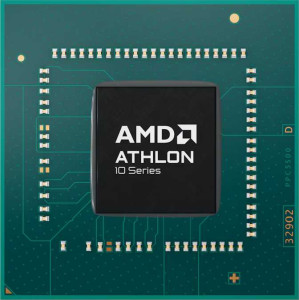
The AMD Athlon Silver 10 is designed for both laptop and desktop use, built on a 6 nm semiconductor process with a thermal design power of just 15W, making it suitable for compact and power-conscious systems. It includes integrated graphics, supports 64-bit computing, and connects via PCIe 3.0, covering the essential connectivity and compatibility requirements for mainstream platform configurations.
This processor runs two cores at a base speed of 2.4 GHz each, with two threads in total and a turbo clock speed of 3.5 GHz for handling brief spikes in workload demand. The clock multiplier is set at 24 and cannot be adjusted, as the chip does not have an unlocked multiplier, nor does it employ big.LITTLE heterogeneous core technology. Cache memory is organized across three levels: 256 KB of L1, 1 MB of L2 at 0.5 MB per core, and 2 MB of L3 at 1 MB per core, providing a modest but functional memory hierarchy for everyday computing tasks.
The integrated Radeon 610M GPU operates at a base clock of 1500 MHz and can boost up to 1900 MHz, with support for up to four displays simultaneously. On the API side, it is compatible with DirectX 12 Ultimate, OpenGL 4.6, and OpenCL 2, covering a solid range of graphics and compute workloads. The rendering pipeline consists of 128 shading units, 8 texture mapping units, and 4 render output units, forming a modest but functional configuration for light graphical tasks and general display output.
This processor supports DDR5 memory running at speeds of up to 5500 MHz across two channels, delivering a maximum memory bandwidth of 88 GB/s. The total addressable memory tops out at 16 GB, which covers the needs of standard consumer and light productivity workloads. ECC memory is not supported, placing this chip firmly in the consumer rather than workstation or server space.
The processor carries a broad set of instruction set extensions, including MMX, F16C, FMA3, AES, AVX, AVX2, SSE 4.1, and SSE 4.2, enabling support for a range of vectorized, floating-point, and cryptographic operations. It does not use multithreading, meaning each physical core handles a single thread at a time. Security coverage includes the NX bit, which helps guard against certain classes of malicious code execution at the hardware level.