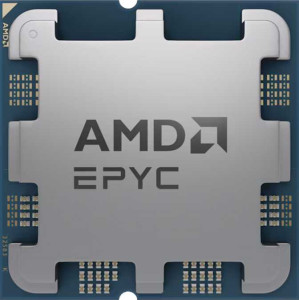
The AMD Epyc 4124P carries a Thermal Design Power (TDP) of 65W, reflecting a relatively contained power profile for an enterprise processor. It is manufactured on a 5nm process node, and supports the latest PCIe 5.0 standard for high-bandwidth peripheral connectivity. The chip is fully 64-bit compatible, though it does not include integrated graphics, meaning a discrete GPU or external display adapter is required in graphics-dependent configurations.
The Epyc 4124P operates across four cores at a base frequency of 3.8GHz each, with a turbo clock speed reaching 5.1GHz, and exposes 8 threads for handling concurrent workloads. The clock multiplier is set at 38, and the multiplier is locked, meaning frequency adjustments outside of standard turbo behavior are not supported. Cache is structured in three tiers: 256KB of L1, 4MB of L2 at 1MB per core, and 16MB of L3 at 4MB per core, providing a reasonable amount of fast on-chip memory to reduce latency for frequently accessed data.
The Epyc 4124P supports DDR5 memory at speeds up to 5200MHz across two channels, with a maximum installable capacity of 192GB. Peak memory bandwidth reaches 83.2GB/s, and the processor fully supports ECC memory, which allows the system to detect and correct common types of data corruption — a relevant consideration for server and data-integrity-sensitive workloads.
The Epyc 4124P supports a broad set of instruction sets including AVX2, FMA3, and AES, alongside MMX, F16C, AVX, SSE 4.1, and SSE 4.2, covering a range of workloads from floating-point operations to hardware-accelerated encryption. The processor also includes the NX bit, a hardware-level security feature that helps prevent certain classes of malicious code execution by marking memory regions as non-executable.
In PassMark testing, the Epyc 4124P achieves a multi-threaded score of 17,958, reflecting its overall throughput across all cores and threads. Its single-threaded PassMark result of 3,891 indicates the per-core processing capability, which is relevant for workloads that rely heavily on sequential execution rather than parallelism.