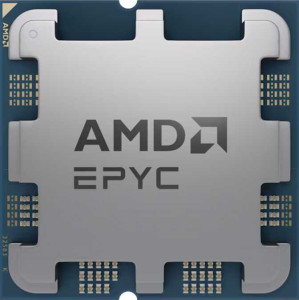
The AMD Epyc 4244P operates within a 65W Thermal Design Power (TDP) envelope, reflecting a balance between compute capacity and energy consumption suited to enterprise environments. It is fabricated on a 5nm process node and supports the PCIe 5.0 interface standard, enabling high-bandwidth connectivity with compatible expansion hardware. The processor fully supports 64-bit computing, while it does not include integrated graphics, meaning a discrete GPU or external display adapter is required for any graphical output.
The AMD Epyc 4244P features six cores running at a base frequency of 3.8GHz each, supporting 12 threads in total, with a turbo clock speed reaching 5.1GHz for demanding single-threaded tasks. The clock multiplier is set at 38 and the multiplier is locked, meaning frequency adjustments through overclocking are not supported. Cache is arranged across three levels: 384KB of L1, 6MB of L2 at 1MB per core, and a 32MB L3 cache amounting to approximately 5.33MB per core, providing a substantial pool of low-latency memory close to the processor cores.
The AMD Epyc 4244P supports DDR5 memory at speeds of up to 5200MHz across two memory channels, delivering a maximum memory bandwidth of 83.2 GB/s. ECC memory is fully supported, which allows the processor to detect and correct single-bit memory errors — a standard requirement in enterprise and server deployments where data integrity is a priority.
The AMD Epyc 4244P supports a broad set of instruction sets including MMX, F16C, FMA3, AES, AVX, AVX2, SSE 4.1, and SSE 4.2, covering a range of workloads from vectorized floating-point operations to hardware-accelerated encryption. The processor also includes NX bit support, a hardware security feature that helps prevent certain classes of malicious code from executing in memory regions designated as non-executable.
In PassMark testing, the AMD Epyc 4244P achieves a multi-threaded score of 27,164 and a single-threaded score of 3,858, reflecting its performance characteristics across both parallel and sequential workloads. An overclocked PassMark result of 27,660 is also recorded, though the difference from the stock score is marginal, which is consistent with the processor having a locked clock multiplier.