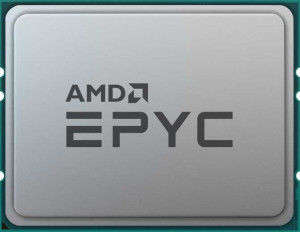
The AMD Epyc 4345P carries a Thermal Design Power (TDP) of 65W, reflecting a relatively modest power envelope for an enterprise-class processor. It is manufactured on a 4nm process node and supports the 64-bit instruction architecture. Connectivity is handled through PCIe 5.0, enabling high-throughput communication with compatible expansion devices. The processor does not include integrated graphics, so a discrete graphics solution is required in any deployment.
The processor runs 8 cores at a base speed of 3.8GHz each, with 16 threads supported through multithreading, and can reach a turbo clock speed of 5.5GHz under boosted conditions. The clock multiplier is set at 38, and the unlocked multiplier allows for manual frequency adjustment. Cache is organized across three levels: 640KB of L1, 8MB of L2 at 1MB per core, and 32MB of L3 cache at 4MB per core, providing a layered structure for data access across the core complex.
The AMD Epyc 4345P uses DDR5 memory, supporting speeds of up to 5600MHz across two memory channels, with a maximum capacity of 192GB. Peak memory bandwidth reaches 89.6GB/s, and the processor includes support for ECC memory, which allows for automatic detection and correction of memory errors — a feature relevant to data-sensitive enterprise workloads.
The processor supports multithreading, allowing each physical core to handle two threads simultaneously. It includes the NX bit, a hardware-level feature that helps prevent certain classes of malicious code execution by marking memory regions as non-executable. On the instruction set side, the chip supports a broad range of extensions including MMX, F16C, FMA3, AES, AVX, AVX2, SSE 4.1, and SSE 4.2, covering vectorized math operations, hardware-accelerated encryption, and floating-point conversion capabilities.
In PassMark testing, the AMD Epyc 4345P achieves a multi-threaded score of 37,671, while the single-threaded result comes in at 4,672, reflecting per-core responsiveness under isolated workloads. When run in an overclocked state, the score rises modestly to 38,295, indicating a limited but measurable gain from the unlocked multiplier.