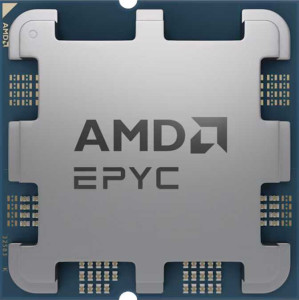
The AMD Epyc 4464P carries a Thermal Design Power (TDP) of 65W, placing it in a relatively efficient bracket for an enterprise-class processor. It is manufactured on a 5 nm process node, which contributes to its compact transistor density. The chip supports PCIe 5.0 for high-bandwidth peripheral connectivity and is fully 64-bit capable. It does not include integrated graphics, so a discrete or external graphics solution would be required for any display output.
The AMD Epyc 4464P runs 12 cores at a base frequency of 3.7 GHz, delivering 24 threads in total, with a turbo clock speed that reaches 5.4 GHz under boosted conditions. The clock multiplier is set at 37 and is locked, meaning the multiplier cannot be adjusted for manual overclocking. Cache resources are distributed across three levels: 688 KB of L1, 12 MB of L2 at 1 MB per core, and a 64 MB L3 cache — equivalent to approximately 5.3 MB per core — providing a substantial pool of low-latency storage to help sustain throughput across concurrent workloads.
The AMD Epyc 4464P uses a dual-channel DDR5 memory configuration, supporting RAM speeds of up to 5200 MHz and delivering a maximum memory bandwidth of 83.2 GB/s across those two channels. The processor also supports ECC memory, which enables detection and correction of certain types of memory errors — a feature commonly expected in server and enterprise deployments where data integrity is a priority.
The AMD Epyc 4464P supports a broad range of instruction sets, including AVX2, AES, and FMA3, alongside MMX, F16C, AVX, SSE 4.1, and SSE 4.2 — collectively covering vectorized math operations, hardware-accelerated encryption, and extended multimedia processing capabilities. The processor also features the NX bit, which enables hardware-level memory protection by marking certain memory regions as non-executable, contributing to system-level security.
In PassMark testing, the AMD Epyc 4464P achieves a multi-core score of 47312, reflecting its capacity to handle parallelized workloads across all cores and threads. Its single-core PassMark result of 4130 indicates the per-core processing capability available for tasks that rely more heavily on single-threaded execution.